

A hybrid team retreat is defined as a structured offsite or distributed gathering that combines in-person and remote participation within a single, coordinated program. 25% of remote workers experience daily loneliness. That statistic alone explains why HR professionals are rethinking how retreats are designed. The best hybrid team retreat format options do not simply replicate an in-person event on a video call. They are built from the ground up to give every participant, whether in a mountain lodge or a home office, equal access to connection, collaboration, and purpose.
1. What are the top hybrid team retreat format options?
Six formats consistently deliver results for distributed corporate teams. Each one solves a different combination of budget, logistics, and engagement challenges.
Microcations
A mication is a 48-hour short-stay retreat built around a focused agenda. Travel time drops, costs stay manageable, and teams return to work before momentum fades. This format works best for teams of 10–30 people who need a quarterly connection boost without a week away from clients.
Pros: Low cost, minimal travel disruption, high focus. Cons: Limited time for deep strategic work or multi-day workshops.
Split-location retreats
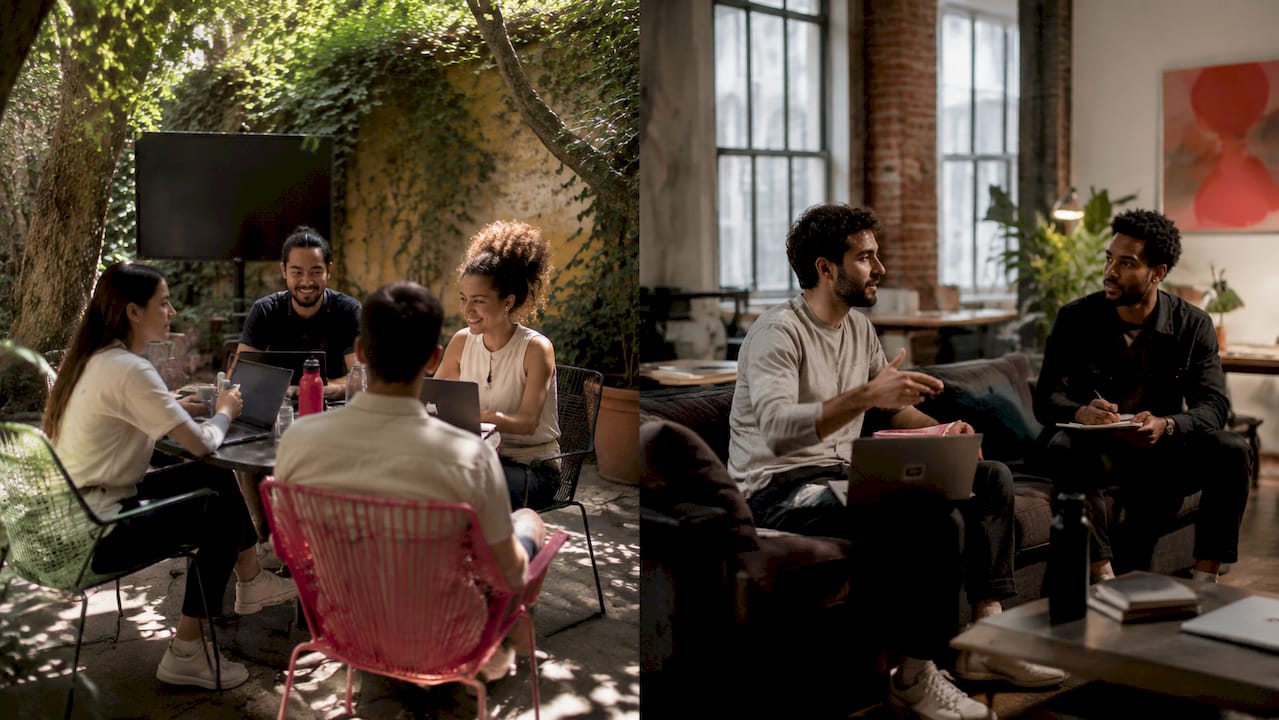
Two or more physical hubs run simultaneously while connected by live video. One group meets in Milan, another in New York, and both share the same agenda in real time. This format suits globally distributed teams that cannot realistically gather in one place.
Pros: Reduces individual travel costs, maintains in-person energy at each hub. Cons: Requires strong AV infrastructure and a dedicated tech coordinator at each location.
Rotating hub retreats
Each quarter, a different city or region hosts the in-person gathering. Remote participants join virtually, but the host location rotates so no single office always bears the travel burden. Teams that use this format report stronger cross-regional relationships over time.
Pros: Builds geographic equity, exposes teams to new environments. Cons: Logistics complexity increases with each new location.
Asynchronous retreats
Not every retreat needs to happen in real time. An asynchronous retreat spreads activities across 3–5 days through recorded workshops, shared digital whiteboards, and timed challenges. Teams in wildly different time zones benefit most from this format.
Pros: Zero time-zone conflict, high flexibility for individual schedules. Cons: Lower spontaneous connection, requires strong facilitation and clear deadlines.
Virtual immersive days
A virtual immersive day is a full-day online program built around themed experiences: a virtual cooking class in Naples, a guided art session, or a live trivia tournament. The key difference from a standard video call is production quality and intentional pacing. Gamified synchronous formats maximize engagement when activities are designed for participation, not passive viewing.
Pros: No travel required, accessible to all team members globally. Cons: Screen fatigue is real; sessions longer than 90 minutes need structured breaks.
Blended offsite-onsite mix
This is the most flexible of all hybrid meeting formats. A core group gathers offsite at a curated venue while remote participants join specific sessions live. The agenda alternates between full-group virtual moments and smaller in-person workshops. 75% of employees report feeling more connected to their team after attending offsite or hybrid retreats. That number reflects the power of combining physical presence with intentional virtual inclusion.
Pros: High flexibility, strong engagement for both groups. Cons: Risk of a two-tier experience if remote participants are not actively included.
2. How technology and scheduling optimize hybrid retreat success
Technology is not a support layer for hybrid retreats. It is the infrastructure. Without the right tools and scheduling discipline, remote participants become observers rather than contributors.
The core tech stack
Every hybrid retreat needs four categories of tools: video conferencing for live sessions, persistent chat for real-time side conversations, breakout room capability for small-group work, and asynchronous tools like shared documents or recorded video for follow-up. Equalizing remote and onsite experience requires each participant to use a personal device, even when in the same room, so that camera angles and audio quality stay consistent for everyone.
Venue and scheduling strategy
Book hybrid-capable venues 3–4 months in advance to secure spaces with dedicated AV setups, reliable high-speed internet, and breakout rooms designed for video. Generic conference rooms with a single camera at the back of the room consistently fail remote participants.
Scheduling across time zones requires one non-negotiable rule: identify a 3–4 hour overlap window where all participants are available during their normal working hours. Build the highest-priority sessions inside that window. Place asynchronous tasks and optional social activities outside it.
Pro Tip: Run a full tech rehearsal 48 hours before the retreat starts. Test every camera, microphone, and screen-share scenario. Technical failures in the first 10 minutes of a retreat destroy trust and momentum for the entire program.
Numbered checklist for hybrid-ready logistics
- Confirm venue AV specs and internet bandwidth before signing any contract.
- Assign a dedicated tech host separate from the session facilitator.
- Create a shared digital agenda accessible to all participants before day one.
- Set up persistent chat channels organized by session topic.
- Record all live sessions and post them within 24 hours for asynchronous access.
3. What activities work best for hybrid retreats?
The distinction between team building and team bonding is not semantic. Team building is efficiency-focused: problem-solving exercises, process workshops, and cross-functional projects. Team bonding is social connection: shared experiences that build trust and psychological safety outside of work tasks. Hybrid retreats need both, and the best programs alternate between them.
Activities that work in hybrid formats
- Synchronous games: Live trivia, virtual escape rooms, and online drawing challenges work well when sessions run 30–45 minutes with clear instructions sent in advance.
- Asynchronous challenges: Photo scavenger hunts, short video introductions, and collaborative playlists build connection without requiring everyone online at once.
- Icebreakers: Two-minute "show your space" tours or one-question polls at the start of each session reduce the cold-start problem that kills hybrid energy.
- Local discovery excursions: For in-person participants, guided walks through a local neighborhood or a visit to a regional producer add authenticity and create stories the whole team shares afterward. TribYou - Your Places specializes in curating exactly these kinds of local discovery experiences for corporate groups.
- Virtual escape rooms: These work across hybrid groups when teams are mixed, meaning each small group contains both remote and in-person participants.
Dos and don'ts for hybrid activity design
Do:
- Mix remote and in-person participants within every small group.
- Keep individual activities under 60 minutes.
- Send all materials and instructions 24 hours before each session.
Don't:
- Schedule purely social activities that require physical presence without a virtual equivalent.
- Run activities longer than 90 minutes without a break.
- Assume remote participants will self-organize. Assign explicit roles.
Pro Tip: The best hybrid team bonding activities have a physical artifact. Send every participant a small kit before the retreat, a local snack, a printed card, a simple craft supply. Shared physical objects create shared experience even across screens.
4. How to choose the right hybrid retreat format for your team
Format selection depends on four variables: team size, geographic distribution, retreat objectives, and budget. No single format wins every scenario.
Matching format to objectives
- Strategic planning: The blended offsite-onsite mix or split-location format works best. Both allow real-time collaboration on complex decisions.
- Trust building: Microcations and rotating hub retreats create the most personal connection because they involve physical presence in a new environment.
- Innovation sprints: Asynchronous retreats give participants time to think deeply before contributing, which produces more original ideas than live brainstorming alone.
- Onboarding new team members: Virtual immersive days are low-pressure and accessible, making them ideal for welcoming new hires across locations.
Format comparison by key criteria
| Format | Best team size | Cost level | Tech complexity | Engagement level |
|---|---|---|---|---|
| Microcations | 10–30 | Low | Low | High |
| Split-location | 20–100 | Medium | High | High |
| Rotating hub | 15–60 | Medium | Medium | High |
| Asynchronous | Any | Low | Medium | Medium |
| Virtual immersive | Any | Low | Low | Medium |
| Blended offsite-onsite | 10–50 | Medium to high | High | Very high |
Budget benchmarks
Mid-tier venues cost $120–$200 per person per night, with food and beverage adding $50–$75 per person per day. Those numbers apply to the in-person component of any hybrid format. Remote participants require a separate budget line for tech tools, shipped kits, and virtual facilitation.
Sustainable venue choices and local partnership integrations reduce costs while increasing authenticity. A locally sourced dinner at a family-run agriturismo in Tuscany costs less than a hotel banquet and creates a far stronger shared memory. TribYou - Your Places builds these local connections into every corporate retreat package it designs.
Key takeaways
The most effective hybrid retreat format is the one that equalizes participation for remote and in-person team members from the first session to the last.
| Point | Details |
|---|---|
| Match format to objectives | Strategic planning needs live collaboration; innovation sprints benefit from asynchronous depth. |
| Book venues early | Secure hybrid-capable spaces 3–4 months in advance to guarantee AV quality and availability. |
| Equalize participation | Use personal devices and mixed small groups so remote participants are never passive observers. |
| Budget both components | Plan separate budgets for in-person venue costs and remote participant kits and tools. |
| Alternate building and bonding | Combine efficiency-focused team building with social team bonding activities for lasting impact. |
Why I think most hybrid retreats fail before they start
Most hybrid retreats fail at the agenda stage, not the technology stage. Teams spend weeks choosing a venue and zero hours designing the remote participant experience. The result is a beautiful offsite for 12 people and a frustrating video call for 8 others.
The formats that consistently work share one quality: they were designed for the remote participant first. When you build the agenda around what works on screen, the in-person experience almost always improves too. Constraints create clarity.
The rise of microcations is the most interesting shift I have watched in corporate retreat planning. A well-designed 48-hour retreat with a purpose-driven agenda outperforms a 4-day retreat with a packed social calendar every time. Teams do not need more time together. They need better time together.
The other pattern worth naming is the value of local authenticity. A team that spends an afternoon with a local ceramicist in Umbria or a morning at a family vineyard in Piedmont leaves with a shared story that no virtual escape room can replicate. That story becomes the social glue that holds the team together for months. Retreats that integrate local community experiences consistently outperform those that stay inside a hotel conference room.
My honest advice: stop trying to replicate your annual offsite in a hybrid format. Redesign it from scratch with the hybrid constraint as the creative brief. The teams that do this come back with something genuinely better.
— Luca
TribYou - Your Places: bespoke hybrid retreats for your team
Corporate teams that want to move from planning to execution need more than a format guide. They need a partner with real venues, real local connections, and real experience coordinating hybrid programs across multiple locations.
TribYou - Your Places designs tailored retreat experiences for corporate teams that combine curated accommodations, authentic local activities, and full hybrid event coordination. From a mication in the Italian countryside to a split-location program across European cities, TribYou - Your Places handles venue sourcing, local partner integration, and on-the-ground logistics. Teams focused on remote worker wellbeing and genuine connection will find the platform built exactly for that purpose. Contact TribYou - Your Places to build a retreat your team will actually remember.
FAQ
What is a hybrid team retreat?
A hybrid team retreat is a structured gathering that combines in-person and remote participation within a single coordinated program. Both groups share the same agenda, activities, and outcomes.
How far in advance should I book a hybrid retreat venue?
Book hybrid-capable venues 3–4 months in advance to secure spaces with reliable AV infrastructure and adequate preparation time.
What is the difference between team building and team bonding?
Team building focuses on work efficiency through problem-solving and process exercises. Team bonding focuses on social connection and trust through shared experiences outside of work tasks.
How do I keep remote participants engaged during a hybrid retreat?
Use personal devices for all participants, mix remote and in-person members in every small group, and keep individual sessions under 60 minutes with structured breaks.
What does a hybrid retreat cost per person?
The in-person component of a mid-tier hybrid retreat typically costs $120–$200 per person per night for the venue, plus $50–$75 per person per day for food and beverages. Remote participants require a separate budget for tools and shipped materials.