

A team building retreat is a structured offsite event designed to strengthen collaboration, alignment, and morale among employees through shared experiences outside the normal work environment. The destination you choose for that retreat is not a backdrop. It is a direct variable in whether your team returns energized and aligned or simply relieved to be home. Business leaders and HR managers who choose a team building retreat destination based on logistics, purpose, and team fit consistently report stronger outcomes than those who default to the most affordable or visually appealing option. This guide gives you the framework to make that decision with confidence.
How to choose a team building retreat destination that actually works
The most common mistake in retreat planning is optimizing for aesthetics over logistics. A stunning villa with unreliable Wi-Fi and no meeting space will derail a strategy retreat within hours. The Where.Team checklist approach recommends scoring each potential destination on a weighted 1-5 scale across seven core criteria: accessibility, meeting-space quality, tech capabilities, accommodation, food quality, activity options, and total cost per person. This destination-first scoring method reduces the risk of falling in love with a property that cannot support your actual program.
Each criterion carries different weight depending on your retreat type. A bonding retreat for a 15-person remote team weights outdoor activities and informal spaces heavily. A strategy offsite for 40 senior leaders weights meeting-room capacity, AV quality, and proximity to a major airport far more. Assigning those weights before you evaluate any venue keeps the decision objective and defensible to stakeholders.

Seasonality belongs in this scoring too. The Voyasee Travel Month Planner and similar tools let you assess weather and crowd conditions month by month for any destination. Scheduling an outdoor-intensive retreat during a region's rainy season or peak tourist period adds friction that no amount of good programming can fully offset.
Pro Tip: Build your destination scorecard in a shared spreadsheet before you contact a single venue. Score three to five candidate destinations first, then shortlist venues only within the top-scoring locations. This prevents venue-level charm from overriding destination-level logic.
How does team type, size, and goal shape your venue choice?
The purpose of your retreat determines the physical and logistical profile of the ideal destination. Where.Team's framework maps this directly: venues for strategy retreats require boardroom-quality meeting spaces, reliable AV, and minimal distraction, while bonding retreats thrive on outdoor access, communal dining, and flexible informal spaces. Choosing a venue that contradicts your primary goal creates structural friction from day one.
Team size drives a separate set of constraints. Groups under 20 can use vacation home buyouts, boutique hotels, or rural agriturismo properties with relative ease. Groups between 20 and 100 require dedicated conference facilities, multiple breakout rooms, and catering infrastructure that most residential properties simply cannot provide. For groups above 100, resort buyouts or purpose-built conference centers become the practical baseline.
Remote and hybrid teams add a technical dimension that purely in-person teams do not face. Time zone spread affects scheduling, which in turn affects destination choice. A team distributed across North America and Europe may need a Central European destination to keep session times workable for both coasts. The benefits of offsite retreats multiply when the destination itself reduces friction for the majority of attendees rather than creating it.
Effective retreats also require a deliberate time structure. The Custom Ink planning playbook recommends balancing retreat time as roughly 30% structured work, 40% team activities, and 30% free time. That ratio means your destination needs spaces that support all three modes, not just a conference room and a bar.
Pro Tip: For hybrid teams, shortlist only destinations where at least two major airlines offer direct routes. Connectivity failures start at the airport, not the venue.
What are the planning steps to secure the right retreat venue?
Venue availability is the single longest-lead-time factor in retreat planning, and it collapses faster than most HR managers expect. For large retreats, booking windows of 9 to 36 months are standard to secure preferred dates and spaces. For groups of 20 to 100 at popular domestic destinations, a 12-week minimum lead time is the practical floor, though 6 months is safer for peak seasons.
Budget benchmarks from the Custom Ink playbook place per-person retreat costs at approximately $600 at the low end for a 2-to-3-day domestic offsite, rising to $2,200 to $4,000 per person for fully planned multi-day international retreats. Those figures exclude hidden costs that regularly surprise first-time planners: ground transportation, AV rental, facilitator fees, visa processing, and travel insurance. Build a 15% contingency into every budget line.
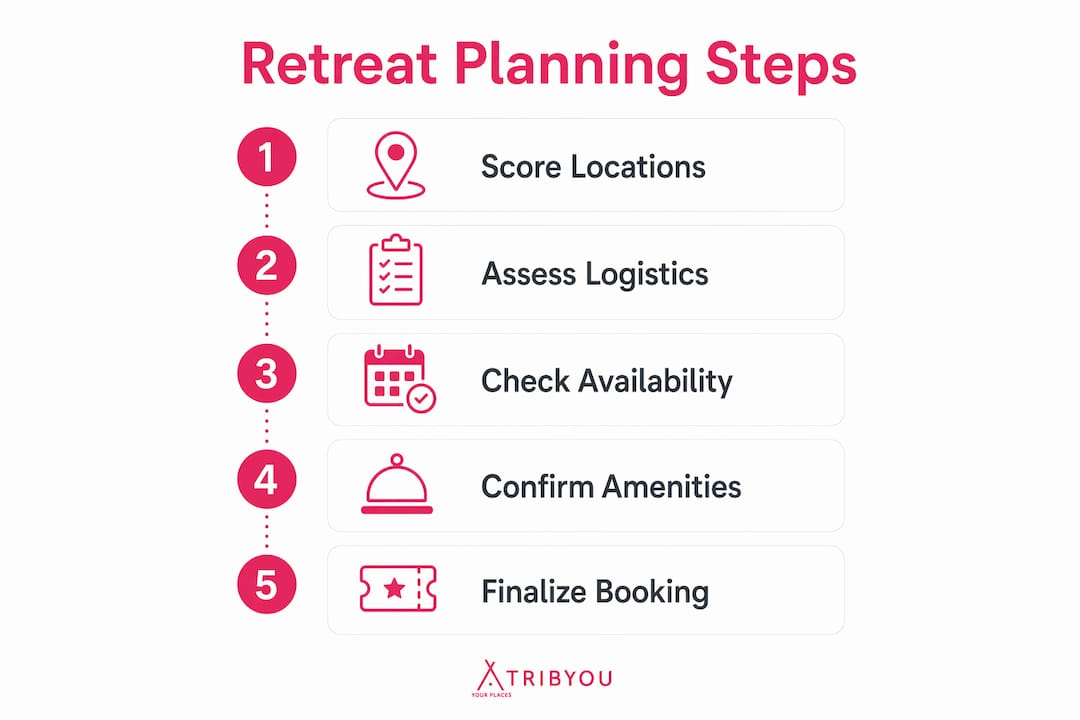
Here is a practical planning sequence for retreat destination selection:
- Define retreat goals and team profile. Confirm purpose (bonding, strategy, training), team size, remote or hybrid split, and any accessibility requirements.
- Set budget range and travel constraints. Establish per-person ceiling and maximum acceptable travel time from each team member's location.
- Score candidate destinations. Apply the weighted criteria scorecard across three to five locations before evaluating any individual venue.
- Shortlist venues within top destinations. Request detailed specs: upload speeds of at least 25 Mbps, simultaneous connection capacity, AV inventory including HDMI and microphone backups, and cell-signal strength.
- Conduct a technical QA call or virtual walkthrough. Test hybrid setup under realistic load before signing any contract.
- Confirm contracts and deposits early. Lock venue, accommodation, and catering before finalizing the program agenda.
Pro Tip: Ask venues for a floor plan with Wi-Fi router locations marked. Dead zones in breakout rooms are a common and entirely avoidable problem.
How do popular retreat destinations compare for business teams?
Applying your scorecard to real destinations reveals trade-offs that generic "best retreat locations" lists never surface. Italy, for example, scores high on authentic local experiences, food quality, and diverse activity options, from Dolomite hiking to Sicilian cooking workshops. It scores lower on direct flight access for teams based entirely in North America, which adds travel time and cost. For European or globally distributed teams, northern Italian cities like Milan and Bologna serve as strong gateway hubs with excellent regional retreat infrastructure.
Portugal, particularly Lisbon and the Alentejo region, consistently ranks well for tech-forward teams. Reliable fiber infrastructure, a favorable cost of living relative to Western Europe, and a well-developed digital nomad ecosystem mean venues there are accustomed to hybrid work demands. The planning of annual retreats in Portugal benefits from a long shoulder season, with April through June and September through October offering mild weather and reduced tourist pressure.
The most effective retreats run for 4 to 7 days, with five days often cited as the sweet spot for meaningful impact. That duration justifies international travel for distributed teams and allows the immersive bonding that shorter offsites cannot replicate.
| Destination | Strengths | Considerations |
|---|---|---|
| Northern Italy | Authentic culture, food, diverse activities, strong regional venues | Longer travel for US-based teams, seasonal crowds |
| Portugal (Lisbon/Alentejo) | Strong tech infrastructure, cost-effective, long shoulder season | Smaller venue inventory for groups above 80 |
| Spain (Barcelona/Basque Country) | Direct flights from most hubs, diverse activity options | Peak season pricing in summer, urban noise |
| Croatia (Dubrovnik/Istria) | Coastal scenery, growing retreat infrastructure, competitive pricing | Limited direct flights, smaller meeting-space inventory |
| United States (Asheville/Sedona) | No visa friction, domestic travel simplicity, strong wellness venues | Higher per-person cost, limited international character |
Visa friendliness matters more than most planners account for. Teams with members holding non-EU or non-US passports face processing times that can run 4 to 8 weeks. Factor that into your destination decision before you fall in love with a specific location.
Key takeaways
The destination you choose defines the ceiling of what your retreat can achieve, so the selection process deserves the same rigor you apply to any strategic business decision.
| Point | Details |
|---|---|
| Score destinations before venues | Apply a weighted criteria scorecard to locations before evaluating individual properties. |
| Match venue type to retreat goal | Strategy retreats need meeting-quality spaces; bonding retreats need outdoor access and informal areas. |
| Book early, especially for large groups | Groups above 50 should target a 9-to-12-month booking window to secure preferred dates. |
| Verify tech specs in writing | Request upload speeds, connection capacity, and AV inventory before signing any contract. |
| Budget for hidden costs | Add a 15% contingency to cover transport, AV rental, facilitator fees, and visa processing. |
Why logistics always beat aesthetics in retreat planning
I have worked with enough teams to say this plainly: the retreats that fail almost always fail for logistical reasons, not programming ones. A facilitator can recover from a weak agenda. Nobody recovers from a venue where the Wi-Fi drops during a hybrid all-hands, or where half the team spent six hours in transit and arrived exhausted before the first session started.
The instinct to choose the most beautiful or the most affordable destination is understandable. Both feel like responsible decisions. But beauty without function is a liability, and cheap venues that cannot support your technical or spatial needs cost far more in lost productivity and team frustration than the savings justify.
What I have found actually works is treating the destination decision as a constraint-satisfaction problem before it becomes a creative one. Lock in your non-negotiables first: minimum upload speed, maximum travel time, required meeting-space capacity, and budget ceiling. Only then open the map and start looking at places. That sequence protects you from the very human tendency to rationalize a bad fit because the photos are compelling.
The technical check is the step most HR managers skip or defer. Asking a venue for their Wi-Fi speed and getting a confident answer is not the same as testing hybrid connectivity under realistic load. Schedule a 30-minute video call with 10 to 15 participants from the venue's main meeting room before you sign. That single test has saved more retreats than any amount of pre-event planning.
Finally, give your team unstructured time. The 30-40-30 framework is not just a scheduling preference. It reflects how trust actually builds between people. Structured sessions create shared context. Free time creates shared experience. Both are necessary, and the destination you choose needs to support both.
— Luca
Plan your next retreat with TribYou - Your Places
TribYou - Your Places specializes in curated team retreats that combine authentic local experiences with the logistical precision that business leaders and HR managers need. From boutique venues in the Italian countryside to tech-ready properties along the Portuguese coast, TribYou connects your team with destinations that fit your goals, your budget, and your people. Every retreat is supported by dedicated planning consultants who handle venue sourcing, technical verification, activity curation, and on-the-ground coordination. Explore curated retreat packages and discover how TribYou turns destination selection from a stressful decision into a confident one.
FAQ
What is a team building retreat?
A team building retreat is a structured offsite event where employees gather outside the normal work environment to strengthen collaboration, alignment, and morale through shared activities and focused sessions. Retreats typically run 2 to 7 days and combine structured work, team activities, and free time.
How far in advance should you book a retreat venue?
Groups of 20 to 100 should plan a minimum 12-week lead time for domestic destinations, while larger groups or international locations require 9 to 36 months of advance booking to secure preferred dates and spaces.
What technical specs should a retreat venue provide?
Request upload speeds of at least 25 Mbps, simultaneous connection capacity for your full group, AV inventory including HDMI and microphone backups, and confirmed cell-signal strength. Test hybrid connectivity under realistic load before signing any contract.
How much does a corporate team retreat cost per person?
Per-person costs range from approximately $600 for a 2-to-3-day domestic offsite to $2,200 to $4,000 for a fully planned multi-day international retreat. Always add a 15% contingency for hidden costs including transport, AV rental, and facilitator fees.
How do you align retreat destination choice with team goals?
Map your primary retreat purpose to the physical features your venue must support. Strategy retreats require boardroom-quality meeting spaces and reliable AV. Bonding retreats need outdoor access, communal dining, and informal gathering areas. Score candidate destinations against those requirements before evaluating aesthetics or price.