
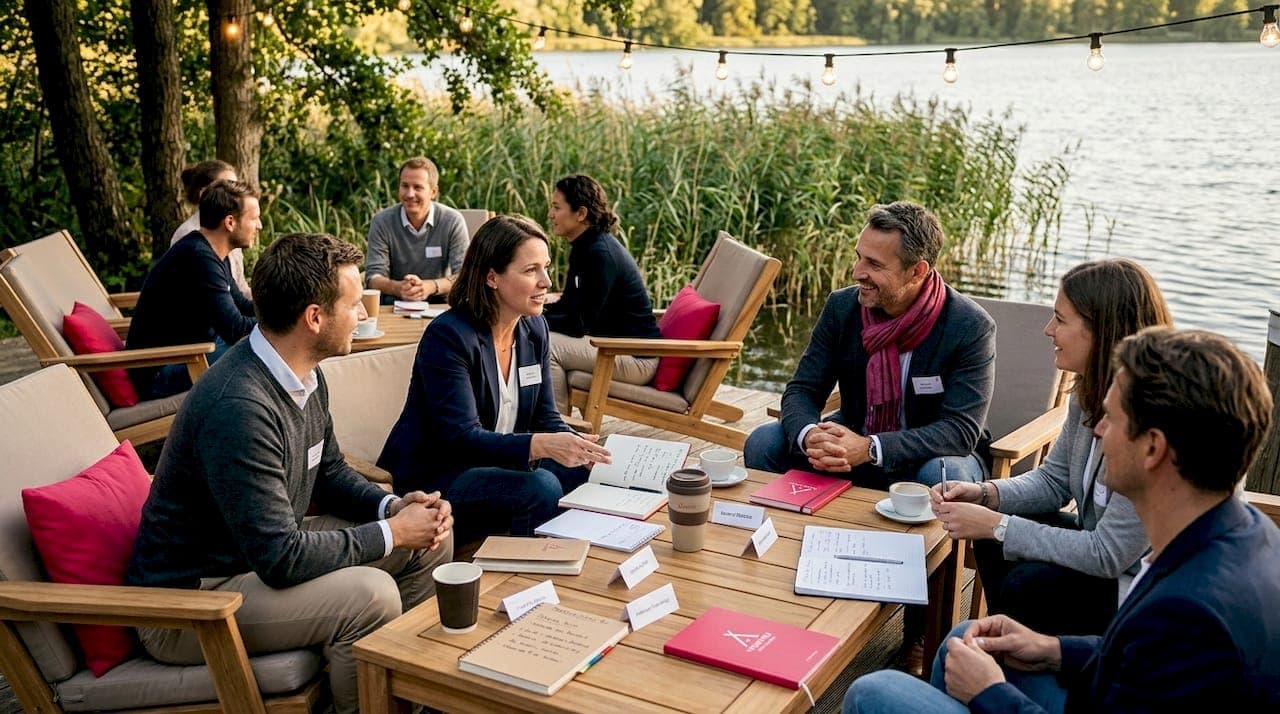
Offsite team retreats are defined as structured company events held away from the regular workplace, designed to strengthen collaboration, restore well-being, and align teams around shared goals. The benefits of offsite team retreats extend well beyond a change of scenery. Research from Babson College and Frontiers in Psychology confirms measurable gains in cross-team collaboration, psychological safety, creativity, and mental health recovery. For corporate team leaders and HR managers, understanding these advantages is the first step toward treating retreats as a strategic investment rather than a discretionary expense.
1. How offsite retreats boost collaboration and build lasting professional networks
The most documented benefit of corporate team retreats is their direct impact on collaboration. A large-scale study tracking over 700 partners at a US law firm found that attendees experienced a 24% increase in new collaboration requests within two months of returning from an annual retreat. That number alone justifies the planning effort. What makes it more compelling is the durability: 17% of those new relationships persisted for over two years, meaning retreats create professional networks that outlast the event itself.

The mechanism is straightforward. Face-to-face interaction, both structured and informal, accelerates trust in ways that video calls and Slack threads cannot replicate. Retreats place colleagues from different departments in shared experiences, from group problem-solving sessions to dinners around a common table, and those interactions break down the silos that slow organizations down. Offsites serve as catalysts for cross-team collaboration, helping employees form connections beyond their immediate units.
Key collaboration outcomes from well-designed team building retreats include:
- New working relationships that cross department and practice group boundaries
- Increased visibility for team members who are less prominent in daily office settings
- Higher rates of proactive outreach and knowledge sharing in the weeks following the retreat
- Stronger coordination on projects that require input from multiple teams
Pro Tip: Track collaboration outcomes by measuring new cross-team project requests and communication patterns over 60 to 90 days post-retreat, not just immediate satisfaction scores. This is where the real ROI shows up.
2. How retreats build psychological safety and improve team communication
Psychological safety, defined as a team member's belief that they can speak up without fear of punishment or embarrassment, is one of the strongest predictors of team performance. Research published in Frontiers in Psychology confirms that leadership behaviors like retreats and informal social events lead to increased cooperation and better team learning outcomes. Retreats work because they create low-pressure environments where people interact as full human beings, not just as job titles.
The agenda design matters significantly. Structured familiarity-building activities, such as icebreakers, shared meals, and collaborative challenges, give team members repeated opportunities to see each other in new contexts. This repeated exposure builds the comfort and trust that psychological safety requires. The Frontiers paper on psychological safety specifically recommends that retreat agendas include explicit agreements on post-retreat norms to translate gains back into daily work.
"Psychological safety as a core leadership competency can be operationalized through retreat activities that build familiarity and trust among team members." — Frontiers in Psychology, 2026
Practical retreat activities that build psychological safety include open feedback sessions with facilitated ground rules, cross-functional team challenges where hierarchy is deliberately flattened, storytelling exercises that invite personal sharing, and leadership-led vulnerability moments where managers model openness. Each of these creates a reference point that teams can return to when navigating difficult conversations back in the office. For HR managers, this is one of the clearest advantages of team getaways: the psychological gains transfer directly into daily team dynamics.
3. What retreats do for employee well-being and mental health recovery
Time away from work reduces the mental load that accumulates in high-pressure environments. A 2026 randomized controlled trial published in Frontiers in Digital Health found that a structured digital intervention after vacations reduced work-related rumination by 22.2% at two weeks post-vacation compared to a control group, with sustained reductions up to four weeks. Rumination, the habit of mentally replaying work problems during rest, is a primary driver of burnout. Retreats that actively interrupt this cycle deliver measurable mental health value.
The challenge is that well-being benefits fade quickly without follow-up rituals, check-ins, and reduced triggers for rumination. This is the "rapid fade-out" problem that HR leaders must plan for. A retreat that ends without a structured re-entry plan loses most of its recovery value within weeks.
Here is a practical post-retreat follow-up sequence to sustain well-being gains:
- Schedule a team debrief within 48 hours of returning, focused on what the team wants to carry forward, not on work deliverables.
- Establish a weekly check-in ritual for the first month, keeping it brief and personal rather than task-focused.
- Reduce high-rumination triggers in the first two weeks back, such as late-evening emails or ambiguous performance feedback.
- Assign a peer accountability partner from the retreat to maintain the connection and mutual support.
- Conduct a 30-day reflection survey to capture which retreat outcomes are holding and which need reinforcement.
Pro Tip: Frame the post-retreat period as a "recovery maintenance window" in your HR calendar. Treating it as a distinct phase, rather than a return to normal, signals to your team that the organization values sustained well-being, not just the retreat itself.
For a deeper look at how wellness-focused travel supports employee recovery, the corporate wellness trip guide from TribYou - Your Places offers a practical HR-focused framework.
4. How retreats spark creativity, surface future leaders, and improve operations
New environments disrupt habitual thinking. When your team steps out of the office and into an unfamiliar setting, whether a rural estate in Tuscany or a coastal conference center, the brain shifts out of default mode and becomes more receptive to novel connections. This is not anecdotal. Cognitive research consistently links environmental novelty with increased divergent thinking, the type of thinking that generates new ideas rather than refining existing ones.
Retreats also create natural leadership identification opportunities. Problem-solving exercises, group facilitation roles, and unstructured social time reveal who steps up, who brings people together, and who communicates clearly under ambiguity. These signals are difficult to observe in standard office settings where roles are fixed and hierarchies are visible. HR managers who attend retreats with this lens gain talent intelligence that no performance review can replicate.
The operational benefits are equally concrete. Research from HR Executive shows that structured rest programs build stronger organizational systems, including better documentation, clearer ownership, and greater transparency. When teams prepare for a retreat, they are forced to document processes and delegate responsibilities. That preparation alone improves organizational resilience.
| Retreat benefit | Operational outcome |
|---|---|
| Environmental novelty | Higher rate of creative problem-solving and new idea generation |
| Leadership exercises | Identification of high-potential team members outside formal hierarchies |
| Pre-retreat preparation | Improved process documentation and clearer role ownership |
| Cross-team interaction | Stronger coordination and reduced duplication of effort post-retreat |
| Structured rest | Reduced burnout signals and improved sustained performance |
The impact of team retreats on manager effectiveness is particularly well-documented, with group travel consistently linked to stronger morale and clearer team direction.
5. Why retreat ROI is measured in months, not days
Most organizations measure retreat success through post-event satisfaction surveys. This is the wrong metric. Retreat ROI shows up more reliably in network and coordination improvements than in immediate engagement scores, which means the real return becomes visible over months, not days. A team that rates a retreat as "fun" but shows no change in cross-team collaboration six weeks later has not received full value from the investment.
The Babson study's methodology is instructive here. Researchers tracked collaboration requests, communication patterns, and relationship persistence over a seven-year period across more than 700 partners. The signal was clear only when measured longitudinally. HR managers who want to demonstrate retreat value to leadership should build a 90-day measurement framework that captures new working relationships, cross-functional project starts, and communication frequency between previously disconnected colleagues.
Organizational benefits maximize when offsites are designed to improve cultural norms around rest and collaboration rather than only employee morale. This distinction matters. A retreat designed purely to boost morale produces a temporary emotional lift. A retreat designed to shift how a team works together, communicates, and supports each other produces lasting structural change. The planning intention determines the outcome. For teams managing complex logistics, the corporate group travel checklist from TribYou - Your Places provides a practical starting point.
Key takeaways
Offsite team retreats deliver their strongest returns when designed with clear collaboration, well-being, and cultural goals, then supported by structured follow-up over 30 to 90 days post-event.
| Point | Details |
|---|---|
| Collaboration gains are measurable | Retreats produce a 24% increase in new collaboration requests within two months, per Babson research. |
| Psychological safety transfers | Retreat activities that build trust and familiarity carry directly into daily team communication and openness. |
| Well-being fades without follow-up | Mental health benefits exhibit rapid fade-out; structured post-retreat rituals are required to sustain recovery gains. |
| ROI is longitudinal | Track network growth and cross-team coordination over 90 days, not immediate satisfaction scores. |
| Operational resilience improves | Pre-retreat preparation forces better documentation and ownership, strengthening organizational systems. |
Why I think most companies are planning retreats for the wrong reasons
I have seen a lot of corporate retreat programs, and the ones that fail share a common trait: they are planned to reward the team rather than to change how the team works. There is nothing wrong with rewarding people. But if that is the primary objective, you are spending a significant budget to produce a temporary emotional lift that evaporates within two weeks of returning to the office.
The retreats that actually move the needle are built around a specific organizational problem. Maybe the sales and product teams have never developed a real working relationship. Maybe a newly promoted manager needs to establish credibility with a skeptical team. Maybe the company is entering a growth phase that requires a different level of cross-functional trust. When the retreat is designed to solve that specific problem, with the right venue, the right facilitation, and the right follow-up plan, the results are concrete and lasting.
The venue choice matters more than most HR managers realize. Placing a team in an environment that is genuinely inspiring, whether that means a working farm in Umbria, a coastal village in Sicily, or a mountain lodge in the Dolomites, changes the quality of conversation. People open up differently when they are somewhere that feels meaningful. That is not a soft observation. It is a consistent pattern I have seen across dozens of retreat programs.
My strongest recommendation: treat the post-retreat period as seriously as the retreat itself. Build a 30-day follow-up plan before you book the venue. Assign ownership of the cultural outcomes you want to sustain. And measure what actually changed in how your team works together, not just how they felt about the trip.
— Luca
Plan your next offsite retreat with TribYou - Your Places
TribYou - Your Places designs corporate retreat experiences that combine authentic destinations, curated programming, and measurable team outcomes. Whether you are planning a leadership offsite in the Italian countryside, a remote team bonding experience along the Adriatic coast, or a wellness-focused getaway for a high-performing team under pressure, TribYou - Your Places connects you with the right venues, local partners, and facilitation support to make it work.
Every retreat planned through TribYou - Your Places is built around your team's specific goals, not a generic package. From incentive retreat packages to full-service logistics coordination, the platform gives HR managers and team leaders a trusted partner for every stage of the planning process. Explore incentive retreat packages and discover what a well-designed offsite can do for your team.
FAQ
What are the main benefits of offsite team retreats?
Offsite team retreats produce measurable gains in cross-team collaboration, psychological safety, creativity, and employee well-being. Research from Babson College shows a 24% increase in new collaboration requests within two months of attending an annual retreat.
How long do the benefits of a team retreat last?
Collaboration benefits can persist for over two years, with 17% of new working relationships formed at retreats remaining active long-term. Well-being benefits fade faster and require structured post-retreat follow-up to sustain.
How do retreats improve psychological safety?
Retreats create low-pressure social settings where team members build familiarity and trust through structured activities and informal interaction. Frontiers in Psychology research confirms that leader-facilitated retreats directly increase cooperation and team learning outcomes.
How should HR managers measure retreat ROI?
Track network growth, cross-team project starts, and communication patterns over 60 to 90 days post-retreat rather than relying on immediate satisfaction surveys. The Babson study found that coordination improvements, not engagement scores, are the most reliable indicators of retreat value.
How often should a company run offsite team retreats?
Annual retreats are the most common cadence supported by research, with the Babson study tracking outcomes from yearly events over a seven-year period. Companies with distributed or remote teams may benefit from semi-annual retreats to maintain connection and alignment.