
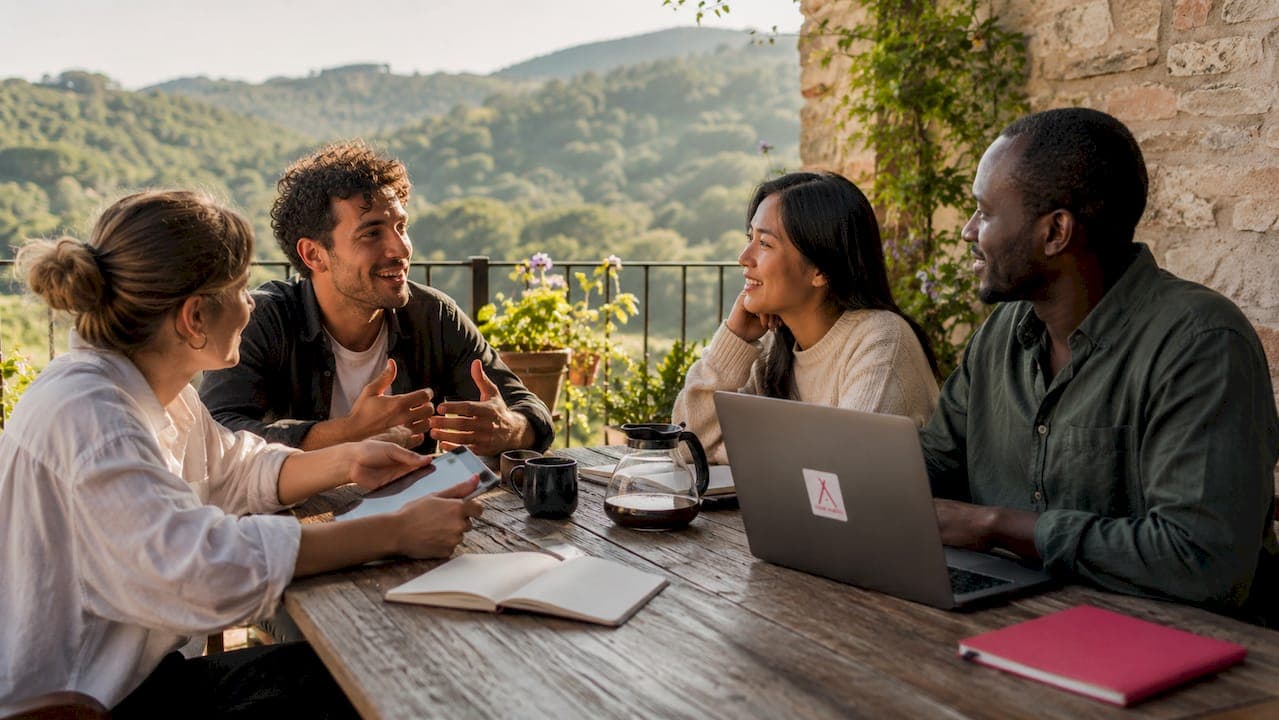
Remote workers join retreats to solve three problems that no digital tool has fixed: isolation, shallow collaboration, and the slow erosion of team culture. The industry term for these gatherings is the "company offsite" or "team retreat," and their purpose in 2026 goes far beyond fun. Research from TravelDealForge shows that teams meeting in person twice a year report 34% higher collaboration scores and 28% lower turnover. That single data point explains why remote professionals treat retreats as a professional necessity, not a reward.
Why remote workers join retreats: the core benefits
The primary benefits of retreats for remote workers fall into three categories: mental health, relationship quality, and collaborative output. Each one addresses a gap that Slack channels and Zoom calls consistently fail to close.
Mental health and loneliness reduction top the list. Remote workers report that anxiety decreases and clarity improves following wellness retreats, and those effects extend well beyond the retreat itself. Loneliness is the most cited challenge in distributed work surveys, and a structured retreat with shared meals, walks, and unscheduled conversation directly counteracts it. The relief is not incidental. It is the result of intentional design.

Stronger interpersonal trust is the second major gain. Remote colleagues who have only interacted through screens often carry invisible friction: misread tones, unresolved tensions, and a lack of shared context. A few days of face-to-face interaction resolves months of accumulated ambiguity. Teams that invest in offsite retreats for culture consistently report that trust built in person sustains remote collaboration for quarters afterward.
Accelerated collaboration and innovation complete the picture. The most successful retreats compress weeks of remote work into focused, in-person sessions of a few days. Decision velocity increases. Projects that stalled in asynchronous threads get resolved in a single afternoon. For digital nomads and distributed teams, this compression is the clearest return on investment a retreat delivers.
"Offsites act as infrastructure to maintain remote culture and alignment where digital tools fall short." — Jason Corso, Beyond the Distributed Work
The advantages of remote worker retreats are measurable, not anecdotal. Companies investing between $1,500 and $3,000 per person on biannual retreats recover those costs within three months through reduced hiring and improved efficiency. That is a faster payback cycle than most employee training programs.
How are remote worker retreats structured to maximize impact?
Structure determines whether a retreat produces real results or just good photos. The format that consistently delivers the highest return follows a 40/30/30 balance: 40% structured work sessions, 30% team-building activities, and 30% free time. This ratio sustains energy across multiple days and prevents the burnout that over-scheduled retreats reliably produce.
Effective retreat planning follows a clear sequence:
- Pre-retreat briefing. Distribute strategy documents, project updates, and discussion frameworks before anyone boards a flight. Proper pre-retreat preparation eliminates redundant context-sharing on-site and lets in-person time focus on decisions, not catch-ups.
- Structured work blocks. Reserve mornings for high-stakes collaboration: product roadmaps, strategic planning, and cross-functional problem-solving. These are the sessions that justify the travel budget.
- Team-building activities. Afternoon sessions work best for shared experiences, whether that is a cooking class in a Sicilian farmhouse, a guided hike in the Dolomites, or a local craft workshop. The activity matters less than the shared experience it creates.
- Unstructured free time. Evenings and at least one full afternoon should remain open. Spontaneous conversations over dinner produce more alignment than any facilitated workshop.
The accommodation choice reinforces the structure. Villas, boutique apart-hotels, and dedicated retreat centers outperform standard conference hotels because they create a shared living environment. When a team shares a kitchen, a terrace, and a morning coffee routine, the social bonds form faster and run deeper.
Pro Tip: If a task can be completed over Zoom or Slack, remove it from the retreat agenda entirely. In-person time is limited and irreplaceable. Protect it for the work that genuinely requires physical presence.
| Retreat element | Recommended approach |
|---|---|
| Work sessions | Morning blocks, 2 to 3 hours, high-stakes decisions only |
| Team activities | Afternoon, local and experiential, not generic icebreakers |
| Free time | Evenings plus one full afternoon, completely unscheduled |
| Accommodation | Shared villa or retreat center, not a standard hotel |
| Pre-work | Strategy brief distributed 5 to 7 days before arrival |
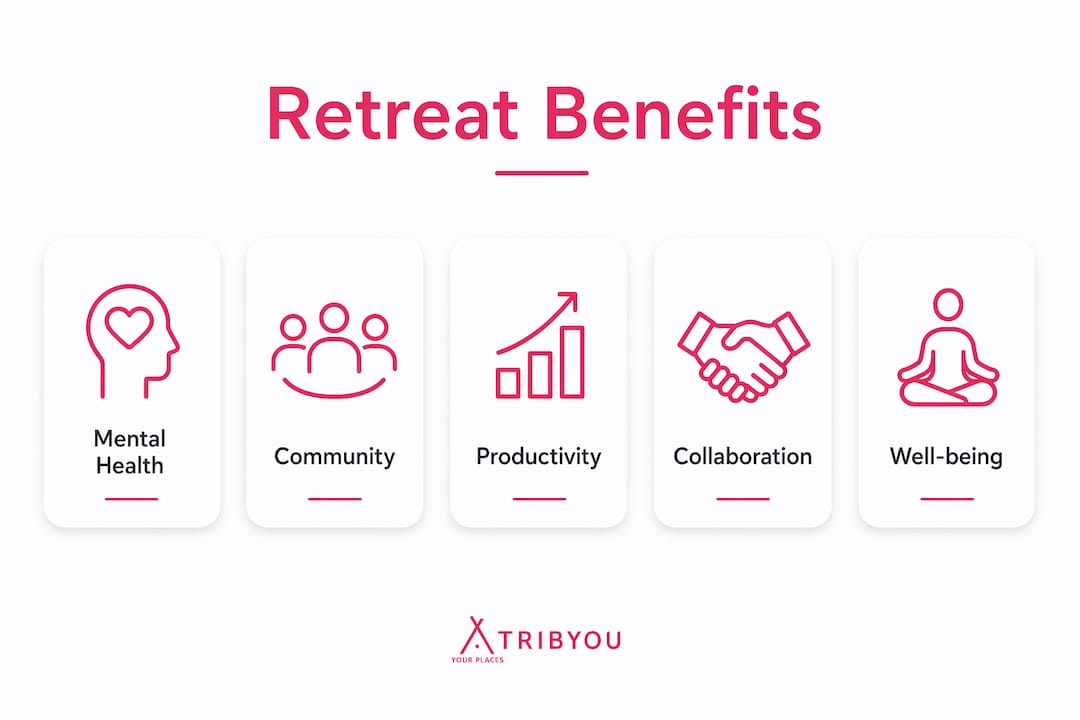
For a deeper look at how to plan these elements into a cohesive program, the guide on planning annual retreats covers agenda design and logistics in practical detail.
Why do remote workers prioritize community and connection in retreats?
The social driver behind retreats for digital nomads and distributed teams is more specific than "wanting to meet colleagues." It is about building the psychological safety that makes remote work sustainable over years, not just months.
Loneliness is the top challenge remote workers face, and it compounds over time. A worker who feels disconnected from their team in month three is far more likely to disengage or resign by month twelve. Retreats interrupt that cycle by creating shared memories and personal knowledge of colleagues that no Slack profile can replicate.
The shift toward smaller, invitation-only retreats reflects this understanding. Smaller retreats foster deeper intimacy and more meaningful conversations than large conferences where networking stays surface-level. Jessica Mah, founder of inDinero, has publicly described shifting her team gatherings away from large industry events toward intimate offsites precisely because the depth of connection is incomparable.
The reasons remote employees attend retreats with a community focus include:
- Onboarding acceleration. New team members who meet colleagues in person during their first 90 days integrate faster and perform better in their first year.
- Psychological safety. Knowing a colleague's sense of humor, personal context, and communication style makes it far easier to give honest feedback remotely.
- Shared culture. Remote teams without a physical office rely on shared experiences to define who they are. Retreats are the primary mechanism for creating those experiences.
- Leadership alignment. Executives and team leads who attend retreats signal that connection is a company priority, not an afterthought.
"The modern retreat's primary goal is strategic acceleration, not just fun or networking." — The Rise of the High ROI Offsite
The impact of retreats on remote work culture is cumulative. One well-designed offsite does not fix a disconnected team permanently, but two per year builds the relational foundation that makes distributed work genuinely effective.
What practical factors shape remote workers' retreat choices?
Choosing the right retreat location is not about finding the most scenic destination. It is about finding the intersection of infrastructure, affordability, and experience quality.
Popular retreat destinations prioritize visa friendliness, internet reliability, and a favorable cost of living. Portugal, Mexico, Thailand, and Georgia consistently rank at the top of this list for international remote teams. Within Europe, Italy offers a compelling combination of cultural richness, culinary depth, and growing digital infrastructure, particularly in regions like Puglia, Sicily, and the Italian Lakes.
Reliable internet and dedicated workspaces are non-negotiable. Workations with enterprise-grade technology, including standing desks, ultrawide monitors, and stable fiber connections, produce measurably better productivity outcomes than standard vacation rentals repurposed for work. The workspace signals to participants that work is real here, not performative.
Pro Tip: Book accommodations that include a dedicated meeting room separate from sleeping and social areas. Mixing work and leisure in the same physical space blurs boundaries and reduces the quality of both.
Practical considerations that influence retreat choices include:
- Team size. Groups of 8 to 15 people benefit most from villa-style accommodations. Larger teams of 20 or more require boutique hotels or retreat centers with breakout spaces.
- Flight logistics. Choose destinations with direct or single-connection flights from the majority of team members' home cities. Travel fatigue on arrival day wastes the first 24 hours.
- Daily routine design. Build in physical activity, whether morning runs, yoga, or evening walks, to maintain energy across a multi-day program.
- Local experiences. Integrating authentic local culture, a truffle hunt in Umbria, a wine tasting in Tuscany, a cooking class with a local chef, creates memories that outlast any workshop.
For remote professionals focused on productivity during travel, the right destination combines inspiring surroundings with the technical infrastructure that makes real work possible.
Key takeaways
Remote workers join retreats because in-person connection, strategic collaboration, and mental well-being are not optional features of distributed work. They are the foundation it depends on.
| Point | Details |
|---|---|
| Connection drives attendance | Loneliness and shallow digital relationships are the top reasons remote workers seek retreats. |
| Structure determines ROI | The 40/30/30 balance of work, team-building, and free time maximizes engagement without burnout. |
| Smaller retreats go deeper | Invitation-only offsites produce stronger trust and more meaningful conversations than large conferences. |
| Location infrastructure matters | Visa-friendly, well-connected destinations with reliable internet protect both productivity and experience quality. |
| Retreats are infrastructure | Two well-designed offsites per year sustain remote culture, reduce turnover, and accelerate collaboration. |
Retreats as infrastructure: what I've learned from watching teams transform
I have seen the difference between a retreat treated as a reward and one treated as a strategic tool. The first produces good photos and a temporary morale lift. The second produces a team that works differently for the next six months.
The mistake most remote teams make is arriving without a clear intention. They book a beautiful villa, fill the agenda with workshops, and wonder why the energy drops by day two. The problem is not the destination or the activities. It is the absence of a shared purpose that every participant understands before they arrive.
The retreats that genuinely change how teams operate share three qualities. They start with a pre-retreat briefing that aligns everyone on goals. They protect unstructured time as fiercely as they protect work sessions. And they choose locations that create a sense of shared adventure, not just a change of scenery.
I also want to push back on the idea that retreats are primarily about fun. Fun is a byproduct of good design, not the goal. The goal is trust, alignment, and the kind of honest conversation that only happens when people are physically present. When you get that right, the fun follows naturally.
Treat your next retreat as infrastructure. Plan it with the same rigor you would apply to a product launch. The return will surprise you.
— Luca
Plan your next retreat with TribYou - Your Places
TribYou - Your Places designs immersive retreat experiences built specifically for remote professionals and distributed teams. Every program balances structured collaboration, authentic local experiences, and genuine rest, so your team leaves with stronger relationships and clearer direction.
From curated villas in Puglia to boutique retreat centers in the Italian Lakes, TribYou - Your Places handles destination selection, workspace setup, local experiences, and logistics so you can focus on what the retreat is actually for. Whether you are planning a team offsite for 10 or a personal workation for one, explore retreat options on the TribYou - Your Places platform and find the experience that fits your goals.
FAQ
Why do remote workers join retreats instead of staying home?
Remote workers join retreats to rebuild the interpersonal trust and collaborative momentum that digital tools cannot replicate. Teams meeting in person twice a year report 34% higher collaboration scores compared to fully remote teams.
What are the main benefits of retreats for remote workers?
The primary benefits include reduced loneliness, stronger team trust, accelerated decision-making, and improved mental clarity. Research confirms that wellness retreat participants experience lower anxiety and improved focus that extends beyond the retreat itself.
How long should a remote team retreat last?
Most high-impact retreats run three to five days. This window is long enough to build genuine connection and complete strategic work, but short enough to avoid travel fatigue and scheduling conflicts.
What makes a retreat location right for remote workers?
The best locations combine visa-friendly access, reliable high-speed internet, dedicated workspaces, and authentic local experiences. Portugal, Mexico, Thailand, and Italy are consistently top choices for distributed teams in 2026.
Are retreats worth the cost for small remote teams?
Companies investing $1,500 to $3,000 per person on biannual retreats recover those costs within three months through reduced turnover and improved team efficiency, making retreats one of the highest-return investments available to remote-first organizations.