

Most people imagine remote work travel as a laptop on a beach and total freedom. That picture is partly true and mostly dangerous. Understanding how remote work travel is structured separates the people who thrive for years on the road from those who burn out in three months. The real model involves deliberate time-zone management, airtight logistics, legal compliance, and work-travel rhythms designed around human performance, not impulse. This article breaks down every layer of that structure so you can build a system that actually holds up over time.
Table of Contents
- Key takeaways
- How remote work travel is structured around time zones
- The essential logistics setup for remote workers
- Visa and legal frameworks for long-term itineraries
- Structuring work and travel rhythms that last
- How remote teams manage travel together
- My perspective on structure versus freedom in remote travel
- Discover your next work-travel base with TribYou - Your Places
- FAQ
Key takeaways
| Point | Details |
|---|---|
| Time-zone discipline is non-negotiable | Stay within ±6 hours of your team to protect a 2–3 hour daily synchronous overlap. |
| Logistics require work-specific planning | Standard vacation checklists miss visas, work insurance, and proof-of-work documents you will need at borders. |
| Visa type determines stay duration | Digital nomad visas like Thailand's Destination Thailand Visa allow multi-year itinerary planning that tourism visas cannot support. |
| Travel days are low-output days | Treat arrival and transit days as buffer periods, not productive work blocks, to protect quality and wellbeing. |
| Team travel needs written policy | Remote-first companies need formal travel policies covering booking, expense limits, duty of care, and legal compliance. |
How remote work travel is structured around time zones
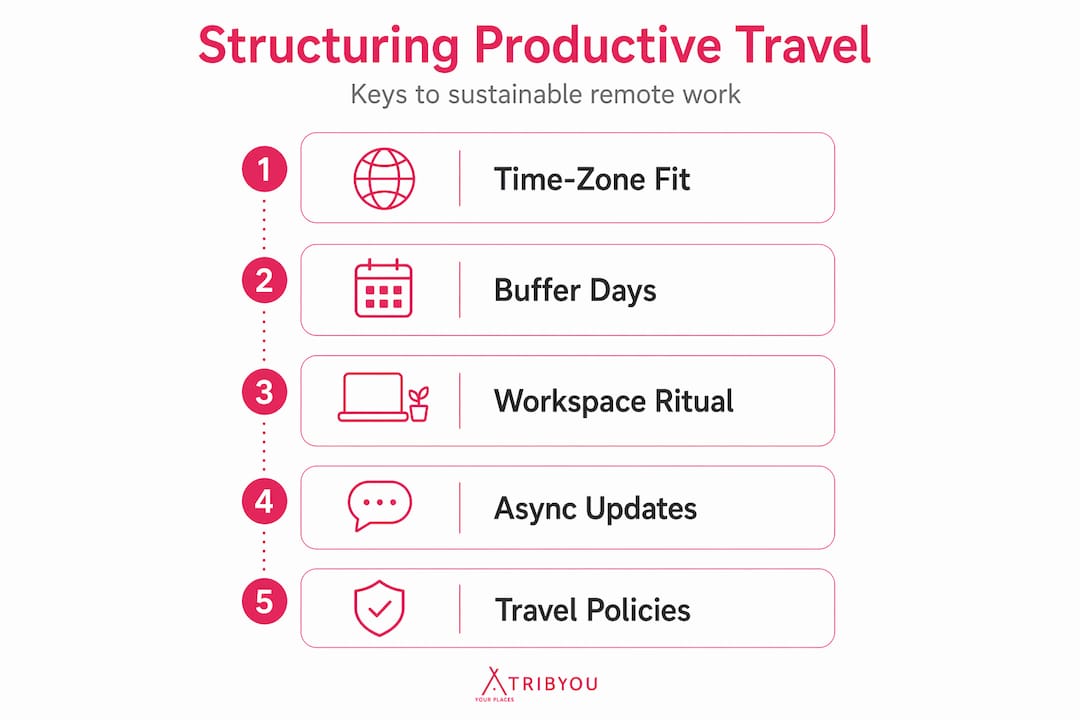
Time-zone fit is the primary driver of nomad sustainability, affecting burnout rates, deliverable quality, and client relationships alike. Yet most new remote travelers pick destinations based on weather or cost of living, and treat the time difference as a minor inconvenience. It is not.
The working framework that holds up long-term is built on two daily anchors:
- Deep work block: Scheduled in your local morning, when your mind is fresh and the rest of the world is mostly offline. This is where your highest-value, highest-focus output lives.
- Synchronous overlap block: Timed to match your team's core hours, wherever they are. This is for meetings, real-time decisions, and collaborative work.
Staying within ±6 hours of your team's time zone preserves at least 2 to 3 hours of genuine real-time overlap per day. Cross into a 9 or 10-hour difference and that window collapses entirely. You end up working evenings, missing async context, and slowly slipping behind on both deliverables and relationships.
"Scattered work windows across the day destroy focus far more than a long, uninterrupted block does. Every context switch carries a cognitive cost that compounds over weeks."
Multiple disconnected work windows, a common workaround when time zones are extreme, fragment attention and erode the quality of output. It feels like you are always working but rarely producing your best.
Pro Tip: Set your calendar to display your team's time zone as primary and your local time zone as secondary. This single habit prevents scheduling errors that damage your professional reputation.

When you are crossing multiple time zones, build one full buffer day into your travel plan before any critical meetings or deliverables land. This is not optional recovery time. It is a structural part of how well-planned remote work travel operates.
The essential logistics setup for remote workers
Treating remote work travel like leisure travel is the single most expensive misconception in the digital nomad world. The documents you need, the insurance you carry, and the accommodation you book all require a work-specific lens.
Here is the core setup process before any trip:
- Gather your proof-of-work documents. This means employment contracts, client invoices, tax registration, and any freelance agreements. Proof artifacts at borders prevent denial of entry when immigration officers question your status.
- Check visa requirements for every country on your itinerary. Tourism visas often prohibit any form of work, even remote. Verify what your specific visa allows before booking.
- Get remote-work-specific travel insurance. Standard travel policies exclude working abroad. Work-specific coverage from providers like SafetyWing or World Nomads includes electronics coverage, extended stay provisions, and protection for professional gear.
- Confirm accommodation with a dedicated workspace. A desk and a door matter more than a pool view. Reliable upload speeds above 20 Mbps and a backup mobile data plan are baseline requirements, not upgrades.
- Pack your core tech kit. A travel router for unstable hotel networks, noise-canceling headphones for calls in shared spaces, a portable monitor if your workflow requires screen real estate, and a universal power adapter.
| Document or resource | Why it matters | Who needs it |
|---|---|---|
| Employment contract or client invoice | Proves remote work status at borders | Every remote traveler |
| Digital nomad or work visa | Legalizes remote work in destination country | Long-stay remote workers |
| Work-specific travel insurance | Covers electronics, extended stays, and work gear | All remote workers abroad |
| Proof of accommodation | Required by some immigration authorities | Especially long-stay travelers |
| Backup connectivity (SIM or router) | Prevents productivity loss from unreliable Wi-Fi | Anyone relying on calls or video |
Pro Tip: Carry both printed and digital copies of your key documents. Cloud-stored PDFs in a dedicated folder save hours if physical documents are lost or damaged in transit.
Planning remote work trips with this checklist in place prevents the two most common crises: border complications and connectivity failures.
Visa and legal frameworks for long-term itineraries
The structure of the digital nomad lifestyle over months and years is largely determined by visa frameworks, not personal preference. You cannot build a sustainable multi-country itinerary without modeling how long you can legally stay in each place and when your status resets.
There are three categories to understand:
- Tourist visas: Short duration (30 to 90 days), often legally prohibit any work, even for foreign clients. Relying on tourist visas long-term creates legal and tax exposure.
- Digital nomad visas: Purpose-built for remote workers. They legalize your work while abroad, typically for 12 to 24 months, and often require proof of minimum income and health insurance.
- Standard work permits: Tied to local employment. Not relevant for remote workers serving foreign clients, but important to distinguish from the above.
Thailand's Destination Thailand Visa is one of the clearest examples of how visa frameworks are reshaping remote travel planning. It offers a 5-year multi-entry visa with 180-day stays per entry and possible extensions, giving remote workers genuine flexibility to build recurring itineraries around a stable base. This changes the calculus entirely. Instead of scrambling for visa resets every 30 days, you can plan six-month cycles and treat Thailand as a real base, not a short stop.
The legal side extends beyond visa status. Tax residency rules in many countries activate after 183 days of presence in a calendar year. Staying ahead of that threshold, or intentionally crossing it with proper registration, is part of long-term nomad planning. Ignoring it creates expensive surprises at tax time. If you are exploring European bases, resources like digital nomad life in Greece are worth reviewing for destination-specific legal and cost details.
The practical takeaway: map your visa validity periods and reset dates into a calendar at the start of every year. Your travel itinerary should follow your legal framework, not the other way around.
Structuring work and travel rhythms that last
The most stable remote work pattern is staying 1 to 3 months per base. Moves shorter than three weeks cause productivity drops from repeated resettling. Stays longer than three months tend to reduce the exploration benefit that makes remote travel worthwhile in the first place. That range is not arbitrary. It reflects real output data from experienced nomads and the time needed to integrate into a local environment rather than just pass through it.
Here is how to structure the rhythm within that framework:
- Day 1 at any new location is a setup day, not a work day. Unpack, confirm your workspace, test internet speed, locate a backup café. Treat it as an investment that pays off for the next 30 to 90 days.
- Travel days are explicitly low-output or no-output. Blocking overlap windows and travel buffers is how experienced remote workers protect their reputation from missed deadlines. Schedule only async tasks for these days.
- Deep focus work gets morning hours. Meetings get afternoon. This is non-negotiable for knowledge workers. Switching the order destroys the quality of your most important output.
- Set clear leisure boundaries and hold them. Remote work travel collapses into burnout when you are always half-working and never fully off. A firm end time, a local activity, or a weekly no-screen afternoon protects your mental bandwidth.
Pro Tip: Build a short daily startup ritual specific to your workspace. Even five minutes of the same sequence signals to your brain that work mode has started, which matters more in changing environments than it does at a fixed desk at home.
Written async updates as default communication reduces the meeting burden when your overlap window shrinks. Keep your team informed through structured written check-ins rather than reactive calls, and your travel flexibility increases without any loss of professional visibility. For practical guidance on eco-conscious planning at specific destinations, sustainable remote travel in Greece is a useful reference for structuring responsible itineraries.
How remote teams manage travel together
Solo digital nomad travel and team travel are structurally different problems. When a distributed company sends its people traveling for retreats, meetups, or workations, the logistics multiply and the stakes are higher.
Remote team travel management requires integrated systems, not improvised coordination. Here is how well-run remote-first companies approach it:
- Write the travel policy before the first trip. It should cover booking approval workflows, maximum accommodation spend per city, expense reporting deadlines, and what counts as a reimbursable business travel cost.
- Centralize booking through a single platform. This reduces cost variance, captures data for auditing, and ensures compliance across different employee locations.
- Address visa and tax compliance per traveler. Distributed team travel involves social security implications, local tax triggers, and visa restrictions that vary by nationality and destination. Legal review is not optional for companies with global teams.
- Build duty of care into the policy. Emergency contacts, medical evacuation coverage, real-time location awareness, and health or vaccine requirements for specific regions protect both employees and the company.
- Plan retreats on a quarterly cadence. Quarterly team meetups of 3 to 5 days balance team cohesion with budget control and prevent the travel fatigue that comes from more frequent full-team movement.
| Policy element | Purpose | Typical format |
|---|---|---|
| Booking approval workflow | Controls costs and ensures compliance | Manager sign-off before booking |
| Per diem and expense caps | Limits spend without micromanagement | City-tier rate tables |
| Duty of care protocol | Protects employee safety abroad | Emergency contact sheet and insurance doc |
| Visa and tax review process | Avoids legal exposure for company and employee | Annual legal audit per destination |
My perspective on structure versus freedom in remote travel
I have watched enough people start remote work travel with no plan and exit it six months later, exhausted and professionally behind, to have a strong opinion on this.
The freedom that remote work travel offers is real. But it only materializes when you have structure underneath it. The people who treat it as perpetual vacation learn quickly that unstructured freedom is just chaos with a better backdrop.
In my experience, the time-zone decision is the most important one you make, and most people make it last. They pick a destination first and then try to retrofit their work schedule to the local clock. That approach works for a week. It does not work for a year.
I have also seen how ignoring travel days destroys output quality in ways that are invisible to the traveler but visible to everyone they work with. Missing a deadline by 24 hours because you scheduled a deliverable on a 14-hour travel day is not a time-zone problem. It is a planning problem.
The difference between someone who sustains remote work travel for three years and someone who quits in three months almost never comes down to destination quality or internet speed. It comes down to whether they built a system. A time-zone rule. A visa calendar. A daily rhythm with real boundaries. The structure is what gives you access to the freedom.
— Luca
Discover your next work-travel base with TribYou - Your Places
At TribYou - Your Places, every property and experience in our ecosystem is curated with remote workers and digital nomads in mind. That means dedicated workspaces, verified connectivity, authentic local integration, and hosts who understand the difference between a guest and a professional working from their location. Whether you are planning a solo workation, a team retreat, or a multi-month stay at a new base, TribYou connects you with the right place at the right time. Stop improvising your remote work travel setup. Discover stays and experiences built around the structure that actually makes travel and work coexist.
FAQ
What is the ideal time-zone range for remote work travel?
Staying within ±6 hours of your team's time zone preserves a 2 to 3 hour real-time overlap window for synchronous collaboration without forcing night shifts.
Do I need special insurance when working remotely abroad?
Yes. Standard travel insurance does not cover remote work activities or electronics. Work-specific policies from providers like SafetyWing or World Nomads include the coverage remote workers actually need.
What documents should I carry as a remote worker crossing borders?
Always carry your employment contract or client invoices, visa documentation, and proof of accommodation. These proof artifacts confirm your remote work status to immigration authorities and prevent entry issues.
How long should I stay in each location as a digital nomad?
The most productive and sustainable pattern is 1 to 3 months per base. Shorter stays cause repeated disruption and productivity loss; longer stays reduce the integration and exploration benefits of the lifestyle.
What does a remote team travel policy need to include?
A complete remote team travel policy covers booking approval workflows, per diem limits, visa and tax compliance, duty of care protocols, and emergency contact procedures for every destination.