

A corporate travel policy is a set of official, documented rules that dictate how employees plan, approve, book, and expense business travel to ensure safety, cost efficiency, and compliance. Also called a business travel policy or corporate travel guidelines, this document governs everything from which booking tools employees must use to how they submit receipts after returning home. For corporate managers and HR leaders, a well-written policy is the single most effective tool for controlling travel spend, protecting employees, and aligning travel activity with company goals.
What is a corporate travel policy and what does it cover?
A corporate travel policy defines the boundaries of permissible business travel behavior in writing. Written instructions cover permissible expenses, booking methods, approval workflows, and how to handle cancellations or lost receipts. Without this document, every traveler makes independent decisions, and finance teams spend weeks reconciling inconsistent claims.
The policy applies to every employee who travels on company time, from junior sales representatives to senior executives. It sets the same baseline rules for everyone while allowing for role-based exceptions where needed. This consistency is what makes the policy enforceable and fair.
What are the essential components of a corporate travel policy?
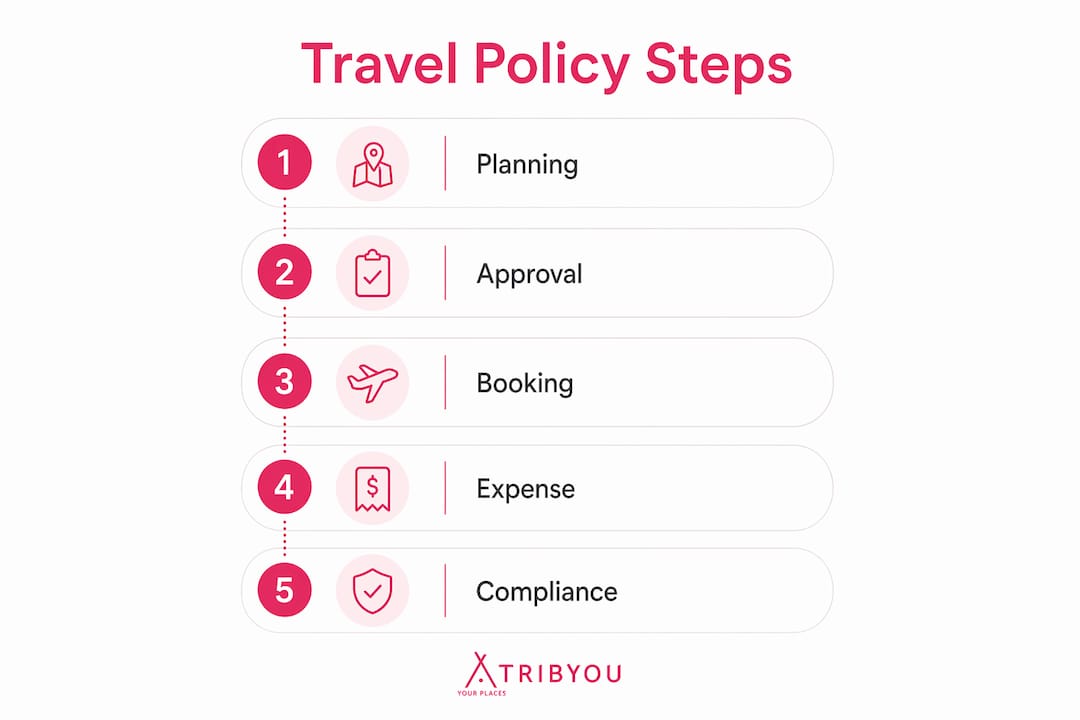
A comprehensive travel policy must address at least 14 critical components to function effectively. Each section removes a specific source of ambiguity that would otherwise create disputes or overspending.
The core elements of travel policy include:
- Purpose and scope: Who the policy applies to and why it exists
- Eligibility: Which roles or trip types qualify for company-funded travel
- Booking tools and procedures: Which platforms employees must use (such as a corporate booking tool or approved travel management company)
- Airfare rules: Permitted cabin classes by trip length, advance booking windows, and preferred carriers
- Lodging limits: Maximum nightly rates by city or region, approved hotel chains, and rules on Airbnb or alternative accommodations
- Ground transportation: Rules on rental cars, rideshare apps, mileage reimbursement, and airport transfers
- Per diem and meal limits: Daily spending caps for meals, broken down by destination
- Reimbursement procedures: Required documentation, submission deadlines, and approval chains
- Corporate card usage: Which expenses go on the company card versus personal cards
- International travel: Visa requirements, currency exchange, and country-specific safety protocols
- Personal and bleisure time: Rules for extending trips for personal reasons
- Safety and duty of care: Emergency contacts, travel insurance, and protocols for medical or security incidents
- Sustainability guidelines: Preferences for train over short-haul flights, carbon offset programs, or eco-certified hotels
- Enforcement and consequences: What happens when employees book outside policy
Pro Tip: Avoid vague phrasing like "reasonable expenses." Specify exact amounts. A rule like "itemized receipts required for all meal expenses over $25" removes interpretation and reduces reimbursement friction significantly.
The corporate travel management process depends on each of these sections working together. Missing even one creates a gap that travelers will fill with their own judgment, which rarely aligns with company expectations.

How does a corporate travel policy benefit organizations and employees?
The financial case for a formal policy is direct. Companies with well-enforced travel policies spend 20–30% less on travel than those without one. That reduction comes from standardized booking behavior, fewer last-minute purchases, and consistent use of negotiated corporate rates.
"Travel policies align travel practices with broader business objectives like market growth or sustainability rather than just cutting costs." — Chase Business Travel Policies
The benefits of travel policies extend well beyond the finance department. Employees benefit from clear rules that remove the stress of guessing what is covered. HR leaders benefit from reduced complaints and faster reimbursement cycles. The organization benefits from better data on travel spend, which feeds smarter negotiations with airlines and hotel chains.
Key organizational benefits include:
- Spend visibility: Centralized booking data shows exactly where travel budgets go
- Risk mitigation: Duty-of-care protocols protect employees and limit company liability
- Compliance: Automated enforcement at the booking stage prevents out-of-policy purchases before they happen
- Employee satisfaction: Clear comfort guidelines, such as permitted hotel star ratings or business class on flights over eight hours, reduce traveler frustration
- Sustainability alignment: Policies that favor rail travel or certified green hotels support corporate ESG commitments
Travel policies must evolve regularly to stay aligned with company goals, traveler expectations, and emerging risk environments. A policy written in 2019 does not account for remote work norms, bleisure travel, or the security risks that have emerged since.
What is the difference between a travel policy and a travel brief?
A corporate travel policy and a corporate travel brief serve different purposes. Confusing them leaves travelers underprepared, especially in high-risk destinations.
A travel policy is a standing document. It sets the rules for all business travel across the organization and changes infrequently. A travel brief is a short, trip-specific document prepared before a particular journey. Travel briefs provide actionable intelligence tailored to the traveler's role and destination, covering risks, legal considerations, safe locations, surveillance awareness, and emergency actions.
The distinction matters most in three scenarios:
- Executive travel: Senior leaders traveling to unfamiliar markets need destination-specific security guidance that a general policy cannot provide.
- High-risk destinations: Travel to regions with political instability, health advisories, or elevated crime rates requires a brief with real-time intelligence, not just standard policy rules.
- First-time international travelers: Employees new to international business travel benefit from a brief that explains local laws, cultural norms, and emergency contacts specific to their destination.
Distinguishing travel policies from travel briefs improves overall traveler safety, because briefs provide role-specific and location-specific intelligence that static policies cannot deliver.
Pro Tip: Travel briefings should be tailored, actionable, and easy to understand. Keep briefs to one page. Avoid compliance jargon. The goal is a prepared traveler, not a documented liability waiver.
How do you develop or improve a corporate travel policy?
The most effective framework for building or updating a travel policy is the four C's: cost, compliance, comfort, and convenience. Effective policies balance all four by setting clear documented rules on permissible spending and booking procedures without making travel unnecessarily difficult for employees.
Follow these steps to build a policy that works in practice:
- Audit current travel spend: Pull 12 months of travel data to identify the top expense categories, most common destinations, and highest-cost behaviors.
- Survey travelers: Ask employees what the current policy gets wrong. Friction points like low hotel caps in expensive cities or inflexible booking windows drive non-compliance.
- Define approval workflows: Specify who approves what. A sales rep booking a domestic flight should not need the same approval chain as an executive booking a two-week international trip.
- Select a booking platform: Tools like corporate travel management software apply policy rules automatically at the booking stage, shifting from reactive audits to proactive compliance.
- Write granular rules: Replace "reasonable expenses" with specific dollar amounts. Replace "preferred hotels" with a named list or a star-rating cap by city tier.
- Train employees: Distribute the policy at onboarding and after every update. A policy no one has read is a policy no one follows.
- Schedule regular reviews: Set a calendar reminder to review the policy every 12 months or after any major organizational change.
| Policy element | Weak version | Strong version |
|---|---|---|
| Meal expenses | "Reasonable meal costs are covered" | "Meals reimbursed up to $75 per day with itemized receipts" |
| Hotel booking | "Use preferred hotels where possible" | "Book hotels from the approved list; max $200/night in Tier 1 cities" |
| Flight class | "Business class for long trips" | "Economy for flights under 6 hours; business class permitted for flights over 8 hours" |
| Booking window | "Book in advance when you can" | "All flights must be booked at least 14 days in advance unless approved by a manager" |
A corporate group travel logistics checklist is a practical companion to your policy for team trips, covering hotel blocks, ground transportation, and group approval workflows in detail.
Key Takeaways
A corporate travel policy reduces spend, protects employees, and drives compliance only when it is specific, regularly updated, and enforced at the booking stage through technology.
| Point | Details |
|---|---|
| Define all 14 components | Cover booking tools, airfare rules, lodging limits, per diems, and duty-of-care protocols to close every gap. |
| Use the four C's framework | Balance cost, compliance, comfort, and convenience so the policy serves both the company and the traveler. |
| Separate policy from brief | Use a standing policy for rules and a trip-specific brief for destination intelligence, especially in high-risk environments. |
| Write granular rules | Replace vague language with exact dollar amounts and named tools to prevent disputes and improve enforcement. |
| Automate enforcement | Apply policy rules at the booking stage with travel management software to prevent out-of-policy expenses before they occur. |
Why most travel policies fail before the first trip
The most common reason a corporate travel policy fails is not that it is wrong. It is that it is vague. I have reviewed policies from mid-size companies that spent pages explaining the philosophy of responsible travel and then said nothing specific about hotel caps or receipt requirements. Travelers filled those gaps with their own logic, and finance teams spent months cleaning up the results.
The second failure point is treating the policy as a one-time project. Travel policies are living documents that need to reflect current hotel rates, current risk environments, and current employee expectations. A policy that has not been updated since before hybrid work became standard is already out of date.
What I find most overlooked is the traveler experience angle. HR leaders who align corporate travel with company goals and employee wellbeing see higher compliance rates than those who treat the policy purely as a cost-control document. When employees feel the policy respects their comfort and safety, they follow it. When it feels punitive or impractical, they work around it. The policy is also a signal about company culture. A policy that allows business class on long-haul flights and includes a clear duty-of-care section tells employees they are valued. That signal matters for retention, especially among frequent travelers.
— Luca
How TribYou - Your Places supports your corporate travel program
Corporate travel policy is the foundation. What you build on top of it determines whether your team travels with purpose or just compliance.
TribYou - Your Places works with corporate managers and HR leaders to design travel programs that align with company policy while delivering authentic, high-quality experiences for employees. From curated corporate retreats and incentive trips to workation programs and team-building experiences, TribYou - Your Places combines policy-aligned logistics with destinations that genuinely motivate teams. Every program is built around your company's goals, your team's needs, and the kind of travel that creates real connection rather than just checked boxes.
FAQ
What is a corporate travel policy in simple terms?
A corporate travel policy is a written document that tells employees how to book, manage, and expense business travel. It sets rules on spending limits, approved booking tools, and reimbursement procedures.
How many components should a corporate travel policy include?
A complete policy covers at least 14 sections, including booking procedures, airfare rules, lodging limits, per diem rates, duty-of-care protocols, and sustainability guidelines.
What is the difference between a travel policy and a travel brief?
A travel policy is a standing document with rules for all business travel. A travel brief is a short, trip-specific document with destination intelligence, security guidance, and emergency contacts for a particular journey.
How much can a travel policy reduce company travel costs?
Companies with well-enforced travel policies spend 20–30% less on travel than those without one, primarily through standardized booking behavior and consistent use of negotiated corporate rates.
How often should a corporate travel policy be updated?
A travel policy should be reviewed at least once every 12 months and after any major organizational change, such as expansion into new markets or a shift to hybrid work arrangements.