

Corporate travel management is the end-to-end process of planning, organizing, and overseeing all business travel activities and expenses within a company, covering policy creation, booking approvals, compliance, duty of care, and spend monitoring. Most organizations treat it as a governance function, not just a logistics task. When done well, it transforms scattered, ad-hoc bookings into a controlled, measurable program that reduces costs, protects employees, and delivers clear operational visibility. Platforms like TravelPerk, Amex Global Business Travel, and drvn have built entire service models around this discipline, which tells you how significant the stakes are.
What is corporate travel management and why does it matter?
Corporate travel management, often abbreviated as CTM, is the systematic approach companies use to govern every aspect of employee business travel. The scope goes well beyond booking a flight. CTM is fundamentally about governance and monitoring: who can travel, how they book, what they spend, and how the company responds when something goes wrong.
The importance of travel management becomes clear when you consider what unmanaged travel actually costs. Without a structured program, employees book on personal credit cards, use non-preferred vendors, and submit expense reports weeks after travel. Finance teams lose visibility. Compliance breaks down. Risk exposure grows. A managed program replaces that chaos with policy-driven processes that are enforceable, auditable, and aligned with company objectives.

The best corporate travel programs align with company objectives to deliver operational outcomes and traveler satisfaction, not just cost savings. That dual focus is what separates a mature CTM program from a basic travel policy document. For decision-makers, understanding this distinction is the starting point for building something that actually works.
What are the main components of an effective corporate travel management program?
A corporate travel management program functions as an operating system for business travel. Its components work together to create a structured, controlled process that replaces decentralized booking with policy-driven workflows. Here are the core elements every effective program includes:
- Travel policy creation and enforcement. The policy defines who can travel, what class of service is permitted, which vendors are preferred, and what approval thresholds apply. Without a clear policy, every other component loses its foundation.
- Centralized booking and approval workflows. Employees book through approved channels, whether a travel management company or an integrated platform. Approval workflows prevent off-policy spend before it happens, not after.
- Traveler support services. This covers changes, cancellations, and emergency assistance during a trip. A traveler stranded at midnight in Milan needs a real support line, not a chatbot.
- Expense management and reconciliation. Payments, invoicing, and expense reporting need to connect directly to trip data. Disconnected systems create reconciliation delays and audit gaps.
- Reporting and analytics. Spend visibility by team, location, and category enables proactive budget management. Without data, you are managing travel by instinct.
- Duty of care protocols. Traveler safety must be integrated throughout the program, not added as an afterthought. This includes tracking, risk alerts, and documented response plans.
Pro Tip: Set your travel policy review cycle at least once per year. Vendor rates, risk profiles, and company travel volumes shift constantly. A policy written in 2023 may actively work against your 2026 budget targets.
These components, when managed travel programs are implemented correctly, function as an interconnected system. Weakness in one area, such as poor expense reconciliation, undermines the value of strong booking controls elsewhere.
How does corporate travel management improve cost control and compliance?
The financial case for corporate travel planning is direct. Unmanaged travel produces unpredictable spend, missed savings opportunities, and no mechanism for accountability. A managed program changes that equation at every stage of the trip lifecycle.
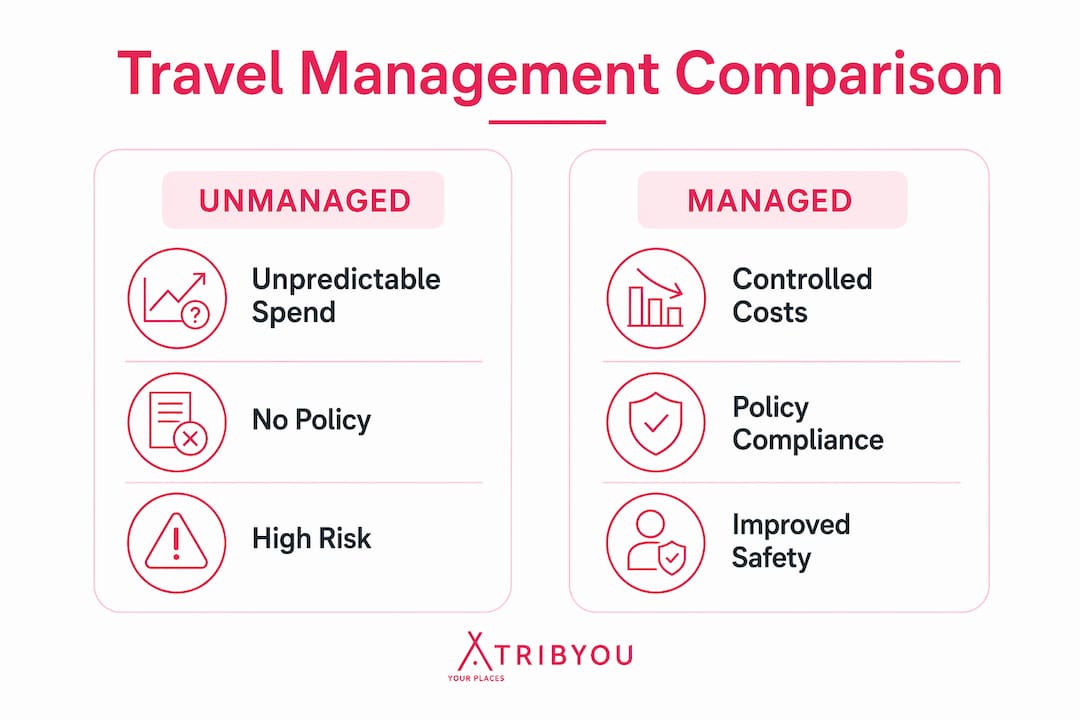
The table below compares unmanaged and managed travel across the dimensions that matter most to finance and operations leaders.
| Dimension | Unmanaged travel | Managed travel program |
|---|---|---|
| Booking behavior | Employees use personal cards and consumer platforms | Centralized booking through approved channels |
| Policy enforcement | Reactive, after expense submission | Automated flags or blocks at point of booking |
| Vendor rates | Retail pricing, no leverage | Negotiated rates with preferred suppliers |
| Spend visibility | Fragmented, delayed reporting | Real-time dashboards by team and category |
| Compliance auditing | Manual, inconsistent | Automated audit trails and exception reports |
| Risk exposure | Unknown traveler locations | Tracked itineraries with emergency protocols |
Preferred supplier agreements are one of the highest-return levers in corporate travel solutions. When your company commits volume to specific hotel chains, airlines, or ground transport providers, you unlock rates and service levels that no individual traveler can access independently. The savings compound across hundreds of trips per year.
Automated policy enforcement during booking is equally powerful. Clear policies and approval workflows prevent off-policy spend before it occurs, rather than catching it during expense review. That shift from reactive to proactive control is where most of the compliance gains are made.
Pro Tip: Run a quarterly spend analysis segmented by department and trip purpose. You will almost always find one category, typically ground transport or last-minute hotel bookings, where a targeted policy change delivers outsized savings.
What is the role of technology and travel partners in corporate travel management?
Technology and service partners are the infrastructure layer that makes corporate travel management scalable. Without them, even the best-designed policy becomes a manual, labor-intensive process.
Travel management companies, or TMCs, provide centralized booking services, handle disruptions, negotiate supplier contracts, and deliver consolidated reporting. Amex Global Business Travel is one of the largest TMCs globally, offering vendor platforms that integrate travel and spend data to support compliance and reporting from a single source. For companies with high travel volumes or complex international programs, a TMC relationship is often the most efficient path to program maturity.
Technology platforms extend that capability further. TravelPerk, for example, offers an integrated platform approach that unifies booking, expense management, risk tracking, and reporting, reducing manual effort and eliminating the blind spots that come from disconnected systems. drvn specializes in ground transportation management, adding a layer of control that many programs overlook entirely.
The practical benefits of integrated technology in how to manage business travel include:
- Single data source for finance and security. Trip itineraries, expense data, and risk tracking feed into one system, so finance and HR are working from the same information.
- Real-time traveler location tracking. Knowing where your employees are during a disruption or security event is not optional. It is a duty of care requirement.
- Automated policy enforcement at booking. The platform flags or blocks non-compliant bookings before they are confirmed, removing the need for manual review.
- 24/7 traveler support. Integrated platforms connect travelers to support agents who have full itinerary context, enabling faster resolution of changes and emergencies.
The benefits of travel management technology are most visible when something goes wrong. A flight cancellation that affects 20 employees simultaneously is manageable with an integrated platform. Without one, it becomes a coordination crisis across multiple departments.
How does corporate travel management support duty of care and traveler safety?
Duty of care is a legal and ethical responsibility that requires companies to protect the health, safety, and security of employees while they travel for work. It is not satisfied by a travel policy document alone. Effective duty of care requires ongoing preparedness and an organizational culture that prioritizes traveler safety at every level.
The operational steps that make duty of care real in a CTM program follow a clear sequence:
- Risk assessment before travel. Evaluate destination-specific risks including political stability, health advisories, and natural disaster exposure before approving trips.
- Traveler tracking and itinerary monitoring. Know where your employees are at all times during travel. Platforms that consolidate booking data make this possible without manual check-ins.
- Real-time alerts and communication. Push notifications to travelers and travel managers when conditions change at a destination. Speed of communication directly affects safety outcomes.
- Documented emergency response protocols. Define who does what when a crisis occurs. This means cross-functional coordination across HR, Security, Legal, and the Travel team.
- Post-incident review and program updates. Every incident is a data point. Programs that learn from disruptions build progressively stronger safety frameworks.
"Duty of care obligations extend beyond static policies to include real-time risk controls and organizational culture fostering traveler safety." — Safe Harbors
The ISO 31030 travel risk management standard provides a recognized framework for structuring these obligations. Companies that align their CTM programs with ISO 31030 demonstrate a level of rigor that satisfies both legal requirements and employee expectations. Training and communication are equally critical. A policy that employees do not understand or trust will not be followed, regardless of how well it is written. The traveler experience dimension of duty of care is often underestimated by finance-focused program managers.
Key takeaways
Effective corporate travel management requires policy, technology, and duty of care to work as an integrated system, not as separate functions.
| Point | Details |
|---|---|
| CTM is a governance function | Corporate travel management covers policy, approvals, compliance, and safety, not just booking logistics. |
| Managed programs reduce cost | Preferred supplier agreements and automated policy enforcement prevent off-policy spend before it occurs. |
| Technology is the enabler | Integrated platforms like TravelPerk unify booking, expense, and risk data into a single operational view. |
| Duty of care is legally required | Companies must track travelers, plan for emergencies, and build a safety culture beyond written policy. |
| Alignment with company goals | The strongest programs connect travel decisions to organizational objectives, not only to budget targets. |
Why most corporate travel programs underdeliver, and what to do about it
I have worked with dozens of companies across Europe and North America on their corporate travel programs. The pattern I see most often is not a technology problem or a budget problem. It is a governance problem. Travel programs are designed by finance, managed by an office administrator, and ignored by the business units that generate most of the spend.
The result is a policy that exists on paper and a reality that looks nothing like it. Employees book outside the system because the approved tools are clunky or the approval process takes too long. Finance loses visibility. The travel manager spends their time chasing receipts instead of analyzing data.
What actually works is treating corporate travel planning as a cross-functional program with real executive sponsorship. When the CFO and the Head of HR both care about the travel program, compliance rates go up and traveler satisfaction improves simultaneously. Those two outcomes are not in conflict. They reinforce each other.
The other shift I advocate for is moving beyond cost as the primary success metric. Cost matters, but so does the quality of the traveler experience. A team that returns from a well-organized trip to a curated destination, with logistics handled and local experiences built in, performs differently than one that spent three days navigating a disorganized itinerary. Aligning corporate travel with company culture is not a soft idea. It is a measurable driver of retention and engagement.
The companies getting this right in 2026 are the ones that have stopped treating travel as a cost center and started treating it as a strategic investment in their people.
— Luca
How TribYou - Your Places supports your corporate travel goals
TribYou - Your Places is built for companies that want more from their corporate travel programs than compliance and cost control. From corporate retreats and workations to incentive travel and team-building experiences across Italy and beyond, TribYou - Your Places curates every detail with a focus on authentic local connection and professional productivity.
The platform connects your team with verified hosts, experience providers, and local partners who understand the needs of corporate travelers. Every itinerary is designed to support both your travel policy requirements and your people's wellbeing. Whether you are planning a leadership offsite in Tuscany or a workation program for a distributed team, TribYou - Your Places delivers the structure your travel manager needs and the experience your team will remember.
Discover how TribYou - Your Places can support your next corporate travel program at tribyou.life.
FAQ
What is corporate travel management in simple terms?
Corporate travel management is the process companies use to plan, control, and monitor all business travel, covering booking, policy compliance, expense tracking, and traveler safety. It turns ad-hoc employee trips into a structured, measurable program.
What are the main benefits of travel management for companies?
The primary benefits include reduced travel costs through negotiated supplier rates, better policy compliance through automated booking controls, and improved traveler safety through duty of care protocols and real-time tracking.
How does a travel management company differ from a booking platform?
A travel management company provides full-service support including policy enforcement, disruption handling, supplier negotiations, and consolidated reporting, while a booking platform primarily facilitates reservations. Many modern solutions, like TravelPerk and Amex Global Business Travel, combine both functions.
What is duty of care in corporate travel management?
Duty of care is the legal and ethical obligation for companies to protect employees during business travel, requiring risk assessment, traveler tracking, emergency response planning, and cross-functional coordination across HR, Security, and Legal teams.
How do you start building a corporate travel management program?
Start by documenting a clear travel policy that defines approved vendors, booking channels, and expense limits. Then select a technology platform or TMC to centralize bookings and reporting, and assign clear ownership of the program to a specific team or individual.