

Employee travel experience is defined as the holistic quality of support, conditions, and care employees receive throughout every stage of a business trip, from booking to return. 84.5% of employees report that travel satisfaction directly influences their overall job satisfaction. That single figure reframes corporate travel from a cost line into a people strategy decision. For HR professionals and corporate leaders, understanding why employee travel experience matters is the starting point for building programs that retain talent, protect productivity, and deliver measurable business results.
Why employee travel experience matters for productivity and results
Employee travel experience shapes cognitive performance, decision quality, and meeting effectiveness in ways that rarely appear on a travel expense report. When employees arrive fatigued, underprepared, or stressed from a disruptive journey, their capacity to contribute drops before the first agenda item is discussed. Brett Copeland, a recognized voice in corporate travel wellness, frames this directly: traveler wellness is a strategic productivity advantage that improves decision quality and meeting contributions when employees arrive rested and mentally sharp.

The data on traveler preferences confirms this. 39.8% of business travelers prefer arriving the day before important meetings to protect their readiness. An equal share, 39.2%, prioritize traveling at preferred times over booking the lowest-cost option. These preferences are not comfort requests. They are performance signals that tell HR leaders exactly where travel policy is undermining the investment made in sending employees on the road.
Travel disruptions compound the problem. Disruptions cause stress that reduces focus and generates productivity losses exceeding the visible cost of the trip itself. Human-enabled, fast support during disruptions is the single most effective mitigation. Without it, a delayed flight becomes a lost afternoon, a missed briefing, and a rattled employee walking into a high-stakes meeting.
Key factors that directly affect employee performance during travel include:
- Advance arrival options: Allowing employees to arrive the day before critical meetings protects cognitive readiness.
- Preferred departure times: Forcing early morning or red-eye flights to cut costs trades short-term savings for performance losses.
- Reliable in-flight connectivity: 39.2% of travelers cite dependable WiFi as a core need, not a luxury.
- 24/7 live support access: Real-time human assistance during disruptions prevents stress from compounding into lost productivity.
- Consistent meal and rest routines: Disrupted nutrition and sleep patterns measurably affect focus and decision-making on travel days.
Pro Tip: When building your travel policy, calculate the fully loaded cost of a trip including the employee's hourly value and meeting outcomes. A $150 upgrade that delivers a rested, focused employee to a $50,000 client meeting is not a cost. It is a return.
What role does safety and duty of care play in employee travel experience?
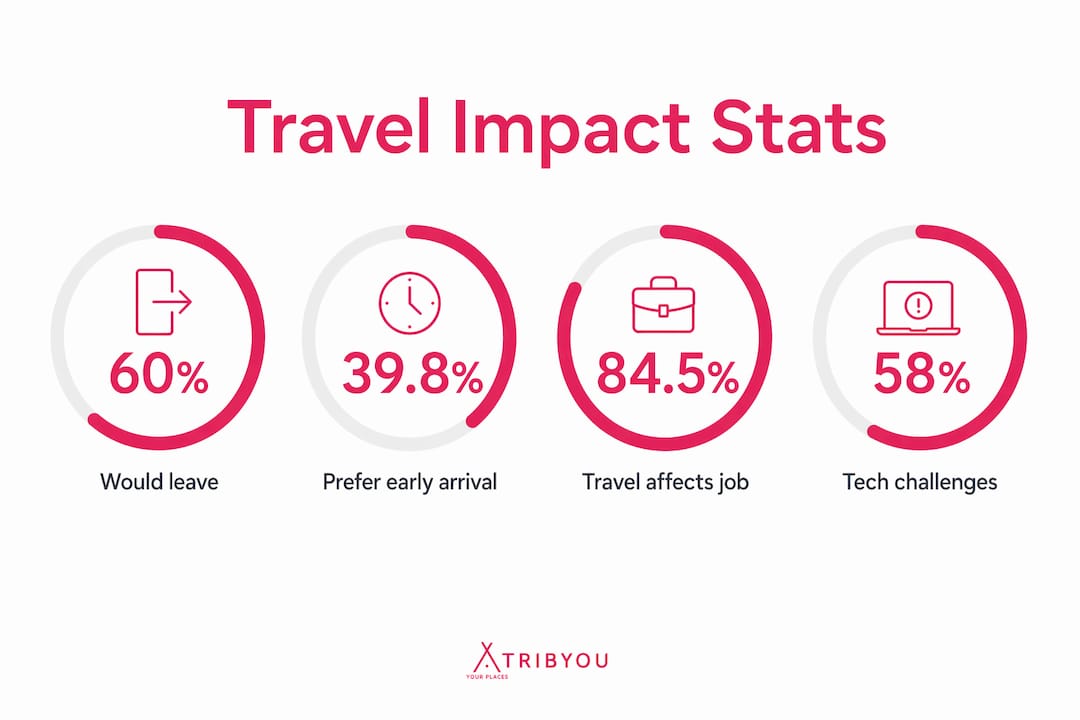
Safety is no longer a back-office insurance matter. It is a talent retention variable. 58% of business travelers believe their employer could do more to protect their safety during travel. More critically, 60% say they would consider leaving their job if safety is not adequately prioritized. Those numbers belong in every HR retention conversation alongside compensation and flexibility data.
Cara Morton, CEO of Zurich's travel insurance division, states this plainly: business travel is a people strategy issue, not just a logistics function. Prioritizing travel safety protects employee well-being and strengthens organizational resilience. That framing shifts the conversation from "what coverage do we have?" to "what experience are we creating for our people when they are most vulnerable?"
"Disruption is the new normal in corporate travel. Companies that treat safety and mental health support as optional extras will pay for it in turnover, not just incident costs." — Cara Morton, Zurich Insurance
Mental health deserves specific attention here. Gen Z travelers report higher rates of travel-related anxiety and burnout than older cohorts, and they represent a growing share of the business travel population. A travel program that ignores mental health support is not just incomplete. It is actively misaligned with the workforce it serves. Corporate travel insurance and proactive assistance programs are now foundational components of a credible duty-of-care policy, not optional add-ons.
How do technology and program design influence travel satisfaction?
Technology is supposed to make corporate travel easier. The reality in 2026 is more complicated. 58% of travel buyers report that AI has had little or no measurable impact on their travel programs. Meanwhile, 61% cite global program management as a persistent challenge. The gap between technology promise and traveler reality is wide, and it costs organizations in compliance, satisfaction, and duty-of-care exposure.
The GBTA research reveals a telling split: travel buyers value technology (54%) and human servicing (46%) almost equally when it comes to delivering a quality traveler experience. That balance matters. Organizations that over-invest in self-service tools while cutting travel advisor access are solving the wrong problem.
| Technology gap | Impact on traveler experience | Recommended fix |
|---|---|---|
| Slow mobile booking flows | Increases out-of-policy bookings | Prioritize mobile UX in platform selection |
| Fragmented data ecosystems | Limits personalization and disruption response | Consolidate to a single managed travel platform |
| Unclear travel policies | Reduces compliance and increases traveler stress | Simplify policy language and surface it at booking |
| Limited AI effectiveness | Fails to reduce friction or improve recommendations | Pair AI tools with live advisor backup |
| Opaque hotel content | Reduces traveler trust and satisfaction | Adopt retail-style hotel booking with full content display |
80% of travelers sometimes book outside their company's approved platform, a direct signal that the managed travel experience is not meeting their needs. When booking friction is high and preferred options are unavailable, employees route around the system. The result is lost visibility, weakened duty of care, and higher costs. Improving booking speed and clarity is one of the highest-return investments a travel program can make.
Pro Tip: Audit your booking platform's mobile completion rate. If more than 20% of employees abandon the booking flow on mobile, your technology is actively driving out-of-policy behavior. Fix the tool before tightening the policy.
What practical strategies improve employee travel experience?
The importance of employee travel as a people investment becomes actionable when HR leaders move from policy documents to program design. The following strategies are grounded in 2026 research and reflect what high-performing travel programs do differently.
-
Build flexibility into policy by default. Allow advance arrival for high-stakes trips, permit preferred departure windows, and authorize comfort upgrades for long-haul routes. These are not perks. They are performance investments with measurable returns.
-
Invest in 24/7 live travel support. Technology cannot replace a human advisor at 11 PM when a connection is missed and the next meeting starts at 8 AM. Live support reduces traveler stress and prevents disruptions from cascading into lost productivity.
-
Simplify your travel policy language. Poor policy clarity is a primary driver of out-of-policy bookings. A policy that employees cannot understand is a policy they will not follow. One page, plain language, and clear approval paths outperform lengthy compliance documents every time.
-
Integrate wellness metrics into travel program KPIs. Measuring traveler happiness alone is insufficient. Connect experience metrics to operational outcomes such as meeting attendance rates, post-trip productivity scores, and incident response times. This is how HR leaders build the finance case for program investment.
-
Create a continuous feedback loop. Survey travelers after every trip with three to five targeted questions. Track trends by route, traveler segment, and trip type. Use that data to refine policy quarterly, not annually.
-
Incorporate bleisure options thoughtfully. Allowing employees to extend business trips for personal time at no additional cost to the company improves satisfaction and signals trust. It also reduces the perception of travel as a burden rather than an opportunity.
-
Align travel with work-life balance priorities. The impact of travel on employees extends beyond the trip itself. Chronic travel fatigue affects home life, mental health, and long-term retention. Programs that account for travel frequency and recovery time demonstrate genuine care for employee well-being.
Pro Tip: Segment your traveler population by frequency and trip type before designing policy. A road warrior flying 80 times a year needs different support than an employee taking two international trips annually. One-size-fits-all policies serve neither group well.
Key takeaways
Employee travel experience is a direct driver of productivity, retention, and organizational resilience, and HR leaders who treat it as a logistics function rather than a people strategy will pay for that gap in turnover and performance.
| Point | Details |
|---|---|
| Travel satisfaction drives retention | 60% of employees would consider leaving if safety is not prioritized during travel. |
| Wellness is a performance variable | Rested, well-supported travelers make better decisions and contribute more in meetings. |
| Technology alone is not enough | 58% of buyers say AI has had little impact; human service remains equally valued. |
| Policy clarity reduces rogue bookings | Simplified, accessible policies improve compliance and protect duty-of-care obligations. |
| Experience metrics justify investment | Linking travel data to operational KPIs builds the finance case for program improvements. |
Why I think most companies are still getting this wrong
I have spent years working with organizations that treat corporate travel as a procurement exercise. The conversation centers on negotiated rates, preferred vendors, and policy compliance percentages. Those metrics matter. But they measure the wrong thing.
The companies that get the most from their travel programs are the ones that ask a different question. Not "how do we reduce travel spend?" but "how do we make sure our people arrive ready to do their best work?" That shift in framing changes everything: the policy design, the technology choices, the support model, and ultimately the outcomes.
What I find consistently underestimated is the compounding effect of poor travel experience on employee engagement. One bad trip does not break a relationship. But a pattern of feeling unsupported, stressed, and undervalued on the road absolutely does. The employees who travel most are often the most commercially critical. Losing them to a competitor with a better corporate wellness program is an entirely avoidable outcome.
The post-pandemic workforce has recalibrated its expectations. Employees now weigh well-being on the road as seriously as they weigh office flexibility. Leaders who recognize this early will build travel programs that attract and retain the people who drive growth. Those who do not will keep optimizing a program that quietly erodes the talent base it depends on.
— Luca
How TribYou - Your Places supports your employee travel program
TribYou - Your Places is built for organizations that understand travel as a people investment, not just a cost center. Whether your team needs a team retreat in Italy, a workation program for remote employees, or a fully curated incentive trip that delivers genuine motivation and loyalty, TribYou - Your Places designs experiences around your people, not around the lowest available rate.
Every program is supported by expert advisors who understand both the operational demands of corporate travel and the human needs of the employees living it. From destination selection to on-the-ground support, TribYou - Your Places combines authentic local experiences with the reliability your duty-of-care obligations require. Discover how TribYou's corporate travel solutions can help your organization turn every business trip into a genuine asset for your team's performance and well-being.
FAQ
Why does employee travel experience affect job satisfaction?
84.5% of employees report that their travel experience directly influences their overall job satisfaction. When employees feel unsupported or stressed during business travel, that sentiment transfers to their broader perception of the employer.
What is duty of care in corporate travel?
Duty of care in corporate travel is the legal and ethical obligation employers have to protect employee health, safety, and well-being during business trips. It covers everything from travel insurance and emergency support to mental health resources and real-time disruption assistance.
How does poor travel policy design increase costs?
Out-of-policy bookings increase when booking tools are slow, policies are unclear, or preferred options are unavailable. These bookings reduce compliance, weaken duty-of-care visibility, and typically cost more than managed alternatives.
What metrics should HR use to measure travel program effectiveness?
Connect traveler satisfaction scores to operational outcomes such as meeting attendance, post-trip productivity, and incident response times. Measuring happiness alone is insufficient; linking experience data to business results is what builds the finance case for program investment.
How does safety affect employee retention in corporate travel?
60% of business travelers say they would consider leaving their employer if travel safety is not adequately prioritized. Safety is now a talent retention variable that belongs in every HR strategy conversation.