

Most corporate travel programs are spending money without a strategy. Trips get approved, budgets get consumed, and no one can clearly explain how a particular flight connected to a company objective. The cost is real: wasted budget, frustrated travelers, and missed business opportunities. To align corporate travel with company goals, you need more than a policy document. You need a deliberate system that ties every trip to a business outcome, keeps employees engaged, and reflects your organization's values. This guide gives you that system, step by step.
Table of Contents
- Key takeaways
- How to align corporate travel with company goals
- Building a travel strategy tied to business outcomes
- Executing the plan with buy-in and smart technology
- Measuring success and refining over time
- My take on travel as a growth lever
- How TribYou - Your Places supports your travel strategy
- FAQ
Key takeaways
| Point | Details |
|---|---|
| Audit before you act | Map your current travel spend, trip purposes, and traveler satisfaction before building any new strategy. |
| Link trips to outcomes | Every travel objective should connect directly to a measurable business result such as sales growth or client retention. |
| Use invisible guardrails | Embedding policy into booking platforms increases compliance without requiring manual enforcement. |
| ESG is non-negotiable | Choosing rail over air on viable routes can deliver up to 80% carbon reduction per journey. |
| Measure and iterate | Track KPIs across cost, traveler satisfaction, and sustainability to refine your program continuously. |
How to align corporate travel with company goals
Alignment starts with honesty. Most organizations treat travel as a transactional cost center rather than a strategic tool. Finance wants to cut spend. HR wants happy employees. Sustainability teams want lower emissions. Travel managers are caught in the middle, trying to satisfy everyone with policies that often satisfy no one.
The fix is not a better spreadsheet. It is a shared framework that defines what travel is supposed to accomplish, for whom, and at what cost. That framework begins with a thorough audit of where you stand today.
Start with a travel program audit
Before you redesign anything, you need to understand what is actually happening. Pull your last 12 months of travel data and answer these questions:
- How much are you spending in total, and on which categories (air, hotel, ground transport, meals)?
- What percentage of trips are client-facing versus internal?
- Which departments travel the most, and why?
- What do traveler satisfaction scores look like, if you are measuring them at all?
- How does your spend compare to industry benchmarks?
| Audit dimension | What to measure | Why it matters |
|---|---|---|
| Spend by category | Air, hotel, rail, meals | Identifies top cost drivers and renegotiation targets |
| Trip purpose | Client, internal, training | Reveals strategic vs. discretionary travel |
| Policy compliance rate | Bookings within policy | Shows where leakage is happening |
| Traveler satisfaction | Post-trip survey scores | Flags friction points affecting retention |
| Carbon emissions | Tons CO2 per trip | Baseline for ESG reporting and reduction targets |
Once the audit is complete, document your company's overarching goals. That means strategic objectives (entering new markets, retaining top accounts), cultural values (flexibility, collaboration), and ESG commitments (net-zero targets, supplier diversity). These are the filters every travel decision should pass through.
Pro Tip: Talk to frequent travelers directly, not just their managers. They know which policies create friction and which ones are simply ignored. That intelligence is worth more than any dashboard.
Building a travel strategy tied to business outcomes
With your audit complete and your company goals documented, you can build a travel strategy that actually connects the two. This is where most programs fall short. They produce a policy instead of a strategy. Policies tell people what they cannot do. Strategies explain why travel matters and how it creates value.
Here is a practical framework for building your integrated corporate travel strategy:
-
Define travel objectives by business function. Sales travel should be measured against pipeline generated or deals closed. HR travel should connect to hiring outcomes or culture initiatives. Each function owns its travel purpose and its results.
-
Set a traveler wellbeing standard. Employee burnout from poor travel conditions is a real cost. Build minimum comfort standards into your policy. Red-eye flights followed by morning presentations are not a productivity strategy. Explore how wellness retreats can complement demanding travel schedules.
-
Embed sustainability into every booking decision. Switching to rail on viable routes can reduce carbon emissions by up to 80%. That is not a marginal improvement. Make it a default option wherever geography allows, and track it.
-
Use AI-powered booking tools. Modern platforms now integrate ESG data, traveler comfort preferences, and cost controls into a single interface. AI-driven travel tools help travel managers make decisions that satisfy finance, HR, and sustainability simultaneously, without requiring three separate approval chains.
-
Balance control with autonomy. Rigid policies breed workarounds. Give travelers a defined range of options within compliant parameters rather than a single approved choice. Autonomy within guardrails drives adoption.
The goal is a strategy that makes doing the right thing the easiest thing. When a traveler opens your booking platform, the best option for the company should also feel like a good option for them.
Pro Tip: Corporate travel planning tips from the field consistently point to one insight: travelers who understand the "why" behind a policy comply far more readily than those who just receive a rule. Build the rationale into the platform, not just the policy document.

Executing the plan with buy-in and smart technology
A strategy no one follows is just a document. Execution is where alignment lives or dies.
Start with your stakeholders. Finance, HR, legal, and executive leadership all have a stake in how travel is managed. Get them into the room before you launch anything. Leadership endorsement is the single most important factor in whether sustainability and cost targets actually get traction. Without it, your program will stall at the department level.
Next, focus on communication. Transparency reduces pushback more effectively than any incentive. When employees understand that a new hotel policy exists because the company negotiated preferred rates with partners who share their values, rather than just to cut costs, the resistance drops significantly.
On the technology side, look for booking platforms with embedded policy guardrails. The principle is simple: configure the system so that non-compliant options are either invisible or flagged automatically. Invisible guardrails shift compliance from a manual enforcement problem to a structural default. Travelers make better choices not because they are policed but because better choices are what they see first.
"Organizations that treat compliance as a design problem rather than a discipline problem consistently outperform those that rely on approval workflows and after-the-fact audits."
For employees who feel constrained by tighter policies, soft-dollar perks offer a proven solution. Priority boarding, lounge access, and seat upgrades cost less than cash bonuses and deliver more perceived value. Soft-dollar benefits avoid tax complications while making compliant travel feel like a reward rather than a restriction.
Finally, build feedback loops into your execution plan. Quarterly pulse surveys, post-trip check-ins, and open channels for traveler feedback give you real-time intelligence. You will spot problems before they become policy failures.
Pro Tip: Roll out policy changes in phases, starting with your highest-volume travel cohort. Their experience becomes your case study. Use it to build trust with the rest of the organization before a full rollout.
Measuring success and refining over time
Alignment is not a one-time achievement. It requires ongoing measurement, honest evaluation, and the willingness to adjust when the data tells you something is not working.
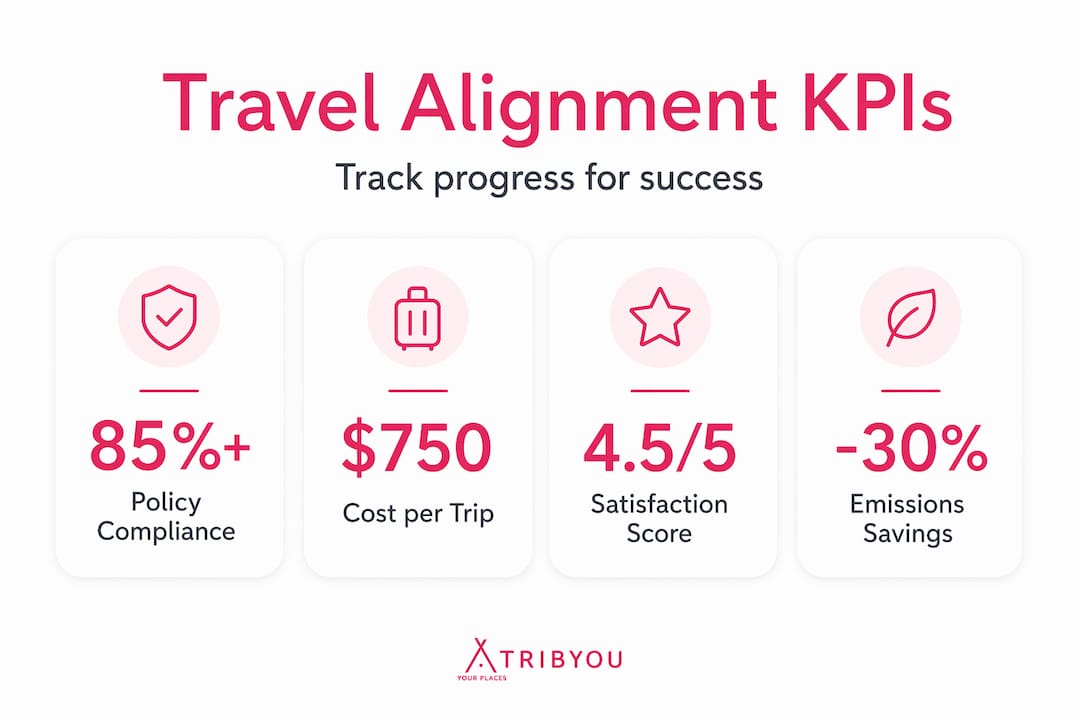
The organizations that manage this well treat travel as an orchestration challenge. They manage cost, compliance, employee satisfaction, and sustainability together as a unified system. According to research on corporate travel orchestration, companies that take this integrated approach outperform peers both financially and in traveler satisfaction.
Here is what a strong measurement framework looks like:
| KPI | Target | Review frequency |
|---|---|---|
| Policy compliance rate | Above 85% | Monthly |
| Cost per trip by category | Within 5% of budget | Monthly |
| Traveler satisfaction score | Above 4.0 out of 5 | Quarterly |
| Carbon emissions per trip | Year-over-year reduction | Quarterly |
| Revenue attributable to client travel | Tracked by deal stage | Quarterly |
Beyond the numbers, share success stories internally. When a sales team closes a major account after a client visit that was planned within policy and on budget, tell that story. Concrete examples of business travel alignment driving real outcomes motivate other teams to take the program seriously.
Benchmark externally too. Companies with well-enforced travel policies consistently spend 20 to 30% less than peers without them. That gap is your argument for continued investment in the program. And for organizations looking to connect offsite experiences with strategic goals, resources like the corporate offsite event guide offer practical frameworks worth reviewing.
My take on travel as a growth lever
I have worked with enough corporate travel programs to know where the real problems hide. They are rarely in the policy itself. They are almost always in the gap between what leadership says the company values and how those values show up in travel decisions.
Here is what I have seen consistently: companies that treat travel alignment as a finance exercise miss the point. They cut costs, tighten approvals, and then wonder why their best people dread traveling for work. The travelers who close deals, build relationships, and represent your brand on the road need to feel supported, not surveilled.
What actually works is treating travel as a signal of company culture. When your travel program reflects your values, whether that means choosing sustainable transport, booking accommodations that support local communities, or giving employees meaningful recovery time between trips, your people notice. Loyalty and performance follow.
The other thing most guides will not tell you: enforce your policies less and design them better. I have seen a single platform configuration change produce higher compliance than six months of email reminders. The managed travel programs that get real results are the ones built around traveler psychology, not just budget math.
Companies with high enforcement and good design report 17 to 30% higher revenues than peers. That is not a coincidence. Strategic travel, done right, creates the conditions for growth.
— Luca
How TribYou - Your Places supports your travel strategy
Building a travel program that genuinely reflects your company's goals takes more than policy work. It takes the right partners and the right experiences. TribYou - Your Places works with corporate teams to design travel that connects business objectives with authentic, meaningful experiences. From incentive trips that reward your top performers to workations that keep distributed teams connected and productive, every experience on the platform is curated for both impact and purpose. TribYou's network of local hosts, retreat providers, and destination partners means your travel budget works harder and lands better. Discover how TribYou can help you build a travel program your employees actually want to be part of.
FAQ
How do I start aligning corporate travel with company goals?
Begin with a full audit of your current travel spend, trip purposes, and traveler satisfaction data. Then map those findings against your documented company objectives to identify gaps between where budget is going and where the business needs to grow.
What KPIs should I track for travel program alignment?
Track policy compliance rate, cost per trip by category, traveler satisfaction scores, carbon emissions per journey, and revenue linked to client-facing travel. Review these on a monthly and quarterly basis to catch drift early.
How can I improve travel policy compliance without strict enforcement?
Configure your booking platform so that compliant options appear first or are the only visible default. This approach, known as invisible guardrails, produces higher compliance with less administrative overhead than manual approval systems.
Does travel alignment help with employee retention?
Yes. Employees who experience well-organized, supportive travel programs report higher job satisfaction. Offering soft-dollar perks like lounge access and priority boarding, along with transparent policies, makes business travel a benefit rather than a burden.
How do I integrate sustainability into corporate travel without major cost increases?
Start by switching to rail on routes where it is viable, which can reduce carbon emissions by up to 80% compared to air travel. Use AI-powered booking tools that display carbon data alongside cost data so travelers can make informed choices at the point of booking.