

Most corporate leaders assume an offsite is either a luxury retreat or a glorified conference. Neither is quite right. A corporate offsite event is a deliberately designed gathering held away from the regular workplace, with the specific goal of strengthening teams, sharpening strategy, or doing both at once. Done well, it is one of the highest-leverage investments your organization can make. Done poorly, it is an expensive day of awkward icebreakers. This guide covers what corporate offsites actually are, why the return toward in-person events is accelerating, and exactly how to plan one that delivers real results.
Table of Contents
- Key Takeaways
- What is a corporate offsite event: definition and types
- The strategic benefits of corporate offsites
- How to plan a corporate offsite effectively
- Activities and venues that drive real engagement
- Measuring success and ROI from offsites
- Why most offsites underdeliver, and what changes that
- Discover curated corporate offsites with TribYou - Your Places
- FAQ
Key Takeaways
| Point | Details |
|---|---|
| Offsites are strategic tools | A corporate offsite is a planned event away from the office designed to align, engage, and develop your team. |
| Connected teams outperform | Teams that connect in person are 21% more profitable and 78% less absent than disconnected ones. |
| Use the 30/40/30 rule | Structure your agenda with 30% structured work, 40% activities, and 30% free time to avoid exhaustion. |
| ROI is measurable | Retaining even one mid-level employee covers the cost of an entire offsite for your team. |
| Venue and culture matter | Hospitality-focused venues with authentic local experiences create stronger post-event memories and engagement. |
What is a corporate offsite event: definition and types
A corporate offsite event is any professionally organized gathering that takes place outside your organization's normal work environment. The location shift is intentional. Removing people from their usual desks, routines, and hierarchies creates psychological distance from day-to-day pressures, which makes deeper thinking and more honest conversation possible.
The corporate retreat definition often overlaps with offsite events, but there are distinctions worth understanding. Here is a breakdown of the main types:
- Strategic planning offsite: Executives and senior managers gather to set direction, review performance, or make high-stakes decisions in a focused environment free from interruption.
- Team-building offsite: Groups participate in structured activities designed to build trust, improve communication, and strengthen working relationships across departments or levels.
- Workshop or training offsite: Skill development sessions, leadership programs, or creative workshops that benefit from an immersive setting rather than a standard conference room.
- Hybrid offsite: A combination of structured work sessions in the morning and experiential activities in the afternoon. This format is the most common for mid-sized companies.
- Incentive retreat: A reward-based offsite offered to high performers, often in a premium destination, to recognize achievement and reinforce loyalty.
What happens at corporate offsites depends entirely on the design. A boutique hotel in the countryside, a castle conference venue, or a mountain lodge each creates a distinct atmosphere that shapes how people interact. The setting is not a backdrop. It is part of the program.
Pro Tip: Avoid booking a generic business hotel for your offsite. A hospitality-focused venue — like a castle or estate setting — changes the group's energy from the first hour and makes the event itself more memorable.
The strategic benefits of corporate offsites
Many HR leaders still treat offsites as a morale perk rather than a business strategy. The data tells a different story.
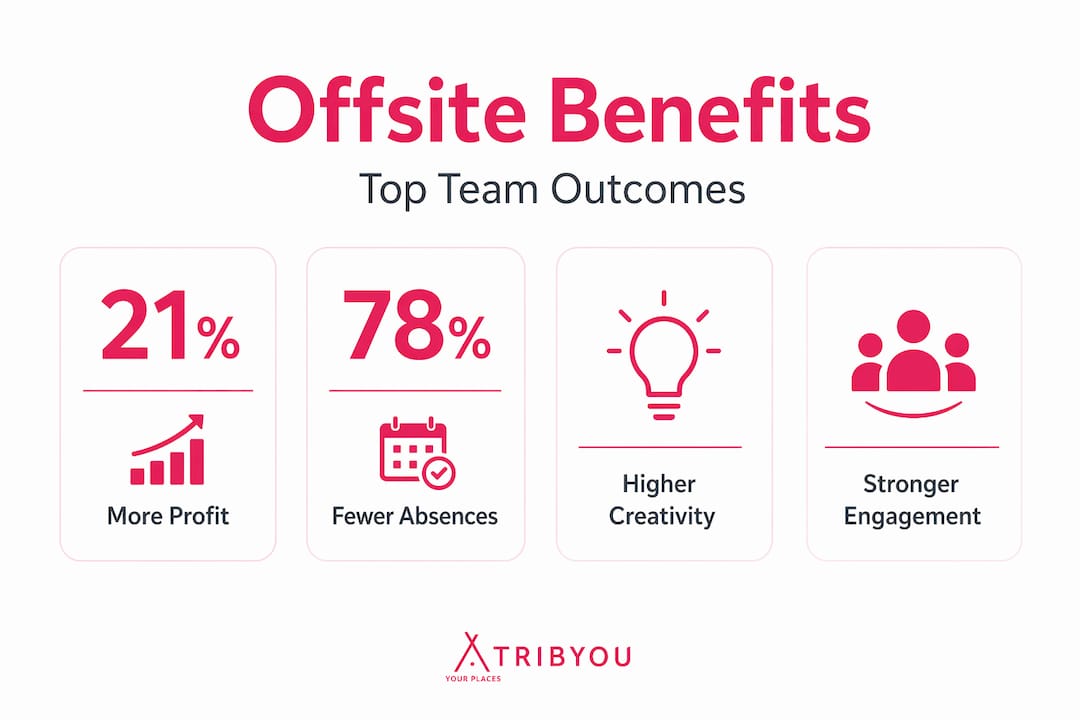
Connected teams are 21% more profitable and 78% less absent than teams that lack genuine interpersonal connection. That is not a soft metric. That is a direct impact on your bottom line, and it makes the purpose of offsite events far more concrete than "team bonding."
| Benefit | What it means in practice |
|---|---|
| Stronger social capital | Informal conversations at offsites build the trust that makes daily collaboration faster and less friction-prone. |
| Retention improvement | Replacing a mid-level employee costs between 50% and 200% of their annual salary. A $3,500-per-person offsite that retains one person pays for itself. |
| Strategic alignment | Face-to-face sessions surface misalignments that email chains and video calls rarely resolve. |
| Cultural reinforcement | Shared experiences outside the office build organizational identity in ways that onboarding documents cannot. |
| Creative breakthroughs | New environments genuinely stimulate new thinking. Physical novelty disrupts habitual thought patterns. |
For distributed and remote teams, the value is even more acute. 91% of offsite organizers now include distributed team members in their events, because offsites have become the primary infrastructure for building the trust that used to form naturally in shared offices.
"Leaders are shifting budgets to prioritize deep, focused human interaction over digital volume, using offsites as strategic business levers rather than calendar events."
The benefits of corporate offsites also include a creativity dividend that is difficult to manufacture in normal work settings. When people are genuinely relaxed and socially connected, they share ideas they would normally self-censor. That is where strategic breakthroughs actually come from.
How to plan a corporate offsite effectively
Planning a successful offsite requires more than booking a venue and sending a calendar invite. The most common failure mode is treating the offsite like a standard meeting, just in a nicer room.
Here is a practical framework for planning a corporate offsite that delivers:
- Define your objectives first. Before you think about venues or budgets, write down two or three specific outcomes you want from the event. "Better team cohesion" is not an objective. "Agree on Q3 priorities and build cross-functional relationships between product and sales" is.
- Apply the 30/40/30 agenda rule. The 30/40/30 formula divides your event into 30% structured work sessions, 40% facilitated activities, and 30% unstructured free time. Overscheduling is the most common mistake, and it turns what should feel energizing into something that feels like work with worse chairs.
- Choose the right duration. A 3-day, 2-night offsite is considered the ideal format. It allows enough time for travel, meaningful work, activities, and a sense of closure without pushing into diminishing returns on culture or ballooning costs.
- Budget with intention. A practical budget rule allocates roughly 25% each to accommodation, transportation, food, and activities, with a separate line for branded swag. Most companies run about 2.8 offsites per year, and 59% have increased their offsite budgets since 2019.
- Select a venue for experience, not just logistics. The venue should serve your outcomes. A creative workshop needs a different environment than a leadership alignment session.
- Plan for follow-up before you leave. Post-event momentum fades fast. Assign owners to decisions made, schedule a 48-hour check-in, and distribute a recap within days, not weeks.
Pro Tip: Build a one-page "offsite brief" before you finalize anything. It should state your objectives, the agenda structure, key roles, and success criteria. Share it with attendees in advance so everyone arrives with context, not questions.
Activities and venues that drive real engagement
The activities you choose shape whether your team remembers the offsite six months later or forgets it in six days. Generic icebreakers and trust falls are not the answer. Specific, well-matched experiences are.
Mixing work with authentic cultural experiences significantly enhances engagement and creates lasting shared memories. Here are the types of offsite team building activities that consistently deliver:
- Escape rooms and problem-solving challenges: These reveal how teams communicate under pressure in a low-stakes, high-energy format.
- Local cultural experiences: Cooking classes with local chefs, guided historical tours, or artisan workshops connect the team to the destination and add genuine novelty.
- Outdoor activities: Hiking, kayaking, or cycling in a scenic location creates informal conversation opportunities that structured sessions cannot replicate.
- Creative workshops: Photography, storytelling, or design sprints activate different cognitive modes and often surface unexpected talent within the team.
- Evening social events: Shared dinners, wine tastings, or live local entertainment provide the unstructured social time that builds real relationships.
When comparing venue types, the difference in engagement outcomes is notable:
| Venue type | Best for | Engagement level |
|---|---|---|
| Standard business hotel | Budget-conscious, urban teams | Moderate |
| Boutique country retreat | Deep-focus strategy sessions | High |
| Castle or heritage estate | Premium incentive events, executive offsites | Very high |
| Adventure or wellness lodge | Team-building, creative offsites | High |
| Unique local destination | Cultural immersion, hybrid events | Very high |
Exclusive hospitality venues in distinct settings consistently outperform generic conference hotels on post-event satisfaction scores. The environment tells your team that the investment in them was real, not perfunctory.
Measuring success and ROI from offsites
Planning a great offsite is only half the work. Measuring its impact ensures you improve each one and defend the investment to leadership.
Track these key indicators before and after each event:
- Employee engagement scores: Use a brief pre/post survey to measure shifts in belonging, motivation, and team trust.
- Retention rates: Monitor turnover in the six months following an offsite compared to baseline periods.
- Productivity metrics: Output quality and cross-team collaboration frequency often measurably improve after well-designed offsites.
- Qualitative feedback: Ask specific questions like "What decision from this offsite will most affect your work next month?" Generic satisfaction surveys miss the signal.
- Decision implementation rate: Track how many commitments made at the offsite are actually acted on within 30 days.
Post-event communication sustains the gains. Visible small wins and progress updates shared in the days after an offsite prevent the event from feeling like a pleasant but ultimately irrelevant interruption. Branded swag, when strategically designed, also plays a role. Swag is more than a souvenir. When distributed at the right moment and tied to the event's theme, it reinforces culture and sustains the emotional connection to the experience.
The offsite event planning guide principle that most companies underuse is this: align every offsite goal explicitly with a broader HR or business strategy initiative. When the offsite feeds directly into your annual people plan, its ROI becomes legible to every stakeholder.
Why most offsites underdeliver, and what changes that
I have worked with dozens of teams on retreat and offsite design, and the pattern I see most often is this: the logistics are immaculate, and the design is an afterthought.
Companies spend weeks comparing venues and negotiating catering contracts, then spend about two hours building the actual agenda. The result is a well-catered meeting that could have been an email. The location does not save it.
What I have learned is that intentional design at three levels transforms an offsite. First, the physical setting must create genuine psychological separation from the office. That means no office-style room layouts, no fluorescent lighting, and no catering that feels like a corporate cafeteria. Second, the agenda must include real whitespace. Not "free time" as a guilty afterthought at 9 p.m., but structured unstructured time where people can walk, talk, and process without a facilitator managing the conversation. That is where the actual breakthroughs happen.
Third, and most importantly, the experience needs to connect to something real and local. I have seen teams completely transform their energy the moment they step into an authentic environment, a local farm dinner, a historic building, a guided walk through a place with actual meaning. Generic venues produce generic conversations. Authentic places produce authentic connection.
My honest take: treat your annual offsite as infrastructure, not a reward. The teams I have seen thrive, especially remote and hybrid teams, are the ones whose leaders treat one or two quality offsites per year as non-negotiable. Not a luxury. Not a nice-to-have. Infrastructure.
— Luca
Discover curated corporate offsites with TribYou - Your Places
Your team deserves an offsite that goes beyond a blocked-out calendar and a rented conference room. TribYou - Your Places is a digital travel ecosystem built specifically to connect companies with authentic destinations, curated hospitality experiences, and local partners that make every offsite genuinely memorable.
From boutique countryside retreats to culturally immersive team experiences in Italy and beyond, TribYou - Your Places combines expert planning support with a trusted network of hosts and experience providers. Whether you are designing your first leadership offsite or scaling a recurring team retreat program, the platform gives you access to venues and experiences that are matched to your objectives, not just your budget. Your team's best offsite is not a matter of luck. It starts with the right place.
FAQ
What is the difference between an offsite and a company retreat?
An offsite is any event held away from the usual workplace, including strategic meetings, workshops, or team days. A company retreat is typically a subset of offsites focused more specifically on team renewal, culture, and wellbeing.
How long should a corporate offsite be?
A 3-day, 2-night format is widely considered the optimal length, providing enough time for meaningful work, team activities, and a sense of closure without excessive cost or diminishing engagement.
How much does a corporate offsite cost per person?
Costs vary significantly by location and format, but a practical budget allocates roughly 25% each to accommodation, transportation, food, and activities. A well-designed offsite typically ranges from $1,500 to $5,000 per person.
How do you measure the ROI of a corporate offsite?
Track engagement scores, retention rates, decision implementation within 30 days, and productivity metrics before and after the event. Qualitative feedback on specific decisions and team trust is equally important.
How often should companies hold offsites?
Most companies run approximately 2.8 offsites per year. For remote and hybrid teams, at least one full team offsite annually is considered the minimum to sustain the trust and connection that daily in-person interaction previously provided.