
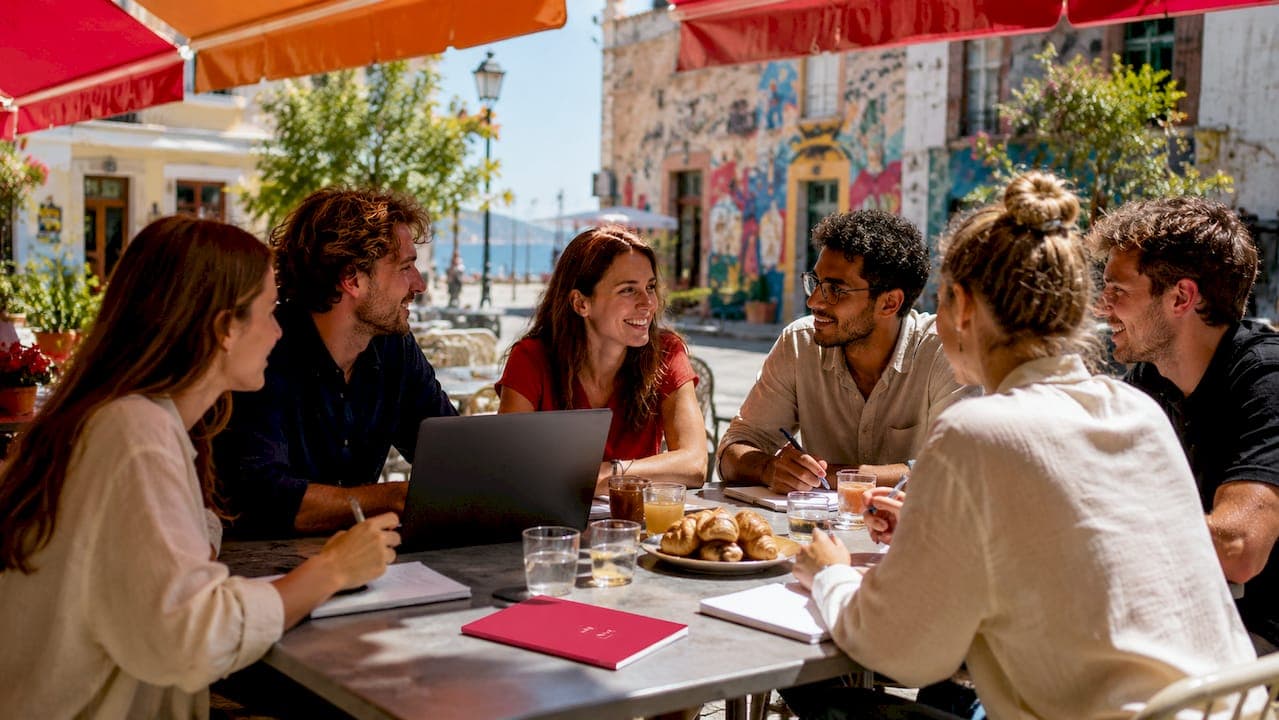
Team values are developed offsite by identifying real behavioral patterns, not by writing aspirational words on a whiteboard. The offsite retreat, known in organizational development as a values alignment retreat, gives teams the compressed time and psychological distance from daily operations needed to surface what they actually believe. High-performing companies run an average of 2.8 offsites annually, linked to 21% higher profitability and 78% less absenteeism in connected teams. That data makes one thing clear: the offsite is not a perk. It is a performance tool. This guide shows team leaders and HR professionals exactly how to use it to build values that stick.
How team values are developed offsite: the core method
The most common mistake in offsite value work is treating it as a brainstorming session. Values are discovered by analyzing behavior under pressure, not by generating abstract ideals in a group setting. The right question is not "What do we want to stand for?" It is "What did we actually do when things got hard?"
This approach is called decision archaeology. A facilitator asks team members to nominate moments of excellence: a time someone made a difficult call, a project that succeeded against the odds, or a conflict that was resolved well. Those stories contain the real values. The team's job is to name the pattern, not invent one.

Leadership behavior is the primary culture signal in any organization. Founders and senior leaders must participate visibly in value discovery, not just endorse the output. When a CEO shares a story about a hard decision they made, it gives the whole team permission to be honest about their own.
Why offsites create the right conditions for value discovery
The offsite environment does something the office cannot: it removes the daily hierarchy and replaces it with shared context. When a team is away from their desks, inboxes, and meeting calendars, the conversations that matter finally have room to happen.
Three conditions make offsites uniquely effective for developing values in teams:
- Compressed focus. Two or three days of uninterrupted time produce more alignment than months of one-hour check-ins. The offsite forces decisions that would otherwise be deferred.
- Reduced status signals. Shared meals, casual settings, and physical distance from the office flatten hierarchy. People speak more honestly when they are not sitting in the same conference room they use for performance reviews.
- Behavioral observation. Leaders can watch how their team actually interacts under low-stakes conditions. Those patterns reveal the values already operating in the culture.
Successful offsites also create space for hard conversations that cannot happen on a video call. That is not a side benefit. It is the primary mechanism through which alignment is built.
Pro Tip: Schedule the most sensitive value conversations for the morning of day two. By then, the team has eaten together, slept in the same location, and shed most of their professional armor.
How to discover genuine values using behavioral examples
The structured process for value discovery at an offsite follows four steps. Each one builds on the last.
- Collect nominations before the retreat. Ask every team member to submit one story: a moment when someone on the team did something that made them proud to work there. Collect these anonymously and sort them by theme before the event begins.
- Run a "best of us" session. On day one, read the stories aloud without attribution. Ask the group to identify what made each moment exceptional. Write the patterns on a shared board, not the values themselves, but the behaviors behind them.
- Test against failure cases. For each pattern identified, ask: "Has this ever cost us something?" A team that values speed will have stories of moving too fast. Naming that tension makes the value real and honest, not just aspirational.
- Write behavioral rules, not words. The output of this session should not be a list of nouns like "integrity" or "excellence." It should be sentences: "We say the hard thing early, even when it is uncomfortable." "We finish what we commit to, and we speak up before we miss a deadline."
The difference between a values list that changes behavior and one that collects dust is specificity. "Integrity" means nothing. "We tell the client the truth before we tell them what they want to hear" means everything. Behavioral rules give people a script for the moment when values are actually tested.
This method works because it grounds the output in real experience. Operational behavioral rules rooted in real scenarios change how people make decisions. Abstract words do not.
What does an effective offsite agenda look like?
Agenda design is where most offsites fail. Teams either pack every hour with structured sessions and exhaust everyone, or they leave too much unstructured time and lose momentum. The research points to a clear formula.
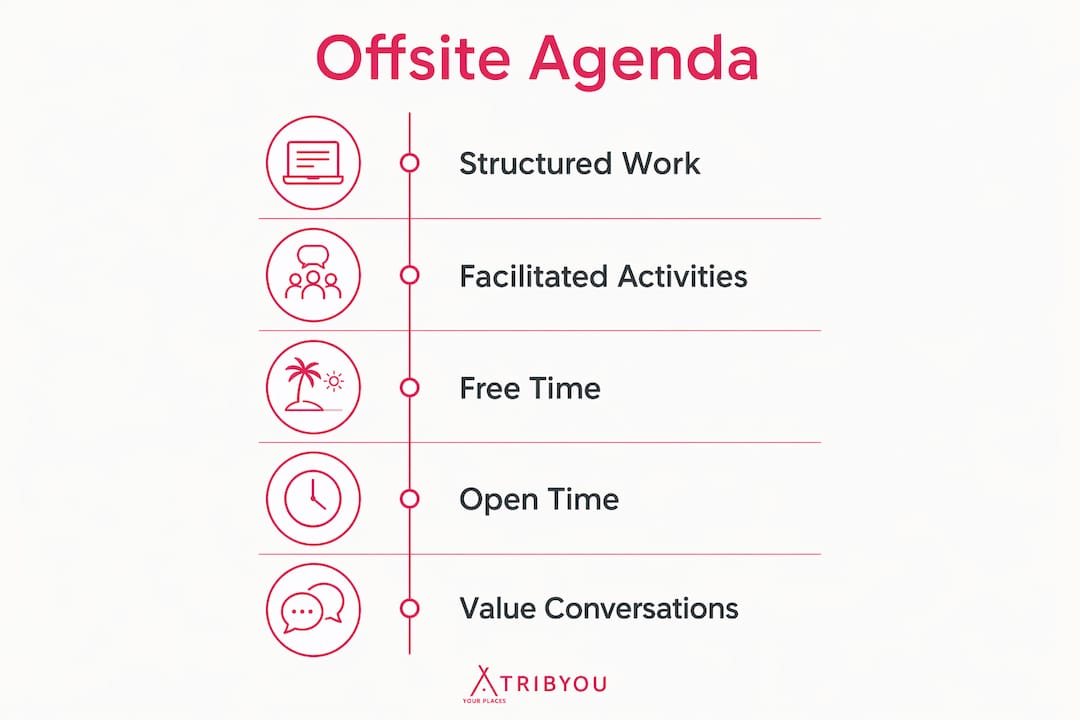
The recommended agenda mix is 30% structured work, 40% facilitated activities, and 30% free time. Work sessions end by 4:00 PM to align with natural energy patterns. Evenings are reserved for shared meals and informal connection.
| Time block | Purpose | Format |
|---|---|---|
| Morning (9 AM–12 PM) | Structured work and value sessions | Facilitated workshops |
| Afternoon (1 PM–4 PM) | Team activities and behavioral exercises | Group activities |
| Evening (6 PM onward) | Free time and shared meals | Unstructured |
Forced fun alienates employees and undermines the psychological safety that value work requires. Activities should be varied and optional where possible. The data supports this directly: 85% of employees prefer free time during offsites, and 89% want activities to be optional. That preference is not laziness. It reflects the fact that genuine connection happens in unscripted moments, not choreographed ones.
For teams with diverse personality types, offering both active and quiet options during activity blocks is the right call. A Lisbon sailing experience or a local food tour gives extroverts the energy they need, while quieter team members can engage at their own pace without feeling excluded.
Pro Tip: Build one completely unscheduled two-hour block into every offsite day. Call it "open time" on the agenda. The conversations that happen in that window are often the most valuable of the entire retreat.
Ensuring lasting impact: making values operational after the offsite
The value of an offsite is measured by what happens in the week after it ends, not by how good the retreat felt. Documented decisions with named owners are the single clearest indicator of a high-return offsite. If the team leaves without a written record of what was decided and who is responsible, the values will fade within two weeks.
Operationalizing values requires four concrete actions:
- Document the behavioral rules immediately. Within 24 hours of the retreat, send every participant a written summary of the values statements agreed upon, with the stories that generated them.
- Assign a values owner for each rule. One person is responsible for modeling and tracking each behavioral value. This is not a committee. It is one named individual.
- Embed values into weekly rhythms. Weekly team rituals that reference the values, such as a standing agenda item where someone shares a values-in-action example, keep them visible and alive.
- Use values in performance conversations. When a manager gives feedback, they reference the behavioral rules, not abstract character traits. "You said the hard thing early in that client call" is more useful than "You showed integrity."
Defining 2–4 concrete outputs before the event is the clearest predictor of offsite ROI. Teams that arrive with defined deliverables leave with real decisions. Teams that arrive with a general agenda leave with good memories and little else.
The benefits of offsite retreats compound over time when values are embedded into daily operations. A single retreat plants the seed. The weekly rhythms are what make it grow.
Key Takeaways
Offsite retreats build lasting team values only when behavioral discovery, intentional agenda design, and structured follow-through work together as a system.
| Point | Details |
|---|---|
| Behavior over brainstorming | Discover values by analyzing real decisions under pressure, not by generating abstract ideals. |
| Agenda balance matters | Use a 30% work, 40% activities, 30% free time formula to maintain energy and genuine connection. |
| Leadership must model values | Founders and senior leaders signal culture through their own visible behavior, not just endorsement. |
| Follow-through determines ROI | Document decisions, assign owners, and embed values into weekly rhythms within 24 hours of the retreat. |
| Optional beats mandatory | 89% of employees prefer optional activities; psychological safety requires choice, not obligation. |
What I've learned from watching offsites succeed and fail
I have seen teams spend three days in a beautiful location and come home with a laminated poster of five words that nobody ever references again. I have also seen a single afternoon of honest storytelling change how a leadership team makes decisions for years. The difference is almost never the venue. It is whether the leaders in the room were willing to go first.
The most common offsite failure I observe is treating the retreat as a morale event with a values session bolted on. When the CEO spends the morning in a strategy session and then joins the values workshop for 45 minutes before leaving for a call, the message to the team is clear: this is not real. The values work dies before it starts.
What actually works is when a founder or senior leader shares a story of a decision they got wrong and names the value they violated. That moment of honesty gives everyone else permission to be specific and truthful. Generic values lists are a symptom of leaders who were not willing to be that honest in the room.
The offsite team building strategies that produce real culture change are the ones where leadership shows up fully, not just symbolically. If you are planning a values retreat, the first question to ask is not "What activities should we book?" It is "Is our leadership team ready to be honest in front of the whole group?" If the answer is no, fix that first.
— Luca
TribYou - Your Places: retreats designed for real team work
Building authentic team values requires the right environment, not just the right agenda. TribYou - Your Places designs corporate team retreats that give teams the space, structure, and local authenticity needed to do meaningful work together.
From curated venues in Italy to facilitated experiences that balance structured sessions with genuine connection, TribYou - Your Places builds offsite programs around real outcomes, not just good vibes. Every retreat is tailored to the team's size, goals, and culture stage. Whether your team needs a first values alignment session or a deeper culture reset, TribYou - Your Places connects you with the right place and the right program to make it count. Reach out to start planning your next offsite with purpose.
FAQ
How are team values developed during an offsite retreat?
Team values are developed offsite by identifying real behavioral patterns through structured storytelling and decision analysis, not abstract brainstorming. Facilitators use techniques like decision archaeology to surface the behaviors that already define the team's culture.
How long should a team values offsite be?
A two to three day offsite gives teams enough time for deep value discovery, behavioral exercises, and genuine informal connection. Shorter events rarely produce the psychological safety needed for honest conversation.
What is the best agenda format for a values offsite?
The most effective agenda allocates 30% to structured work, 40% to facilitated activities, and 30% to free time, with work sessions ending by 4:00 PM. This balance maintains energy and creates the unscripted moments where real alignment happens.
How do you make sure offsite values last after the retreat?
Document all behavioral rules and assign a named owner to each value within 24 hours of the retreat. Embed the values into weekly team rituals and performance conversations so they remain visible and operational.
Why do offsites work better than in-office sessions for value development?
Offsites remove daily hierarchy, reduce distractions, and create compressed time for honest conversation. Research links regular offsites to 21% higher profitability and 78% less absenteeism, reflecting the deeper alignment they produce.