
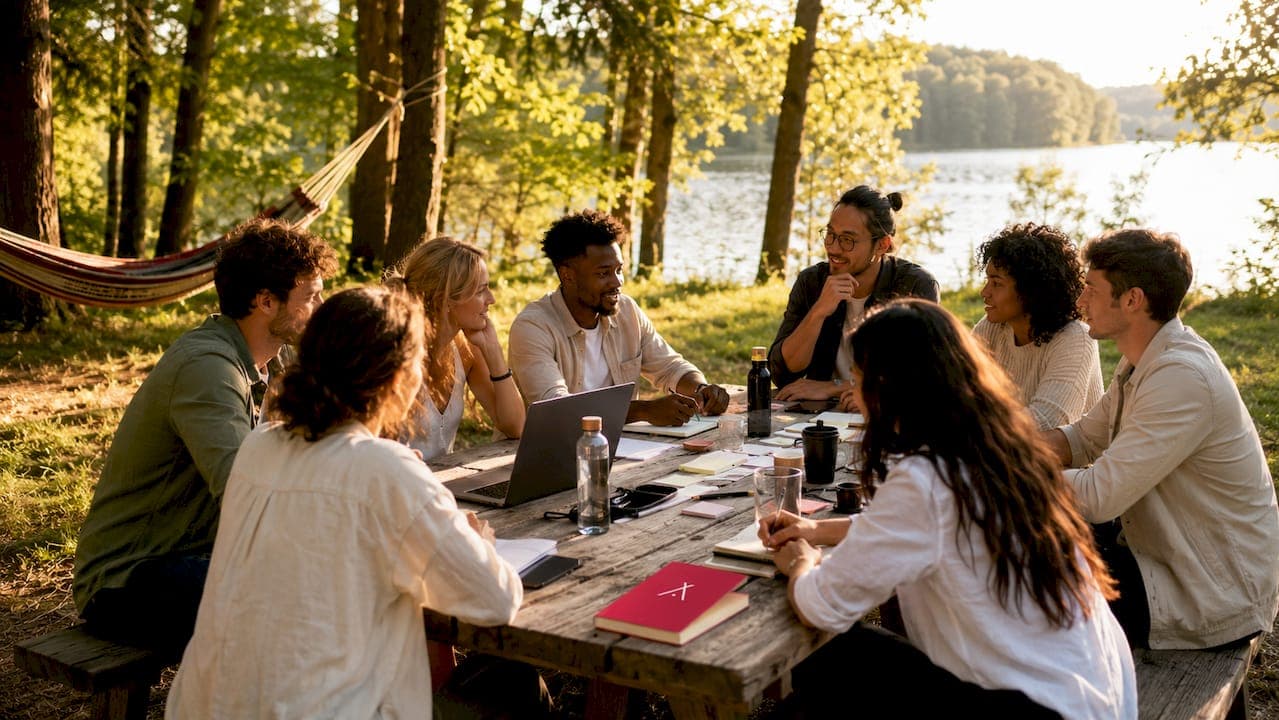
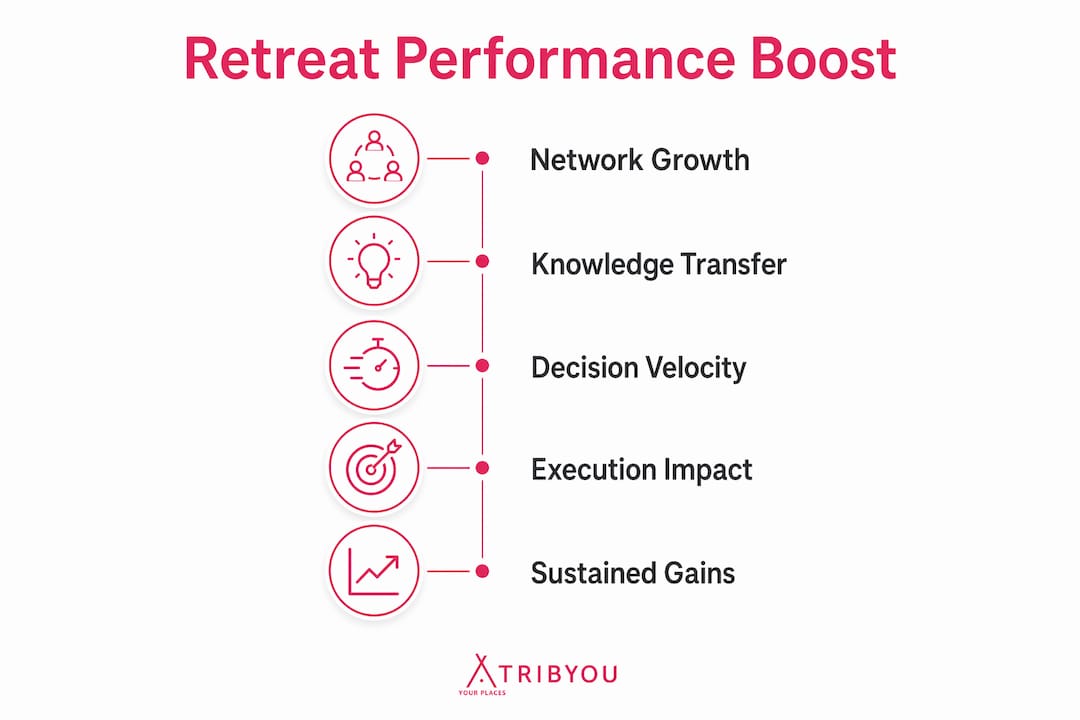
Team retreats are structured offsites designed to accelerate collaboration, decision-making, and trust in ways that daily work routines cannot replicate. Research from Babson College and Harvard Business Review confirms that well-designed retreats produce measurable, lasting performance gains. The mechanisms behind why team retreats increase performance go beyond social bonding. They include network formation, knowledge transfer from experienced colleagues, and documented decision ownership that drives execution long after the event ends. This guide breaks down each mechanism so you can design retreats that deliver real business results.
How do team retreats foster new connections and collaborative networks?
Retreats create the conditions for cross-team relationships that would never form through email or Slack. Babson College research shows that partners who attended retreats received 24% more new collaboration requests afterward. More striking: 17% of those relationships lasted over two years. That is not a social side effect. It is a structural change in how your organization shares information and solves problems.
The network effect works because retreats remove the friction of formal introductions and departmental silos. When a product manager spends two days working alongside a finance lead on a shared challenge, they build context and trust that no org chart can manufacture. That relationship then becomes a channel for faster decisions, shared resources, and cross-functional ideas that would otherwise stall in a meeting request queue.
"Retreat network effects go beyond social bonding; they enable new cross-team collaborations that generate revenue and innovation." — Babson Thought & Action
The practical implication for managers is clear. Retreat design should deliberately mix participants across teams and functions. Structured activities that require genuine collaboration, not just shared meals, are what produce the network density that persists. Consider:
- Mixing seating and working groups across departments at every session
- Assigning cross-functional problem-solving tasks tied to real business challenges
- Building in unstructured time where organic conversations can develop without agenda pressure
These design choices transform a retreat from a pleasant gathering into a corporate offsite event that rewires how your team operates for months afterward.
What role does experience transfer play in team productivity?
Knowledge transfer from experienced teammates is one of the most underestimated levers in team performance. A PLOS ONE study of a fully remote Japanese company found that experienced teammates raise individual productivity by an average of 12.2%, with newer workers seeing gains as high as 26.2%. That is a significant output difference driven entirely by proximity to the right people at the right time.
Retreats create the concentrated exposure that distributed work rarely allows. A junior analyst who spends three days working alongside a senior strategist absorbs decision frameworks, communication patterns, and institutional knowledge that would take months to accumulate through normal work channels. The retreat compresses that timeline dramatically.
The same PLOS ONE research makes a critical distinction: communication volume alone does not drive these gains. More messages and more meetings do not replicate the effect. What matters is the quality and targeting of knowledge transfer. Experienced teammates sharing specific, contextual expertise with those who need it most is what moves the needle.
Pro Tip: Design at least one retreat session where senior team members explicitly walk through how they approach a recurring challenge. Frame it as a working session, not a presentation. The informal Q&A that follows is where the real knowledge transfer happens.
This insight reframes how you should think about retreat programming. Sessions where experienced leaders share real decision-making processes, not polished slide decks, are where the productivity gains originate. Pair newer team members with senior colleagues on working tasks rather than separating them by seniority. The productivity data supports this approach directly.
How do decision-focused retreats improve execution and business outcomes?
The most underused feature of any team retreat is the decision block. HBR-backed research shows that leadership teams who exit retreats with documented, named-owner commitments are three times more likely to execute on strategic decisions than those who leave with only shared understanding. Alignment and commitment are not the same thing. Alignment means everyone understands the direction. Commitment means one person owns the outcome and a deadline exists.

The difference in execution rates between these two states is where most retreat value is lost. Teams spend two days building shared context, then return to the office and watch that context dissolve under the weight of competing priorities. Without a decision log that names owners and timelines, the retreat produces goodwill but not momentum.
Structuring a retreat for decision velocity requires deliberate design choices:
- Send pre-work before the retreat. Distribute context documents, data summaries, and framing questions at least five days in advance. Attendees should arrive informed, not learning.
- Limit attendees to decision-makers. Every additional person in a decision session increases discussion time and dilutes accountability. Keep decision blocks to the people who own the outcomes.
- Use a decision-first agenda. Place the hardest, most consequential decisions in the morning of day one when energy is highest. Do not save them for the final session.
- Document decisions in real time. Assign a dedicated note-taker to capture every decision with the owner's name, the agreed action, and the deadline before the session closes.
The table below summarizes the difference between a traditional retreat agenda and a decision-focused offsite design:
| Agenda element | Traditional retreat | Decision-focused offsite |
|---|---|---|
| Primary goal | Team bonding and alignment | Named decisions with owners |
| Session structure | Presentations and discussions | Decision blocks and working sessions |
| Pre-work | Optional or minimal | Required context documents |
| Output | Shared understanding | Decision log with deadlines |
| Follow-up | Meeting recap email | Named owner check-ins at 30/60 days |
Operational performance gains from retreats come primarily from improved shared context and decision velocity. The time together is the catalyst. The documented commitments are the mechanism that converts that catalyst into results.
Why are traditional team-building retreats giving way to high-ROI offsites?
The classic team-building retreat, built around trust falls, group dinners, and motivational speakers, is losing credibility with leaders who need to justify the cost of pulling distributed teams together. Offsite Substack analysis identifies a clear industry shift toward what practitioners now call the "high ROI offsite." These events prioritize decision-making blocks, live collaboration on real priorities, and hard conversations that only happen in person.
The shift is driven by economics and necessity. Remote and hybrid teams have fewer natural touchpoints, which means each in-person gathering carries more weight. Spending that time on activities that feel good but produce nothing measurable is a harder sell when travel and accommodation costs are visible line items.
| Retreat type | Focus | Primary output | Measurable result |
|---|---|---|---|
| Traditional team-building | Social bonding | Improved morale | Difficult to quantify |
| High ROI offsite | Decisions and collaboration | Named commitments | Execution rate, decision velocity |
This does not mean connection and fun have no place. Retreats focused on real-time collaboration see faster decision velocity and greater business impact precisely because intentional breaks for connection serve as release valves. A shared meal or an evening activity recharges the group for the next working session. The difference is that connection is designed into the agenda as support for the work, not as the primary purpose.
Pro Tip: Reserve the final hour of each retreat day for an unstructured social activity. This is not wasted time. It is when the informal conversations happen that reinforce the decisions made during the day and build the trust that makes future collaboration easier.
You can explore incentive retreat packages that balance authentic local experiences with structured business outcomes. The best offsites do both without sacrificing either.
How to measure and sustain the performance impact of retreats
Measuring team retreat success outcomes requires defining what success looks like before the retreat begins. Most teams skip this step and then struggle to justify the investment afterward. The metrics that matter fall into two categories: behavioral change and business KPIs.
Behavioral metrics track whether the retreat changed how people work together. These include:
- Number of new cross-team collaboration requests in the 60 days following the retreat
- Frequency of informal communication between participants from different departments
- Completion rate of decisions documented in the retreat decision log
- Self-reported psychological safety scores from pre- and post-retreat surveys
Business KPIs connect retreat outcomes to organizational performance. These include project delivery timelines, revenue from cross-functional initiatives, and reduction in decision cycle times. MIT Sloan research shows that strong leadership alignment after offsites correlates with 2.5 times higher revenue growth. That correlation only becomes visible if you are measuring alignment before and after.
Sustaining the impact requires embedding retreat outputs into regular work rhythms. A decision log is only useful if someone reviews it. Assign a team lead to run a 30-day and 60-day check-in on every named commitment from the retreat. This single practice closes the gap between retreat momentum and day-to-day execution. For a detailed framework on planning retreats that produce lasting results, the guide on planning annual team retreats covers agenda design, goal-setting, and follow-up structures in depth.
Key takeaways
Team retreats increase performance through three compounding mechanisms: network formation, knowledge transfer, and decision accountability. Each mechanism is measurable, and each requires deliberate design to activate.
| Point | Details |
|---|---|
| Network effects are measurable | Babson research shows 24% more collaboration requests post-retreat, with 17% of relationships lasting two years. |
| Knowledge transfer drives productivity | Experienced teammates raise individual output by up to 26.2%, especially for newer team members. |
| Decision ownership triples execution | Named-owner commitments documented at retreats make strategic decisions three times more likely to be executed. |
| High ROI offsites outperform social retreats | Decision blocks and real-time collaboration produce tangible outcomes that traditional team-building cannot match. |
| Measurement sustains impact | Pre-defined behavioral and business KPIs, combined with 30/60-day decision reviews, convert retreat momentum into lasting results. |
Why retreats only work when they are designed as interventions
I have seen a lot of retreats that felt great in the moment and produced nothing three weeks later. The pattern is consistent: too many presentations, not enough decisions, and zero follow-up structure. Leaders walk away energized but without a single named owner on a single commitment. That energy dissipates by the second Tuesday back in the office.
The research is unambiguous on this. Psychological safety created during retreats is the strongest predictor of team performance improvement, according to Amy Edmondson's work cited in leadership offsite research. But psychological safety is not a team dinner. It is built through structured small-group conversations where people can surface real tensions without hierarchical barriers. Most retreat agendas never create that space.
The leaders who get the most from retreats treat them as purposeful interventions, not events. They define the decisions that need to be made before anyone books a flight. They design sessions around those decisions. They build in the informal time that makes hard conversations possible. And they leave with a document that has names and dates on it, not just a shared sense of direction.
The most common mistake I see is treating the retreat as the destination. It is not. The retreat is the starting point for the work that follows. Design it that way, and the performance gains are real and lasting.
— Luca
Plan your next retreat with TribYou - Your Places
Your team deserves a retreat that produces results, not just memories. TribYou - Your Places designs tailored corporate retreats that blend authentic local experiences with structured business outcomes. Whether your team needs a decision-focused offsite in the Italian countryside or a workation that combines deep collaboration with genuine cultural immersion, TribYou builds the experience around your goals.
Every retreat TribYou designs starts with your business objectives. From agenda structure and venue selection to local experiences that build real connection, the platform connects you with a trusted network of hosts, experience providers, and destinations across Italy and beyond. Explore what a purposefully designed retreat can do for your team at TribYou - Your Places and start planning an offsite that your team will still be executing on six months later.
FAQ
Why do team retreats increase performance?
Team retreats increase performance by creating conditions for cross-team network formation, knowledge transfer from experienced colleagues, and documented decision commitments. Babson research shows 24% more collaboration requests post-retreat, while HBR-backed data confirms named-owner decisions are three times more likely to be executed.
How are team retreat success outcomes measured?
Retreat success is measured through behavioral metrics such as new collaboration rates and decision completion, combined with business KPIs like project delivery speed and revenue from cross-functional initiatives. Pre- and post-retreat surveys on psychological safety provide an additional layer of measurement.
What is a goal-setting team retreat?
A goal-setting team retreat is a structured offsite where teams define specific decisions, assign named owners, and set deadlines before returning to daily work. This format, supported by pre-work and a decision-first agenda, converts shared alignment into accountable execution.
Why do team retreats reduce conflict?
Retreats reduce conflict by building psychological safety through structured small-group conversations that surface tensions in a controlled, trust-building environment. Amy Edmondson's research identifies psychological safety as the strongest predictor of team performance improvement, and well-designed retreats are one of the few settings where that safety can be deliberately constructed.
How long do the performance benefits of a retreat last?
The performance benefits of a retreat last longest when the event produces a documented decision log with named owners and scheduled follow-up reviews at 30 and 60 days. Without that structure, the collaboration gains from Babson's research, which showed relationships persisting over two years, are the most durable outcome.