

Leadership retreats are intentional offsites that remove senior teams from daily operations to reset relationships, align on strategy, and rebuild the trust that routine work erodes. The term "offsite" is the standard industry label, but "leadership retreat" captures the deliberate, restorative purpose that separates these events from ordinary off-site meetings. Understanding why leadership retreats matter is the first step toward using them as a genuine business tool rather than a calendar obligation. Research shows that companies with aligned leadership are 2.5 times more likely to outperform peers in revenue growth, which makes the case for retreats impossible to ignore.
What measurable benefits do leadership retreats deliver?
The business case for leadership retreats is grounded in numbers, not sentiment. Team building retreats reduce turnover by up to 36% and return $4 to $6 for every $1 invested. That ratio outperforms most conventional training programs and competes favorably with technology investments that take years to show returns.
The benefits of leadership retreats extend across three measurable dimensions:
- Retention: Lower turnover directly reduces recruiting and onboarding costs, which average tens of thousands of dollars per senior role.
- Engagement: Leaders who feel connected to their peers and to organizational purpose report higher motivation and carry that energy back to their teams.
- Strategic alignment: When leadership teams share a clear picture of priorities, execution accelerates. Misaligned leadership, by contrast, creates conflicting signals that slow every layer of the organization.
Physical and psychological distance from the office enables leaders to think differently and engage with challenges more deeply than regular meetings allow. That cognitive shift is not a soft benefit. It produces decisions that would not emerge from a two-hour video call. The importance of leadership retreats, measured in these terms, is a hard business argument, not a wellness perk.
Pro Tip: Track three metrics before and after each retreat: voluntary turnover rate, employee engagement scores, and the number of strategic initiatives with clear ownership. Those three numbers tell you whether the retreat paid off.

Why do many leadership retreats fail to achieve their goals?
The gap between retreat potential and retreat reality is wide. Only 34% of executive teams report strong alignment on strategic priorities after their annual leadership offsite. That means two out of three leadership teams leave their retreat without the alignment they came to build. The failure is almost never about the location or the catering. It is about design.
The most common mistakes that undermine leadership retreat effectiveness include:
- Treating the retreat as a reward. When leaders arrive expecting a relaxed getaway, they resist structured work sessions. The retreat becomes a social event with a few PowerPoint slides attached.
- Overloading the agenda. Cramming 18 agenda items into two days prevents any topic from receiving the depth it needs. Leaders leave with a long list and no real clarity.
- Ignoring HR and legal guardrails. 28% of HR professionals report misconduct complaints following retreats, with 15% escalating to formal investigations. Informal settings lower social inhibitions, and without clear behavioral expectations, that creates liability.
- Failing to disconnect from operations. The gravitational pull of daily work is real. Leaders who spend retreat sessions answering emails never fully engage with the strategic work in the room.
The organizational context matters too. Retreats scheduled during high-pressure periods, such as quarter-end or product launches, compete with the very urgency they are meant to interrupt. Timing a retreat poorly signals that leadership development is optional, not core.
Pro Tip: Send a pre-retreat briefing document two weeks in advance. Include the three questions the team must answer by the end of the retreat. This primes participants to arrive ready to work, not to wait and see.
What elements make a leadership retreat truly effective?
Effective retreats are designed as interventions, not events. Retreats designed as interventions with small group debates activate trust, vulnerability, and shared ownership in ways that polished presentations never can. The distinction matters because most retreats default to presentation mode, which keeps leaders passive and leaves relational dynamics unchanged.
The design principles that separate high-impact retreats from forgettable ones follow a clear sequence:
- Create psychological safety before strategic work. Leaders will not surface real disagreements in a room where candor feels risky. Open with structured activities that normalize vulnerability, such as sharing one professional failure and what it taught them.
- Use small group formats. Break plenary sessions into groups of four to six people. Small groups produce more honest conversation and give quieter voices a chance to contribute.
- Apply a no-tech policy during core sessions. No-tech policies during core sessions prevent operational distractions and maintain the focused attention that makes retreats work. Designate two short windows per day for email and calls.
- Build compounding sessions. The most impactful retreats build in compounding effects where ideas from one session intentionally feed subsequent discussions. Day two should begin with a synthesis of day one's key tensions, not a fresh topic.
- Assign ownership before leaving. Every decision made at the retreat needs a named owner and a deadline. Without that, retreats without follow-up accountability produce only a temporary high with little lasting organizational change.
"Retreats provide the rare condition where the entire leadership system pauses simultaneously, creating unique opportunities for strategic alignment that no weekly meeting can replicate."
Purposeful discomfort during retreats biologically reinforces persistence and adaptability. That is not motivational language. Research on stress inoculation shows that moderate challenge in a safe environment builds the cognitive resilience leaders need in complex situations. A well-designed retreat builds that capacity deliberately. For practical exercises that develop these skills, leadership development retreat exercises offer a structured starting point for HR leaders planning their next offsite.
How can HR professionals and business leaders apply retreat insights?
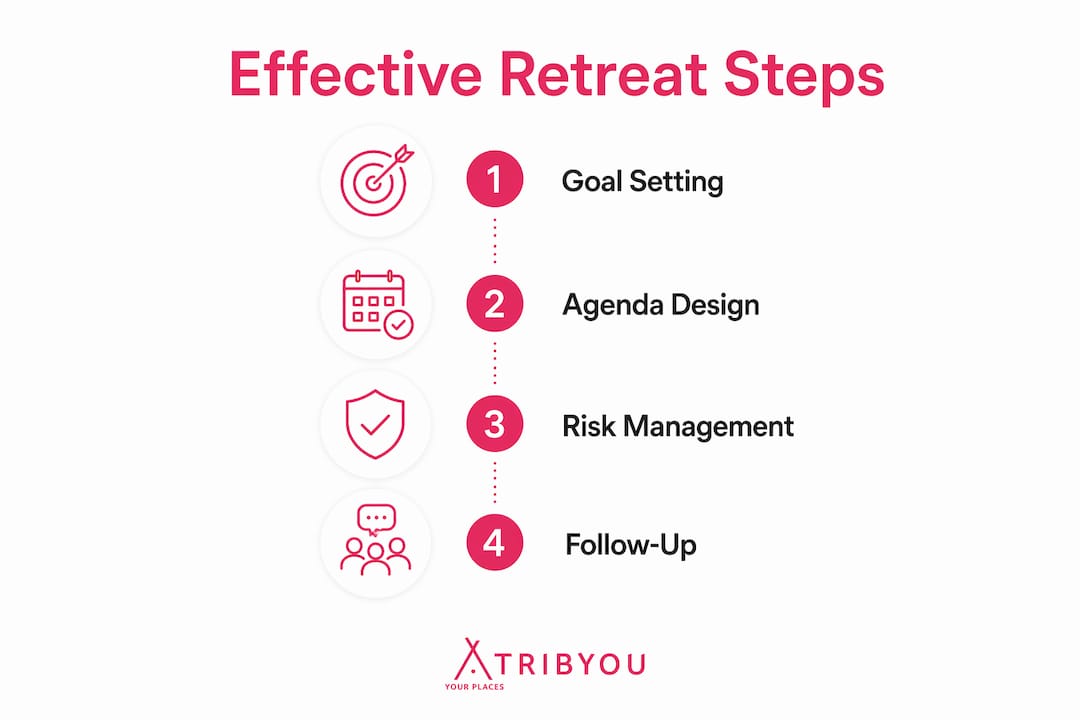
Translating retreat research into a working plan requires decisions across four areas: goal setting, agenda design, risk management, and follow-up.
Goal setting is where most retreats go wrong before they even begin. Align retreat goals with the organization's top three talent and strategy priorities for the year. If retention is the primary concern, design sessions around trust and belonging. If execution is the gap, focus on decision rights and accountability structures.
Agenda design should balance structured work with informal connection. A two-day retreat works best with a 60/40 split: 60% structured sessions and 40% informal time, including meals, walks, and unscheduled conversation. That informal time is not wasted. It is where relationships deepen and where leaders say things they would not say in a formal session.
Risk management requires HR involvement from the planning stage. Circulate a code of conduct before the retreat. Brief facilitators on escalation procedures. Designate a point of contact for any concerns that arise during the event. These steps protect both participants and the organization.
Follow-up is the most neglected phase. Schedule a 90-minute debrief meeting within two weeks of the retreat. Review every action item, confirm ownership, and set the next checkpoint. Retreat effectiveness compounds when leaders treat the offsite as the beginning of a change cycle, not the end of one.
| Planning phase | Key action |
|---|---|
| Pre-retreat | Define three strategic questions the team must answer |
| Agenda design | Balance structured sessions with informal connection time |
| Risk management | Circulate a code of conduct and brief facilitators |
| During the retreat | Apply no-tech policy and use small group formats |
| Post-retreat | Hold a 90-day debrief and track ownership of action items |
For teams working across remote or distributed structures, structured workation retreats offer a model that integrates focused work with genuine connection, particularly relevant for leadership teams that rarely share physical space.
Key takeaways
Leadership retreats deliver measurable business results only when they are designed as structured interventions with clear goals, active facilitation, and disciplined follow-up.
| Point | Details |
|---|---|
| Retreats drive retention | Team building retreats reduce turnover by up to 36% and return $4–$6 per $1 invested. |
| Alignment gaps are common | Only 34% of executive teams achieve strong strategic alignment after their annual offsite. |
| Design determines outcomes | Small group formats, no-tech policies, and compounding sessions separate effective retreats from forgettable ones. |
| Follow-up is non-negotiable | Without named owners and deadlines, retreat decisions fade within weeks. |
| HR guardrails protect everyone | 28% of retreats generate misconduct complaints; clear behavioral expectations prevent escalation. |
What I have learned about retreats that most guides miss
I have seen leadership teams spend three days in a beautiful location and return to the office with nothing changed. I have also seen a single well-designed two-day offsite shift a leadership team's culture for the better part of a year. The difference was never the venue. It was always the willingness to treat the retreat as a serious business intervention.
The most common mistake I observe is what I call "retreat theater." Leaders go through the motions of strategic discussion without ever surfacing the real tensions in the room. The facilitator keeps things comfortable. The agenda moves on schedule. Everyone leaves feeling good. And two weeks later, the same unresolved conflicts resurface in the same weekly meetings.
The retreats that actually work create moments of productive discomfort. Someone says the thing that everyone has been thinking but not saying. A small group session surfaces a disagreement that the plenary format would have buried. A shared meal after a hard conversation rebuilds trust in a way that no team-building exercise can manufacture.
My honest view is that most organizations under-invest in retreat design and over-invest in retreat logistics. The location matters less than the facilitation. The catering matters less than the agenda. And the agenda matters less than the psychological safety that determines whether leaders actually use it.
If you are planning a retreat, spend at least as much time on the facilitation design as you spend on the venue selection. Brief your facilitator on the real tensions in the team, not just the official agenda. And build in at least one session that has no predetermined outcome, where the team decides what needs to be said. That session is usually the most valuable one.
— Luca
How TribYou - Your Places supports leadership retreat planning
TribYou - Your Places designs retreat experiences that put the conditions for real leadership work at the center of every program. From curated locations that create genuine distance from daily operations to structured agendas that balance focused sessions with authentic local experiences, TribYou - Your Places builds retreats that deliver results beyond the event itself.
Whether your team needs a multi-day offsite in Italy, a workation format for distributed leaders, or a full incentive travel program, TribYou - Your Places connects you with trusted hosts, experienced facilitators, and destinations that make the work meaningful. Plan your next retreat with a team that understands both the business goals and the human experience behind every great offsite.
FAQ
What is a leadership retreat?
A leadership retreat is a purposeful offsite that removes senior leaders from daily operations to focus on strategic alignment, trust-building, and team cohesion. It differs from a standard meeting by creating physical and psychological distance that enables deeper thinking.
How long should a leadership retreat last?
Most effective leadership retreats run two to three days. Single-day offsites rarely provide enough time for trust to build and for strategic conversations to reach meaningful conclusions.
What is the ROI of a leadership retreat?
Team building retreats associated with leadership development return $4 to $6 for every $1 invested and reduce employee turnover by up to 36%. Those figures make retreats one of the higher-return leadership investments available.
Why do leadership retreats fail?
The most common causes of failure are unclear goals, overloaded agendas, no follow-up accountability, and the absence of HR guardrails. Only 34% of executive teams achieve strong strategic alignment after their annual offsite, which reflects how often retreat design falls short.
How do you measure leadership retreat effectiveness?
Track voluntary turnover rate, employee engagement scores, and the percentage of retreat action items completed within 90 days. Those three metrics give you a clear picture of whether the retreat produced lasting change or only a short-term boost.