

Organized group travel is defined as a structured approach to travel where a professional operator manages itineraries, logistics, and support so that participants can focus entirely on the experience. This model delivers measurable results: 94% of travelers report that structured itineraries significantly enhance their enjoyment. That number alone explains why organized group travel matters far beyond simple convenience. Whether you are planning a leisure trip with friends or a corporate team retreat, the difference between a well-structured group experience and an improvised one is the difference between a trip you remember and one you recover from.
What are the main benefits of organized group travel?
Organized group travel delivers five concrete advantages that independent travel rarely matches.
- Enhanced enjoyment through structure. A well-organized itinerary eliminates dozens of small daily decisions, from where to eat lunch to which museum entrance to use. That mental relief frees your attention for the actual experience.
- Faster social bonding. Shared destination interests reduce awkward small talk and create an immediate common ground. Participants connect quickly because they already agree on what excites them.
- Expert logistical support. Professional travel consultants handle flight disruptions, closed attractions, and local emergencies. Their 24/7 expert support makes a critical difference when things go wrong.
- Lower individual costs. Tour operators use bulk booking power to negotiate better rates on hotels, transport, and experiences. Bundled packages typically cost less than booking each component separately.
- Reduced decision fatigue. Decision fatigue silently undermines travel joy. Organized travel routines reclaim the mental bandwidth you need for genuine cultural immersion.
Pro Tip: When evaluating a group travel program, count how many daily decisions it removes for you. The fewer choices you need to make on the ground, the more present you will be during the experience itself.
The combination of these five benefits explains why the group travel model has grown well beyond budget tour buses. Corporate teams, digital nomads, and leisure travelers increasingly choose structured programs because the return on attention is simply higher.

How does organized group travel facilitate stronger social connections?
The social dimension of group travel is its most underrated advantage. Shared interests act as a catalyst for friendship in ways that random social settings cannot replicate.
- Common ground from day one. Every participant chose the same destination for similar reasons. That shared motivation removes the usual friction of getting to know strangers and replaces it with immediate, genuine conversation.
- Structured shared moments. Group dinners, guided tours, and collaborative activities create repeated, low-pressure interactions. Repeated contact in positive settings is one of the most reliable conditions for forming real friendships.
- Lasting travel companions. Travelers often form lifelong bonds through shared group experiences. These relationships extend well beyond the trip itself, creating networks of people who share your values and curiosity.
- Community over crowd. A well-designed group program builds a sense of belonging. Participants stop feeling like tourists and start feeling like members of a temporary community with a shared purpose.
"Shared interests in group travel reduce social friction and enable faster, deeper bonds than random social settings. The group becomes the experience, not just the vehicle for it."
This social dynamic is especially powerful for corporate teams. When colleagues share a meaningful travel experience outside the office, they return with a different kind of trust. That trust translates directly into better collaboration and communication at work. For leisure travelers, the friendships formed during a well-run group trip often become the reason they book the next one.
What logistical advantages make organized group travel practical and low stress?
Logistics are where most independent trips quietly fall apart. Organized group travel solves this at the structural level, not just the surface level.
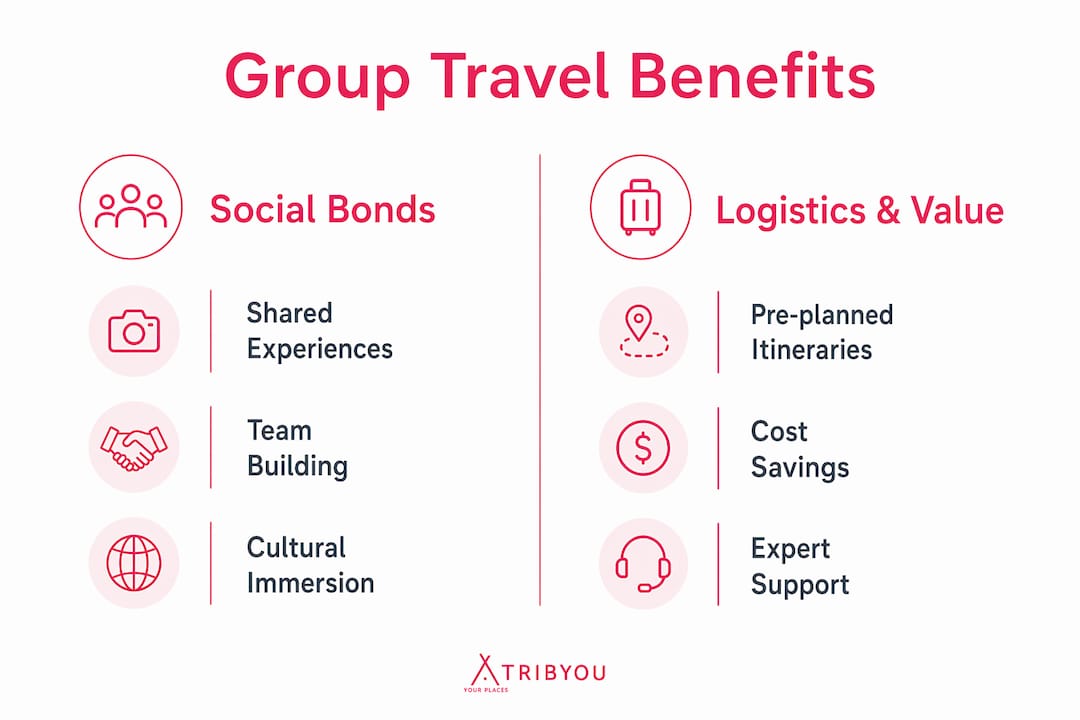
Pre-planned itineraries respect both geography and human energy. Grouping sights logically by location prevents unnecessary transit time and the exhaustion that comes with crossing a city twice in one day. A good itinerary reads like a well-edited route, not a wish list.
Local guides and translators remove the language and cultural barriers that frustrate independent travelers. Structured group travel simplifies navigating non-English-speaking destinations by placing a knowledgeable local between you and the confusion. That person does not just translate words. They translate context, etiquette, and meaning.
| Logistical challenge | Independent traveler | Organized group traveler |
|---|---|---|
| Flight disruption | Handles alone, often at full cost | Consultant manages rebooking immediately |
| Language barrier | Relies on translation apps | Local guide provides real-time support |
| Attraction closures | Loses time and money | Operator substitutes alternatives instantly |
| Daily route planning | Consumes hours each evening | Pre-planned and geographically optimized |
The true value of constant support only becomes visible during disruptions. Expert backup often determines whether a trip succeeds or collapses. An independent traveler stranded by a canceled train in rural Italy faces a very different situation than a group traveler whose consultant has already rebooked the connection and notified the hotel.
Pro Tip: Before booking any group travel program, ask the operator specifically how they handle flight cancellations and attraction closures. Their answer tells you everything about the quality of their support infrastructure.
For corporate planners, these logistical strengths are not optional extras. They are the foundation of a group travel logistics checklist that protects both the team and the company's investment.
How does organized group travel deliver cost savings and value?
Group travel pricing works differently than most travelers expect. Tour operators do not itemize their prices, and that opacity is intentional. Independent booking almost always costs more because operators access supplier discounts that individual travelers cannot.
The cost advantages fall into three clear categories:
- Negotiated bulk rates. Hotels, transport providers, and experience operators offer lower per-person rates to group buyers. Those savings pass directly to participants in the form of lower package prices.
- Bundled risk reduction. A package price protects you from the compounding cost of individual components. If one element becomes more expensive, the operator absorbs the variance, not you.
- Exclusive access. The best group tours include private venue entrances and unique local dinners that are simply not available to solo travelers at any price. These experiences add genuine value that no comparison spreadsheet captures.
For adventure travelers specifically, the benefits of group tours extend to shared equipment costs, group transport to remote locations, and safety in numbers during physically demanding activities. The per-person cost of a guided trek drops significantly when split across a group of twelve versus a group of two.
The cost argument for organized group travel is not just about saving money. It is about getting more for what you spend, with less risk of overspending or missing out entirely.
What are best practices for choosing the right organized group travel experience?
Choosing the right program requires honest self-assessment before comparing any options.
- Match group size to your comfort level. Smaller groups of 8–12 people offer more flexibility and personal attention. Larger groups of 20 or more provide more social variety but less individual customization. Know which environment energizes you.
- Prioritize balance between structure and freedom. The best programs build in free time every day. A fully scripted itinerary can feel as exhausting as no plan at all. Look for programs that schedule breathing room alongside organized activities.
- Evaluate the support model. Ask whether the operator provides on-the-ground support or only pre-departure assistance. The difference matters enormously when something goes wrong mid-trip. Reviewing how operators handle group travel emergencies gives you a clear picture of their real capabilities.
- Demand cost transparency. A reputable operator explains what is included and what is not. Hidden costs for meals, entrance fees, or transfers are a red flag. Ask for a full inclusions list before committing.
- Consider the group's shared purpose. A leisure group focused on food and culture needs a different program than a corporate team focused on connection and motivation. Aligning the program to the group's actual goal is the single most important factor in satisfaction.
Pro Tip: Read reviews specifically for how the operator handled problems, not just how beautiful the destinations were. Positive disruption management is the clearest signal of a trustworthy operator.
A useful resource for planning structured group experiences is the group travel planning workflow framework, which outlines the key decision points from initial concept to post-trip debrief.
Key Takeaways
Organized group travel delivers superior enjoyment, stronger social bonds, and lower costs precisely because professional structure removes the friction that undermines independent travel.
| Point | Details |
|---|---|
| Structure enhances enjoyment | 94% of travelers report better experiences with structured itineraries, freeing attention for the destination. |
| Shared interests accelerate bonding | Common destination goals reduce social friction and create genuine friendships faster than random settings. |
| Expert support protects your trip | 24/7 consultant backup handles disruptions, closures, and emergencies that would derail independent travelers. |
| Group pricing reduces individual cost | Bulk booking power and bundled packages deliver lower per-person costs and exclusive access unavailable to solo travelers. |
| Program fit determines satisfaction | Matching group size, structure level, and shared purpose to your goals is the most important selection criterion. |
What I have learned from watching groups travel well and badly
I have spent years observing how people experience travel, and the pattern is consistent. The trips that generate the most genuine satisfaction are almost never the ones with the most freedom. They are the ones with the most thoughtful structure.
The counterintuitive truth is that constraints create connection. When a group shares the same itinerary, the same guide, and the same unexpected detour through a village market, they share a story. That shared story is what people talk about years later. The solo traveler who improvised everything often has impressive photos and a harder time explaining what actually mattered.
I have also seen what happens when support fails. A group stranded by a canceled connection without a consultant in their corner loses not just hours but confidence. The trip's emotional tone shifts in a way that is very hard to recover. Professional support is invisible when everything works. It becomes the entire trip when something breaks.
The teams I have seen return from well-organized group travel are measurably different from the ones who attended a standard conference. They reference shared moments, they laugh at the same memories, and they trust each other in a way that took a three-day retreat to build. That outcome is not accidental. It is the direct result of group travel strengthening team morale through deliberate design.
My honest recommendation: stop treating organized group travel as a compromise between freedom and convenience. Treat it as a deliberate choice to get more out of every hour you spend away from home.
— Luca
How TribYou - Your Places supports your group travel experience
TribYou - Your Places designs curated group travel experiences that connect people, communities, and destinations through authentic, well-supported programs. Every itinerary balances structure with genuine local immersion, from corporate retreats in the Italian countryside to leisure group experiences in hidden destinations that most travelers never reach. The platform's network of local hosts, experience providers, and travel consultants handles the logistics so your group focuses entirely on connection and discovery. Whether you are organizing a team retreat, an incentive trip, or a leisure group experience, TribYou - Your Places builds programs around your group's specific goals, not a generic template.
FAQ
What is organized group travel?
Organized group travel is a structured travel model where a professional operator manages itineraries, logistics, and on-the-ground support for a group of participants. It differs from independent travel by removing daily planning decisions and providing expert assistance throughout the trip.
Why does group travel cost less than independent travel?
Tour operators use bulk booking power to negotiate lower rates with hotels, transport providers, and experience operators. Bundled packages also protect travelers from cost overruns that frequently occur when booking individual components separately.
How does group travel help people make real connections?
Shared destination interests reduce social friction and create immediate common ground among participants. Repeated positive interactions during structured activities accelerate the formation of genuine, lasting friendships.
What should I look for when choosing a group travel program?
Prioritize programs that balance structured activities with free time, provide 24/7 on-the-ground support, and offer full cost transparency before booking. Group size and alignment with your trip's purpose are the two most important selection factors.
Is organized group travel suitable for corporate teams?
Organized group travel is one of the most effective formats for corporate team building because shared experiences outside the office build trust that transfers directly to workplace collaboration. Well-structured programs designed around team goals deliver measurably stronger results than standard conference formats.