

A corporate group travel emergency is any unplanned event that disrupts the safety, movement, or well-being of multiple travelers on a company-sponsored trip. To handle corporate group travel emergencies effectively, you need three things working simultaneously: confirmed traveler location data, a pre-assigned crisis team, and a clear escalation path for rebooking decisions. Frameworks from TruTrip, CTM, and Airgo all point to the same conclusion. The organizations that recover fastest are the ones that prepared before anything went wrong.
How to handle corporate group travel emergencies before they happen
Effective corporate travel crisis response starts weeks before departure, not at the moment a flight gets canceled. The industry term for this is travel risk management, and it covers everything from contract flexibility to real-time tracking infrastructure.
Build a unified traveler data system first. Combining PNR records with mobile check-ins and itinerary parsing is not optional for group travel. Integrated traveler data increased hotel-level location accuracy from 52% to 91%, with a median 19-minute confirmation lag. That accuracy gap is the difference between locating 10 travelers in a crisis and losing track of half your group.
Your group travel emergency plan should include these foundational elements:
- Traveler data system: One centralized list, owned by a single person, updated continuously before and during the trip
- Flexible contracts: Hotel agreements with date-change waivers, alternate-property clauses, and name-change provisions for flights
- Crisis management team: Defined roles across security, HR, travel desk, legal, finance, and local destination managers
- Real-time alert tools: Platforms that push notifications on airspace closures, weather events, and political disruptions
- Escalation framework: Pre-approved thresholds for when a travel manager can authorize premium fares without waiting for executive sign-off
On contract negotiation: hotel flexibility provisions that allow date extensions and property switches are the single most underused tool in corporate group travel planning. Most planners negotiate price. The smart ones negotiate flexibility.
Pro Tip: Run a tabletop simulation with your crisis team at least 60 days before any major group trip. Assign roles, test your communication tools, and time how long it takes to locate all travelers on a mock manifest. The gaps you find in a simulation cost nothing to fix.
| Preparation Area | What to Put in Place |
|---|---|
| Traveler visibility | Centralized list with PNR, mobile check-in, and real-time itinerary data |
| Contract flexibility | Date-change waivers, alternate hotel clauses, and name-change rights on flights |
| Team structure | Named owners for security, HR, travel desk, legal, and local coordination |
| Escalation authority | Pre-approved fare thresholds to avoid approval delays during live disruptions |
| Communication tools | Multi-channel alert system covering SMS, email, app push, and phone backup |
How do you execute a rapid response during a live group emergency?
Speed and sequence both matter. The first 30–60 minutes of a corporate travel crisis determine whether your group gets rebooked on the next available flight or spends the night on airport floor tiles.

Confirming traveler safety within 30–60 minutes using multiple contact channels is the first non-negotiable step before any evacuation or rebooking planning begins. Skipping this step wastes logistics resources on travelers who are already safe and accounted for.
Follow this sequence when a disruption hits:
- Activate your crisis team immediately. Do not wait for the situation to escalate. CTM's 2026 airspace closure case study shows that overnight response activation supported 2,550+ travelers with zero safety incidents and sub-10-minute call wait times. Early activation is what made that possible.
- Verify traveler impact within the first 30 minutes. Use SMS, app notifications, email, and phone calls in parallel. Do not rely on a single channel.
- Triage by travel urgency. Separate travelers with immovable commitments (board presentations, client signings, medical needs) from those who can delay or rebook flexibly. Booking support triage that prioritizes imminent travelers protects business continuity without abandoning the rest of the group.
- Extend hotel and transfer commitments. Contact accommodation providers before travelers are stranded. A confirmed room extension costs far less than a last-minute booking during a mass disruption.
- Apply your escalation model. Airgo's 2026 playbook recommends a 3-level escalation model that enables quick approval of premium fares and defines clear decision rights. Use seat availability and cancellation rates as your triggers, not news headlines.
- Log every action with a timestamp. This protects you legally, supports insurance claims, and feeds your post-incident review.
Pro Tip: Prepare a crisis communications playbook with pre-written message templates for the five most common disruption types: flight cancellation, weather closure, political event, medical emergency, and accommodation failure. Sending a calm, factual update within 15 minutes of a disruption does more for traveler confidence than any rebooking.
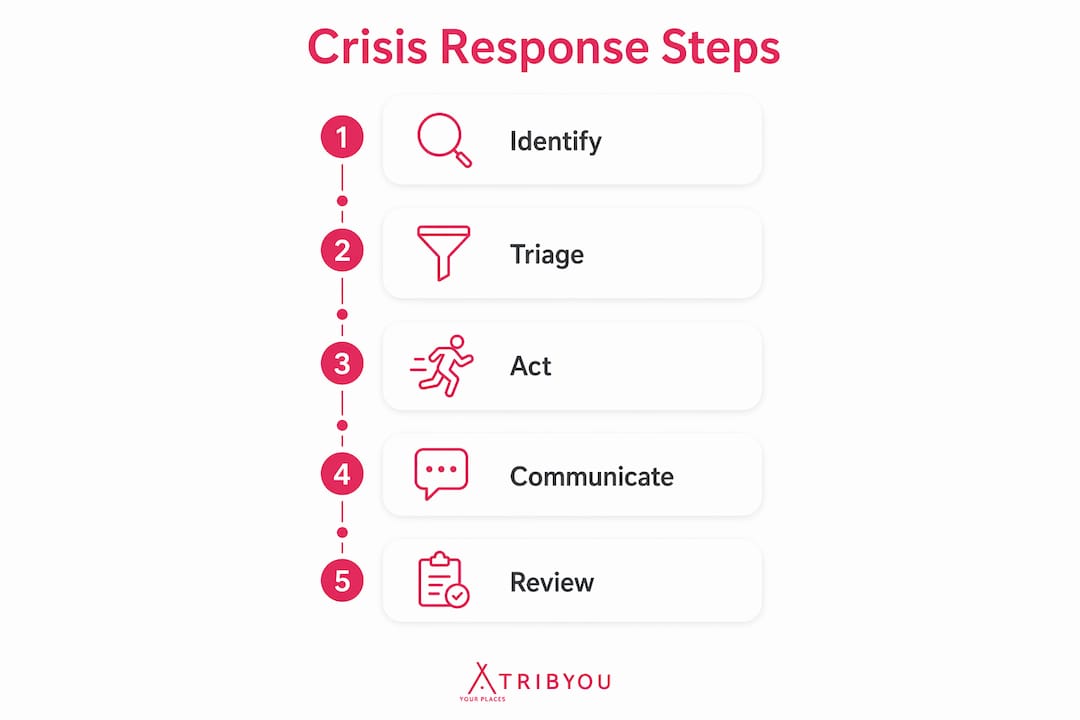
The triage, act, and communicate framework used by hospitality operations translates directly to group travel management. Detect the incident, triage affected travelers, mitigate the immediate impact, communicate clearly, escalate if needed, and document everything.
What challenges make group travel crisis response break down?
Handling travel disruptions for groups fails in predictable ways. Knowing the failure points in advance lets you build defenses before a crisis tests them.
The most common breakdown is scattered traveler data. When booking records live in three different systems and the traveler list was last updated two weeks before departure, identifying who is actually affected takes 90 minutes instead of 10. That delay costs real options. Pre-crisis visibility and immediate disruption detection are the gold standard for effective corporate travel crisis response.
The second breakdown is fragmented team handoffs. Security knows about the threat. HR does not know which travelers are on the ground. The travel desk is waiting for approval from a manager who is unreachable. Fragmented handoffs among security, HR, and travel management weaken crisis response and require integrated data and coordinated team orchestration to fix. Business Travel News describes this as an ecosystem problem, not a process problem. The fix is structural, not procedural.
Other common challenges include:
- Call volume surges: A single disruption affecting 50 travelers can overwhelm a two-person travel desk. Build overflow protocols and pre-contract with a travel management company that offers 24/7 group support.
- Evacuation vs. shelter-in-place decisions: These require input from security and local partners, not just travel managers. Define who makes this call before you need to make it.
- Out-of-hours emergencies: Most corporate travel crises happen outside business hours. Your group travel emergency plan must include after-hours coverage with named contacts and escalation paths.
- Outdated contact information: A traveler list with wrong phone numbers is worse than no list at all. Verify contact data at check-in, not at booking.
"In-crisis travel programs are only as strong as the weakest link. A single gap in data, team coordination, or escalation authority can unravel an otherwise solid response." — Business Travel News, June 2026
How do you improve emergency readiness after an incident?
Post-incident work is where most corporate travel teams leave value on the table. The debrief after a disruption is your best source of intelligence for the next one.
Follow this post-incident process to build lasting resilience:
- Document the full incident timeline. Pull your time-stamped logs and reconstruct every action from first alert to resolution. This record supports insurance claims, duty-of-care audits, and internal reviews.
- Run a structured stakeholder debrief. Bring together security, HR, the travel desk, and any local partners involved. Ask three questions: What worked? What failed? What would we do differently?
- Update your contracts and traveler protocols. If a hotel clause failed you, renegotiate it. If a communication channel went dark, add a backup. Proactive cross-team coordination before disruptions escalate is what separates organized rebooking from chaos.
- Run a tabletop exercise within 90 days. Use the actual incident as your scenario. New team members learn faster from real events than from hypotheticals.
- Integrate lessons into your managed travel program. The benefits of managed travel programs include built-in emergency readiness, dedicated crisis support, and continuous policy updates that solo travel desks cannot replicate at scale.
Structured travel risk capability with clear triggers and defined roles consistently outperforms improvised reactions during emergencies. The teams that treat post-incident review as a core process, not an optional debrief, build measurably stronger response systems over time.
Pro Tip: Assign a single owner to maintain the master traveler list and crisis protocol document year-round, not just before trips. When an emergency hits at 2 a.m., you need one person who knows exactly where everything is.
Key takeaways
Effective group travel emergency management requires integrated traveler data, pre-assigned team roles, and a tested escalation framework activated within the first 30–60 minutes of any disruption.
| Point | Details |
|---|---|
| Confirm safety first | Verify traveler location and status within 30–60 minutes using multiple contact channels. |
| Integrate traveler data | Combine PNR, mobile check-in, and itinerary data to achieve accurate real-time location tracking. |
| Assign clear ownership | Name a single owner for group rebooking and pre-approve escalation authority for premium fares. |
| Triage by urgency | Prioritize travelers with immovable commitments before addressing flexible rebooking needs. |
| Review and update after every incident | Use time-stamped logs and stakeholder debriefs to strengthen contracts, contacts, and protocols. |
What i've learned about group travel crises that most guides won't tell you
Most corporate travel crisis guides focus on the response. The real differentiator is the 30 days before departure.
I have seen well-resourced travel teams fail during disruptions because their traveler list was three versions out of date and nobody owned the update process. I have also seen lean teams with a single dedicated coordinator handle airspace closures affecting 80 travelers with calm precision, because they had done the unglamorous work of keeping data clean and roles clear.
The technology matters. Real-time alert platforms, integrated PNR systems, and multi-channel communication tools all make a measurable difference. But technology without human accountability is just noise. The teams that perform best under pressure are the ones where every person knows their role before the crisis starts.
One more thing that rarely gets said: the traveler experience during a crisis shapes how your people feel about the company for years afterward. How you resolve group travel problems under pressure is a direct signal of how much you value your team. That is not a soft consideration. It is a retention and loyalty factor that HR leaders increasingly track.
Build the system. Test it. Own it. The investment pays off in ways that never show up on a travel budget line.
— Luca
Manage your next group trip with TribYou - your places
Corporate group travel deserves more than a booking platform. TribYou - Your Places combines curated travel coordination, flexible itinerary management, and dedicated support for corporate groups, retreats, and incentive trips.
Whether you are planning a team retreat in Italy, an international incentive trip, or a multi-city conference tour, TribYou - Your Places provides the infrastructure and human expertise to keep your group moving, even when plans change. From pre-trip logistics to real-time support, every detail is managed with your team's safety and experience in mind. Explore corporate travel solutions built for groups that cannot afford to improvise.
FAQ
What is a corporate group travel emergency?
A corporate group travel emergency is any unplanned event that disrupts the safety, movement, or accommodation of multiple company travelers simultaneously. Common triggers include flight cancellations, airspace closures, political events, and natural disasters.
How quickly should you confirm traveler safety during a crisis?
Traveler safety and location should be confirmed within 30–60 minutes of a disruption using multiple contact channels. TruTrip's 2026 framework identifies this window as critical before any evacuation or rebooking planning begins.
What is the most common reason group travel crisis response fails?
Fragmented traveler data and unclear escalation authority are the two leading causes of failed crisis response. Business Travel News describes this as an ecosystem problem requiring integrated data and coordinated team roles to resolve.
How do you prioritize rebooking during a mass travel disruption?
Triage travelers by urgency: those with immovable business commitments get priority rebooking support first. CTM's 2026 case study used this approach to support 2,550+ travelers while maintaining sub-10-minute call wait times.
How often should corporate travel emergency protocols be updated?
Protocols should be reviewed after every significant incident and tested through tabletop exercises at least once per year. Contract flexibility clauses, traveler contact data, and escalation thresholds should be updated before each major group trip.