

Cross-functional retreats are strategic gatherings intentionally designed to generate measurable business outcomes by creating new professional connections, resolving organizational tensions, and driving aligned decisions across diverse teams. Research from Babson College and Rework confirms that these offsites, when properly structured, produce collaboration gains that no weekly meeting or video call can replicate. For business leaders and HR professionals asking why cross-functional retreats work, the answer is grounded in behavioral science, network theory, and organizational design. The combination of informal interaction and structured decision-making creates conditions that transform how teams collaborate long after the event ends.
Why cross-functional retreats work: the core evidence
Cross-functional retreats work because they disrupt the silo patterns that form naturally in daily workflows. According to Babson research, retreats break silo patterns by providing deliberate interactions with colleagues outside everyday teams, giving participants access to diverse information and perspectives that fuel innovation. This is not a soft benefit. It is a structural advantage that regular meetings cannot replicate.
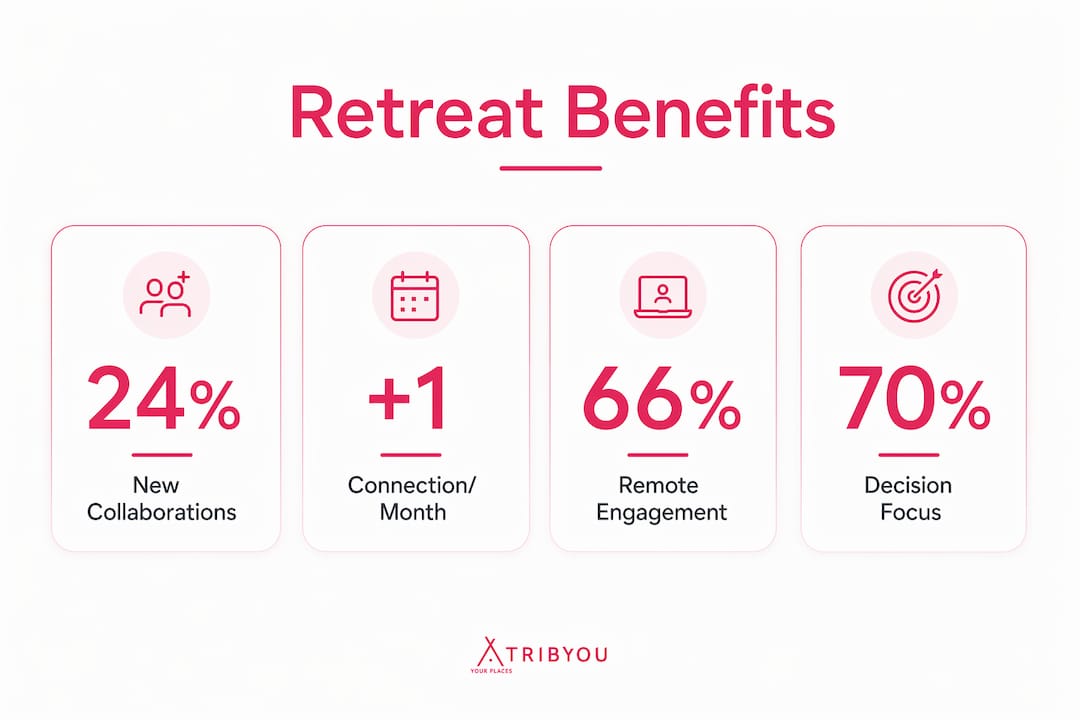
The numbers are specific. Partners who attend annual retreats generate 24% more new client-collaboration requests in the two months following the event. That figure represents real pipeline growth, not just improved morale. The same Babson study found that 17% of new post-retreat working relationships continued for two years, which means the collaboration network built at a retreat has a measurable shelf life.

Retreats also increase new professional connections by about one per month for attendees compared to non-attendees. The mechanism behind this is the combination of informal touchpoints, shared meals, hallway conversations, and structured group tasks that lower the friction of forming new working relationships. The Harvard Business Review and U.S. Chamber of Commerce have both noted that this mix of formal and informal interaction is what separates effective cross-functional teams from groups that simply share an org chart.
In-person vs. virtual collaboration: what the data shows
| Dimension | In-person retreat | Virtual collaboration |
|---|---|---|
| New connections per month | +1 per attendee vs. non-attendees | Minimal measurable increase |
| Post-event collaboration requests | 24% increase (Babson) | No comparable data |
| Long-term relationship formation | 17% sustained for 2 years | Difficult to sustain |
| Creativity boost | 1 in 3 employees most creative offsite | Limited by screen fatigue |
| Decision accountability | Named owners, 90-day outcomes | Often diffuse and untracked |
The table above makes the importance of collaboration retreats concrete. Virtual tools are effective for execution. They are not effective for building the trust and cross-team understanding that drives innovation.
What specific benefits do cross-functional retreats offer?
The benefits of team retreats extend well beyond a single event. The most significant benefit is the creation of new working relationships that persist. When a product manager and a finance director spend two days solving a shared problem at an offsite in the Italian countryside, they return with a working relationship that changes how they interact for months. That relationship is the asset.
For remote and hybrid teams, the benefit is even more acute. Two-thirds of remote employees report finding virtual connection difficult, and 25% actively miss regular coworker interaction. Annual or semi-annual in-person retreats directly address this gap. They provide the face-to-face interaction time that short video calls cannot offer, and they do so in a context that encourages openness rather than task completion.
Cross-functional retreats also improve organizational alignment. When teams from engineering, marketing, sales, and operations spend structured time together, they develop a shared understanding of each other's constraints and priorities. This understanding reduces friction in day-to-day collaboration and accelerates decision-making. The result is a measurable improvement in how cross-functional retreats improve productivity across the organization.
Pro Tip: Plan at least one cross-functional working session where participants from different departments must solve a real business problem together. The shared challenge creates the kind of trust that generic icebreakers never produce.
How does agenda design determine retreat success?
Retreat design is where most organizations fail. The most common mistake is filling the agenda with presentations and status updates, which are conversations without decisions. Rework's executive offsite research is direct on this point: effective retreats spend 60 to 70% of agenda time on decision debates with named owners and 90-day outcomes. The remaining time goes to relationship-building and informal interaction.
The logic is clear. Teams with documented commitments are 3x more likely to execute strategic decisions versus those that only share understanding. A retreat that produces clarity and ownership is worth ten times more than one that produces inspiration without accountability.
Here are the core design principles for a high-impact retreat:
- Assign decision ownership before the event. Every agenda item should arrive with a named decision owner and a defined outcome. Ambiguity in the room produces ambiguity in execution.
- Limit plenary presentations to 20% of total time. Presentations inform. They do not produce decisions or relationships. Prioritize working sessions and structured debates.
- Mix functions deliberately in every small group. Seat an engineer next to a sales lead. Put the CFO in a working group with the HR director. Proximity and shared tasks are the mechanism behind new connections.
- Create psychological safety through structure. Psychological safety emerges only with intentional structure in larger groups. Use facilitated formats that surface tension constructively rather than suppressing it.
- Close every session with a written commitment. Name the owner, the action, and the 90-day deadline. Read it back to the group before moving on.
What makes retreats successful is not the venue or the team-building activity. It is the discipline of designing for decisions and relationships simultaneously.
Why remote and hybrid teams need retreats more than anyone
The shift to remote and hybrid work has made cross-functional retreats more important, not less. When teams are distributed across time zones and communicate primarily through Slack and Zoom, the informal touchpoints that build trust simply do not happen. There is no equivalent to running into a colleague in the hallway or sharing lunch with someone from a different department.
The U.S. Chamber of Commerce data is clear: over a third of employees report being most creative outside their traditional work environment. Removing people from their screens and placing them in a new physical context, whether a villa in Tuscany or a mountain lodge in the Dolomites, produces a measurable shift in how they think and communicate.
"In remote and hybrid organizations, retreats fill a critical gap by offering real interaction opportunities that are impossible to replicate virtually." — U.S. Chamber of Commerce HR Research, 2025
The psychological and wellbeing benefits are equally significant. Retreats signal to employees that the organization values their connection and development, not just their output. This signal improves morale, reduces turnover risk, and strengthens organizational culture in ways that no benefits package can replicate. For HR professionals, the employee travel experience is increasingly recognized as a direct driver of engagement and retention.
What practical steps maximize the ROI of a retreat?
Planning a retreat is straightforward. Designing one that produces lasting results requires deliberate choices at every stage.
Before the retreat:
- Define 3 to 5 strategic decisions the organization needs to make. Build the agenda around them.
- Assign a decision owner to each topic in advance. Send pre-read materials so participants arrive informed, not learning.
- Mix attendee groups intentionally. Avoid clustering people who already work together daily.
During the retreat:
- Protect informal time. Shared meals, evening activities, and unstructured conversation are not wasted time. They are where the new working relationships that drive post-retreat collaboration actually form.
- Use small-group formats for complex topics. Groups of 4 to 6 produce more candid conversation than plenary sessions of 20.
- Incorporate wellness elements that support mental clarity and physical energy. A morning hike or a guided meditation session is not a luxury. It is a performance investment.
After the retreat:
- Distribute a written summary of all decisions and owners within 48 hours.
- Schedule a 30-day check-in to review progress against 90-day commitments.
- Track new cross-functional connections and monitor whether collaboration patterns shift in the weeks following the event.
Post-retreat follow-up is where most organizations lose the gains they worked hard to create. Without follow-through, many retreat benefits remain temporary. The accountability system is not optional. It is the mechanism that converts a good experience into a lasting operational change.
Pro Tip: Use a shared digital workspace, such as Notion or Confluence, to track retreat commitments and update progress publicly. Visibility creates accountability without requiring additional meetings.
For a detailed look at how leading organizations approach this, the guide on planning annual team retreats covers the full planning cycle with practical frameworks.
Key takeaways
Cross-functional retreats work because they create the structural conditions for new professional relationships, aligned decisions, and sustained collaboration that no virtual tool or regular meeting can replicate.
| Point | Details |
|---|---|
| Retreats build lasting networks | Babson research shows 17% of new retreat connections persist for two years, with a 24% rise in collaboration requests. |
| Agenda design determines outcomes | Spending 60 to 70% of time on decision debates with named owners makes teams 3x more likely to execute. |
| Remote teams benefit most | Two-thirds of remote employees find virtual connection difficult; in-person retreats directly address this gap. |
| Psychological safety requires structure | Intentional facilitation formats surface tension constructively and unlock open dialogue in larger groups. |
| Follow-up converts gains into results | Post-retreat accountability systems are what transform relational benefits into measurable operational change. |
Retreats are execution systems, not events
I have worked with dozens of organizations that invest in retreats and walk away with great memories and zero follow-through. The problem is almost never the venue, the facilitator, or the team. The problem is that leaders treat retreats as conferences rather than execution systems.
The most effective retreats I have seen share one characteristic: they are designed backward from decisions, not forward from an agenda. The team identifies the three or four choices the organization must make in the next quarter, and every session is built to produce clarity on those choices. The informal time, the dinners, the morning runs, all of it serves the same purpose. It builds the trust that makes hard conversations possible.
There is also a power dynamics issue that most retreat guides ignore. When a senior executive dominates every discussion, psychological safety collapses and the retreat produces consensus theater rather than real alignment. The best facilitators I have encountered spend as much time managing status dynamics as they do managing time. That is the uncomfortable truth about what makes retreats successful at the leadership level.
Post-pandemic, retreats have taken on an additional role. They are culture repair events for organizations that lost their connective tissue during years of remote work. Used well, a corporate offsite event is one of the most cost-effective investments a leadership team can make in organizational health. Used poorly, it is an expensive team dinner with a whiteboard.
— Luca
Plan your next retreat with TribYou - Your Places
TribYou - Your Places designs cross-functional retreats and executive offsites that combine research-backed agenda frameworks with curated destinations across Italy and beyond. From a strategic offsite in the Tuscan hills to a team-building program on the Amalfi Coast, every retreat is built around your team's specific collaboration goals and decision priorities.
TribYou - Your Places handles venue selection, logistics, facilitation support, and wellness programming so your leadership team can focus entirely on the work that matters. Whether you are planning your first offsite or redesigning an annual retreat for better results, explore TribYou's retreat experiences to find the right format for your team. You can also browse incentive retreat packages designed specifically for cross-functional corporate teams.
FAQ
Why do cross-functional retreats work better than regular meetings?
Cross-functional retreats combine informal interaction with structured decision-making, creating conditions for new professional relationships that regular meetings cannot produce. Babson research shows retreat attendees gain approximately one new professional connection per month compared to non-attendees.
How much time should a retreat agenda spend on decisions?
Rework's executive offsite research recommends spending 60 to 70% of agenda time on decision debates with named owners and 90-day outcomes. Teams that document commitments this way are three times more likely to execute on strategic decisions.
Are retreats worth the investment for remote teams?
Yes. The U.S. Chamber of Commerce reports that 25% of remote employees miss regular coworker interaction and two-thirds find virtual connection difficult. Annual in-person retreats directly address this gap and produce collaboration gains that virtual tools cannot replicate.
What is the most common reason retreats fail to deliver results?
The most common failure is designing an agenda around presentations and status updates rather than decisions. Without named decision owners, documented commitments, and post-retreat accountability systems, most retreat gains remain temporary.
How soon after a retreat should follow-up happen?
Distribute a written summary of all decisions and owners within 48 hours of the retreat. Schedule a 30-day progress check-in and track 90-day outcomes to convert relational gains into operational results.