

A corporate travel manager is the executive responsible for designing, managing, and improving a company's entire business travel program to balance cost, compliance, and traveler safety. The role of travel managers in corporations has grown well beyond booking flights and hotels. These professionals now sit at the intersection of Finance, HR, Procurement, and Security, overseeing what the GBTA 2025 Business Travel Index projects as $1.48 trillion in global business travel spend. That scale makes corporate travel one of the largest controllable expense categories in any multinational organization. Travel managers who operate at a strategic level directly shape employee productivity, program compliance, and corporate risk exposure.
What are the core responsibilities of travel managers in corporations?
Travel managers own the full lifecycle of a corporate travel program. The industry term for this function is "Travel Buyer," and the modern Travel Buyer sits between Procurement and Finance, managing supplier relationships while enforcing policy across every booking channel. The scope is broad, and the daily work is more operational than most executives realize.
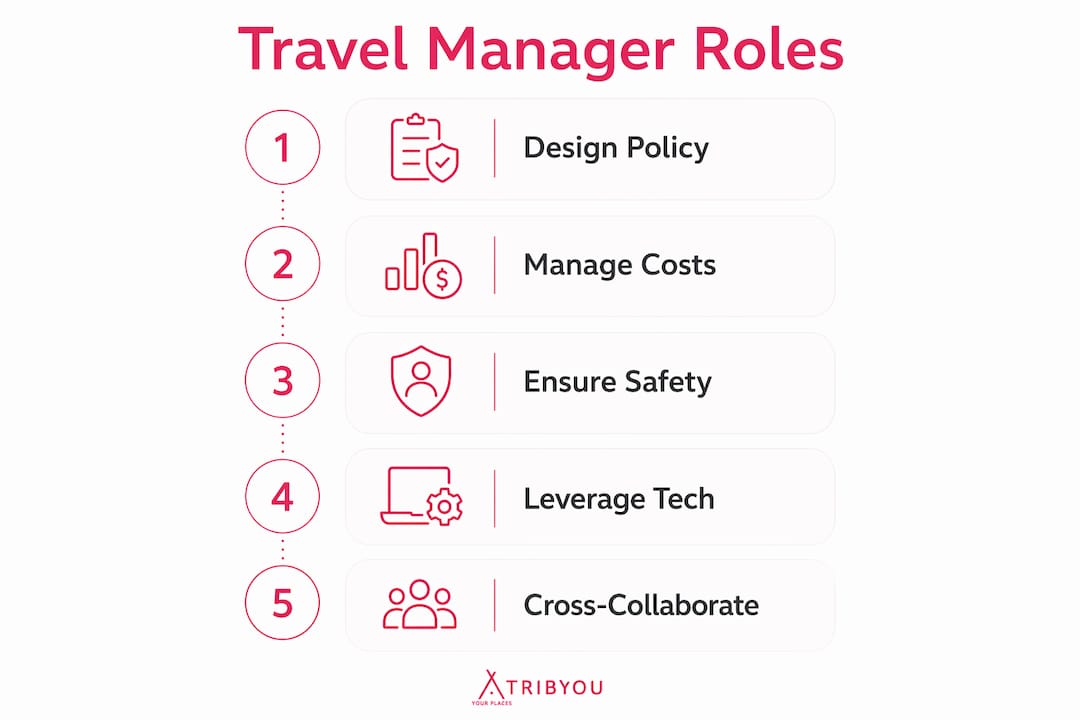
Core corporate travel responsibilities include:
- Policy design: Writing and updating travel rules, expense caps, booking windows, and exception workflows for every traveler tier.
- Supplier management: Running airline and hotel RFPs, negotiating volume contracts with preferred suppliers, and managing relationships with Travel Management Companies (TMCs).
- Duty of Care: Coordinating traveler safety protocols, emergency response plans, and risk approvals for high-risk destinations under standards like ISO 31030:2021.
- Spend analytics: Tracking cost-per-trip, policy compliance rates, unused ticket recovery, and leakage from ground transport and expense misreporting.
- Technology oversight: Managing booking platforms, expense tools, and traveler safety systems to keep data centralized and auditable.
- Stakeholder coordination: Aligning with Finance on budgets, HR on traveler wellbeing, Procurement on contracts, and Security on risk protocols.
Travel managers own core KPIs including cost per trip, policy compliance rates, and traveler safety response times. These metrics translate directly into executive reporting and budget decisions.
Pro Tip: Build a shared KPI dashboard with Finance and HR from day one. When travel data lives in a single view alongside expense and HR data, policy exceptions become visible before they become budget problems.

The biggest misconception about travel manager duties is that the role is transactional. Booking a flight is a task. Designing the policy that governs how 5,000 employees book flights across 40 countries is a program. That distinction defines the difference between a reactive coordinator and a Travel Buyer who generates measurable ROI.
How do travel managers optimize corporate travel cost savings and compliance?
Cost control is the most visible output of a well-run travel program. Business travel costs often exceed $1,700 per employee annually, which means even a mid-sized company with 500 traveling employees carries a significant annual exposure. Travel managers reduce that exposure through managed travel programs, supplier contracts, and data-driven enforcement.
A managed travel program centralizes all bookings through approved channels. Managed travel reduces off-policy spend by enforcing booking rules at the point of purchase, before the expense is incurred. That is a fundamentally different approach from reviewing expense reports after the fact.
The key cost-saving mechanisms travel managers use include:
- Supplier negotiations: Hotel and airline RFPs with volume commitments typically yield blended savings across the program.
- Leakage control: Ground transport, last-minute bookings, and out-of-policy hotels are the most common sources of untracked spend.
- Unused ticket recovery: Tracking and reusing airline credits from canceled trips is a direct cost recovery lever most programs underuse.
- Compliance monitoring: Programs targeting policy compliance rates above 85% consistently outperform lower-compliance programs on cost per trip.
Strategic travel managers achieve up to 30% reductions in travel expenses through program design and enforcement. That figure reflects the combined impact of supplier contracts, compliance enforcement, and spend visibility rather than any single tactic.
Technology accelerates these gains. AI-powered platforms can handle up to 40% of routine customer inquiries, lowering service costs and freeing travel managers to focus on program strategy rather than transactional support. That shift in workload is significant for teams managing high booking volumes.
Pro Tip: Set a documented exception workflow before you launch any new travel policy. Exception culture, where travelers routinely book outside policy and request approvals afterward, erodes compliance rates faster than any supplier issue. Clear, fast approval paths remove the friction that drives off-policy behavior.
You can read more about the benefits of managed travel programs and how structured programs deliver measurable cost and compliance gains.
In what ways do travel managers contribute to employee safety and duty of care?
Duty of Care is the legal and ethical obligation a company has to protect employees while they travel on business. Travel managers are the operational owners of that obligation. Their work in this area is the most consequential and least visible part of the role.
The practical steps travel managers take to protect travelers include:
- Traveler tracking: Deploying real-time location and alert systems so the company knows where employees are during weather events, strikes, or security incidents.
- Pre-trip risk approvals: 84% of large enterprises require pre-trip risk approval for elevated-risk destinations. Travel managers design and manage these approval workflows.
- ISO 31030:2021 compliance: This international standard defines travel risk management requirements. Travel managers translate the standard into internal protocols, supplier requirements, and traveler communications.
- Emergency response coordination: Building escalation paths that connect HR, Security, TMCs, and local contacts so the company can respond within minutes, not hours, during a crisis.
- Traveler guidance: Providing pre-trip briefings on safe transportation options, neighborhoods, check-in protocols, and local health requirements.
- Communication workflows: Establishing clear channels for travelers to report incidents and for the company to push urgent updates in real time.
The complexity of Duty of Care has grown sharply. Global health risks, geopolitical instability, and climate-related travel disruptions have all increased the frequency of emergency activations. Travel managers who treat safety as a checklist item rather than a living program expose their companies to significant liability.
Pro Tip: Test your emergency response plan twice a year with a simulated scenario. Most companies discover their escalation paths have gaps only when a real incident occurs. A tabletop exercise with HR, Security, and your TMC takes two hours and reveals problems that would otherwise surface at the worst possible moment.
Understanding corporate travel policy design is the foundation for building effective Duty of Care protocols into your program from the start.
How is the travel manager role evolving with technology and cross-department collaboration?
The travel manager role is shifting from operations to program leadership. AI-powered booking and audit tools now handle a growing share of transactional work. That shift gives travel managers capacity to focus on supplier strategy, cross-functional alignment, and executive reporting.
The most effective travel managers today operate across four dimensions:
- Data integration: Connecting booking, expense, and risk platforms into a unified reporting view. Fragmented data is the root cause of most compliance failures and budget surprises.
- Cross-functional influence: Travel managers coordinate across Finance, HR, Security, and Procurement to prevent siloed travel decisions. When each department manages its own travel exceptions, program integrity collapses.
- Expense auditing: High-performing travel managers audit expense and credit card data to catch out-of-policy spending that booking tools miss. This is the single most underused compliance lever in most programs.
- Supplier evaluation: Assessing suppliers not just on price but on service consistency, escalation processes, and technology compatibility with the company's existing stack.
The table below shows how the travel manager's focus has shifted as technology absorbs transactional tasks.
| Traditional focus | Evolving focus |
|---|---|
| Manual booking support | AI-assisted booking oversight |
| Reactive expense review | Proactive spend auditing |
| Single-department reporting | Cross-functional program reporting |
| Vendor price negotiation | Supplier ecosystem management |
| Policy documentation | Policy enforcement and exception governance |
Program orchestration, meaning the standardization of how trips are booked, supported, and reconciled, is the defining capability of high-performing travel programs. Travel managers who master orchestration deliver consistent results regardless of booking volume or traveler behavior. Those who do not find themselves managing exceptions rather than outcomes.
The role is also gaining executive visibility. Travel managers at director level now regularly present to CFOs and CHROs, connecting travel spend to workforce productivity, employee retention, and sustainability targets. Salaries reflect this seniority: US travel manager compensation ranges from $72,000 at entry level to $165,000+ for directors, a range that signals genuine strategic value rather than administrative function.
For a broader view of how travel programs connect to organizational goals, the guide on aligning corporate travel with company goals covers the strategic framework in detail.
Key Takeaways
Travel managers are the strategic owners of corporate travel programs, and their impact on cost, compliance, and employee safety is measurable, direct, and tied to organizational performance.
| Point | Details |
|---|---|
| Strategic ownership | Travel managers own the full program lifecycle, from policy design to supplier contracts and safety protocols. |
| Cost control impact | Managed programs and proactive auditing can reduce travel expenses by up to 30% through design and enforcement. |
| Duty of Care leadership | 84% of large enterprises require pre-trip risk approvals, with travel managers running those workflows. |
| Cross-functional role | Effective travel managers align Finance, HR, Procurement, and Security to prevent siloed decisions. |
| Technology shift | AI tools handle up to 40% of routine inquiries, freeing travel managers to focus on program strategy. |
Why the travel manager title undersells the actual job
I have spent years watching companies treat travel management as a support function, something to hand off to an executive assistant or fold into Procurement as a side responsibility. That approach costs real money and creates real risk. The companies that get this right treat the travel manager as a program architect, not a booking coordinator.
The shift I find most significant is the move toward what practitioners call program orchestration. It is not enough to have a policy document and a preferred hotel list. The question is whether every booking, every exception, and every expense flows through a system that captures data and enforces rules consistently. Most programs I have seen fail at the reconciliation step. Bookings happen in one system, expenses land in another, and the gap between them is where leakage lives.
The Duty of Care dimension is where I see the most underinvestment. Executives often treat it as a compliance checkbox rather than an operational capability. A travel manager who has never run a simulated emergency response exercise is managing risk on paper only. The ISO 31030:2021 standard exists precisely because real incidents do not follow policy documents.
My honest view is that the importance of travel managers will only grow. Sustainability reporting requirements, geopolitical complexity, and the rise of workations and hybrid travel patterns are all adding new layers to the role. Companies that invest in capable travel managers now will have a significant advantage in managing those layers as they arrive. Those that do not will spend more, comply less, and protect their people less effectively.
— Luca
How TribYou - Your Places supports your corporate travel program
Corporate travel programs work best when they connect cost discipline with genuine employee experience. TribYou - Your Places is built for exactly that intersection, offering curated corporate retreats, incentive trips, and workation programs that align with managed travel goals without sacrificing authenticity.

Whether your team needs a structured retreat in Italy, an incentive program that motivates and retains talent, or a workation framework that keeps remote teams connected, TribYou - Your Places provides the human-centered approach that standard booking platforms cannot replicate. Every program is designed to support your travel manager's compliance and safety requirements while delivering experiences that employees actually value. Visit TribYou - Your Places to see how your corporate travel program can work harder for your people and your business goals.
FAQ
What is the primary role of a travel manager in a corporation?
A corporate travel manager designs and oversees the company's entire business travel program, balancing cost control, policy compliance, and traveler safety. The role spans supplier negotiations, Duty of Care protocols, spend analytics, and cross-departmental coordination.
How do travel managers reduce corporate travel costs?
Travel managers reduce costs through managed travel programs that enforce booking rules at the point of purchase, supplier contracts negotiated with volume commitments, and proactive auditing of expense and credit card data to catch off-policy spending. Strategic programs can achieve up to 30% reductions in travel expenses.
What is Duty of Care in corporate travel management?
Duty of Care is a company's legal and ethical obligation to protect employees during business travel. Travel managers fulfill this obligation through traveler tracking systems, pre-trip risk approvals, ISO 31030:2021 compliance protocols, and emergency response coordination with HR, Security, and TMCs.
How does technology change the travel manager's job?
AI-powered platforms now handle up to 40% of routine booking inquiries, reducing transactional workload. Travel managers use that capacity to focus on program strategy, cross-functional reporting, and supplier evaluation rather than day-to-day booking support.
What qualifications does a corporate travel manager need?
Corporate travel managers typically combine experience in procurement, finance, or hospitality with knowledge of travel management platforms, supplier contract negotiation, and risk management frameworks like ISO 31030:2021. Director-level roles in the US command salaries above $165,000, reflecting the program's strategic scope.