

Coworking retreats are specialized, environment-focused work experiences designed to rebuild deep concentration by removing the conditions that fragment it. Understanding how coworking retreats boost focus requires looking beyond the novelty of a new location. The real mechanism is structural: purpose-built spaces, digital fasting protocols, and outcome-driven schedules work together to reduce cognitive load and restore the kind of sustained attention that home offices routinely destroy. Research shows well-designed shared spaces can boost individual productivity by up to 20% compared to home-based work. That number reflects a design philosophy, not a coincidence.
How coworking retreats boost focus through intentional space design
The physical environment of a coworking retreat is not incidental. It is the primary tool. Retreat designers use what researchers call "low-entropy" principles: minimalist layouts, limited visual noise, and clear spatial zoning that tells your brain what mode it should be in before you even sit down.
The most effective retreat spaces divide the floor plan into distinct zones:
- Deep focus zones: Private or semi-private areas with acoustic panels, minimal decor, and no casual foot traffic. These spaces signal single-task work.
- Collaborative zones: Open tables, whiteboards, and casual seating where conversation is expected and welcomed.
- Decompression zones: Outdoor terraces, lounge areas, or garden spaces designed for mental rest between sessions.
This zoning matters because context switching is one of the largest productivity drains for remote workers. When your kitchen table serves as your desk, your dining room, and your meeting room, your brain never fully commits to any one mode. A retreat eliminates that ambiguity by design.
Ergonomic furniture, natural lighting, and private areas reduce fatigue and headaches, directly improving mental well-being during work sessions. Ambient lighting also plays a specific role. Non-directional soft lighting, as opposed to harsh overhead fluorescents, reduces eye strain and lowers the cognitive load associated with visual discomfort. This is not a luxury detail. It is user experience infrastructure that shapes how long and how well you can concentrate.

Pro Tip: When evaluating a retreat venue, ask specifically about lighting setup and acoustic treatment in focus zones. Venues that cannot answer this question in detail have not thought seriously about the work environment.
The balance of privacy and community is equally deliberate. You are surrounded by other professionals working seriously, which creates a motivational pull that isolation at home cannot replicate. The social proof of seeing focused peers reinforces your own focus without requiring direct interaction.
What role does digital detox play in focus enhancement retreats?
Digital fasting is the most underestimated tool in the focus enhancement retreat toolkit. The concept is straightforward: structured periods without smartphones, social media, or non-essential apps interrupt the dopamine feedback loops that fragment attention throughout a normal workday.
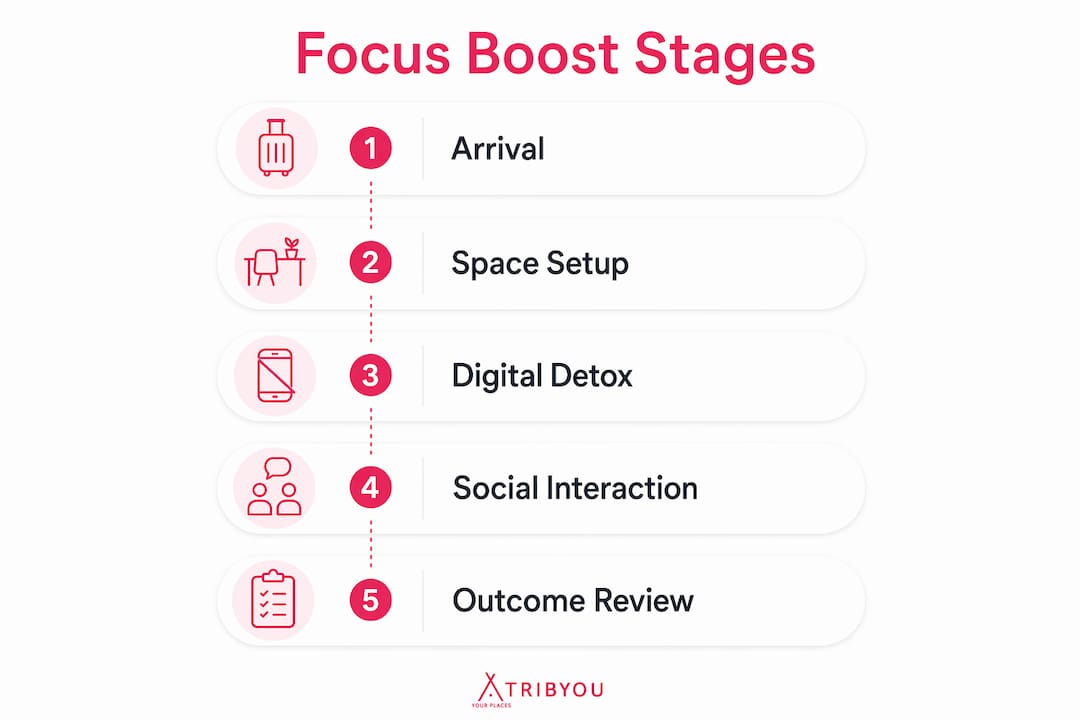
Focus is a mental muscle that atrophies without deliberate training. Coworking retreats like the Wuchi Retreat treat digital fasting and sensory reduction protocols as core programming, not optional add-ons. The results are measurable: participants report moving from fragmented, reactive attention to sustained, deep presence within 24–48 hours of beginning a structured digital fast.
Here is how the best retreats structure digital detox protocols:
- Device-free morning blocks: The first 90 minutes of the day are reserved for analog work, journaling, or mindfulness practice. This delays the dopamine hit of notifications and primes the brain for sustained focus.
- Scheduled connectivity windows: Email and messaging are limited to two or three defined windows per day, typically mid-morning and late afternoon. This trains the brain to batch reactive tasks rather than respond continuously.
- Evening digital curfews: Screens off by 9 p.m. allows the nervous system to downregulate, improving sleep quality and next-day cognitive performance.
- Mindfulness integration: Short meditation or breathwork sessions are placed between work blocks. These are not wellness extras. They are attention resets that reduce the cognitive residue left over from one task before starting the next.
Integrating daily mindfulness breaks and digital detox protocols within coworking retreats improves executive function and builds sustainable focus habits that persist after the retreat ends. That carry-over effect is what separates a retreat from a vacation. You return to your regular work environment with rebuilt attention capacity, not just a refreshed mood.
Retreats that blend skill-building with mindful rest combat cognitive fatigue more effectively than traditional offsites. The combination creates shared meaning among participants and improves learning retention, which compounds the productivity gains beyond the retreat itself.
Pro Tip: Before your retreat begins, set an out-of-office message that covers the full duration, not just the travel days. Protecting your attention from the start is the single highest-leverage preparation you can make.
Are short microcations more effective than long retreats for productivity?
The answer is yes, with one condition: the short retreat must be engineered for specific, measurable outcomes. Microcations of 48–72 hours outperform longer, open-ended offsites on retention, output quality, and team culture when they are structured like product launches rather than extended team dinners.
The comparison below shows why format determines results:
| Format | Duration | Structure | Primary outcome |
|---|---|---|---|
| Traditional offsite | 4–7 days | Loose agenda, social-heavy | Team bonding, variable productivity |
| Focused microcation | 48–72 hours | Outcome-driven sprints | Measurable deliverables, faster shipping |
| Workation | 1–4 weeks | Individual-paced, location-flexible | Sustained output, lifestyle integration |
| Focus enhancement retreat | 3–5 days | Structured protocols, digital detox | Rebuilt attention capacity, skill development |
The microcation model works because urgency and clarity reinforce each other. When a team arrives at a retreat with a defined deliverable, such as a product prototype, a strategic decision, or a cycle time reduction target, every session has a purpose. Participants do not drift into unfocused conversation or passive attendance. The time constraint creates the same psychological pressure that a deadline does, but without the stress of an impending failure.
Treating retreats like product launches with clear planned outcomes and time-constrained formats improves measurable productivity and reduces wasted time. Identity provisioning matters here too: participants need frictionless access to tools, spaces, and each other from the moment they arrive. Any logistical friction in the first few hours erodes the focused momentum the format depends on.
For remote workers who cannot afford a week away, the 48–72 hour microcation is the most practical entry point into structured workation programs and the benefits they deliver.
How does social interaction at retreats improve motivation and mental health?
The social dimension of a coworking retreat is not a distraction from focus. It is one of its primary drivers. Social interaction in coworking spaces significantly impacts job satisfaction and productivity by providing motivation and creativity through communal atmosphere and networking opportunities.
Remote workers who join retreats consistently report that the casual interactions between sessions, the shared meals, the hallway conversations, and the evening discussions, generate ideas and energy that solo work cannot. This is not sentiment. It reflects a well-documented psychological principle: social accountability and ambient motivation from peers raise individual output without requiring direct collaboration.
The benefits of the social environment at a well-run coworking retreat include:
- Reduced isolation: Remote workers who spend most of their time alone experience a measurable reduction in loneliness after just two or three days in a shared work environment.
- Increased creativity: Exposure to professionals from different industries and disciplines introduces cognitive diversity that sparks new approaches to familiar problems.
- Stronger job satisfaction: The sense of belonging that a retreat community creates carries over into daily work, reducing the disengagement that remote workers often experience after months of solo work.
- Lower mental fatigue: The rhythm of focused work followed by genuine social connection is more sustainable than eight hours of isolated screen time.
Hybrid work arrangements produce output equivalent to or greater than in-office work in 70% of job categories when anchor days support collaboration and mental health. Retreats function as high-intensity anchor days, compressing the social and collaborative benefits of office life into a short, intentional format. The result is a mental health reset and a motivation spike that sustains output for weeks after the retreat ends.
For teams, the benefits of offsite retreats extend further: shared experiences build trust that makes remote collaboration faster and more effective long after everyone has returned home.
Key takeaways
Coworking retreats boost focus by combining intentional space design, digital fasting, structured social interaction, and outcome-driven formats into a single, high-impact experience.
| Point | Details |
|---|---|
| Environment design drives focus | Zoned spaces with natural lighting and acoustic treatment reduce cognitive load and signal deep work. |
| Digital fasting rebuilds attention | Structured device-free periods interrupt dopamine loops and restore sustained concentration within 24–48 hours. |
| Microcations outperform long offsites | 48–72 hour outcome-driven retreats deliver measurable results faster than open-ended, week-long formats. |
| Social interaction amplifies output | Communal atmosphere reduces isolation, raises creativity, and sustains motivation well beyond the retreat itself. |
| Local anchors protect focus time | On-the-ground support eliminates logistical distractions so participants stay fully engaged in work and connection. |
Why I think most people approach retreats completely wrong
Most remote workers treat a coworking retreat like a change of scenery. They book a nice venue, pack their laptops, and expect the location to do the work. It does not. I have seen teams spend three days in a beautiful setting and return home with nothing to show for it except a shared photo album.
The retreats that actually shift your focus capacity share one trait: they are designed before they begin. That means a defined outcome, a daily structure that protects deep work hours, and a digital protocol that starts on day one, not day three when people finally feel comfortable putting their phones down.
Local anchors are the detail most organizers overlook. Having someone on the ground who knows the destination, handles logistics, and can solve problems without pulling you out of a focus session is the difference between a retreat that works and one that just feels like a stressful trip. The Sanctuary 3 case study makes this point clearly: when logistics are invisible, attention is available.
My honest advice is to treat your next retreat as an investment in your mental architecture, not a reward for hard work. Choose a venue that has thought seriously about its work environment. Commit to the digital protocols even when they feel uncomfortable. And define what success looks like before you arrive, so you know whether you achieved it.
The carry-over effect is real. Participants who complete a well-structured focus retreat report stronger concentration habits for four to six weeks afterward. That return on a 72-hour investment is hard to match with any other productivity intervention I know of.
— Luca
Discover curated coworking retreats with TribYou - Your Places
TribYou - Your Places designs coworking retreats built around the principles this article covers: intentional spaces, structured digital protocols, outcome-driven formats, and authentic local experiences that make every destination more than a backdrop.
Whether you are a remote professional looking to rebuild your focus capacity or a team leader planning a high-output offsite, TribYou - Your Places connects you with curated venues and experiences tailored to your goals. Every retreat in the TribYou - Your Places network is selected for its work environment quality, local anchor support, and ability to deliver measurable results. Explore curated retreat experiences and find the format that fits your next 48–72 hours of serious, focused work.
FAQ
How do coworking retreats improve concentration?
Coworking retreats improve concentration by combining purpose-built focus zones, digital fasting protocols, and structured daily schedules that eliminate the context switching and notification-driven distractions of home-based work. Research shows well-designed shared environments can boost productivity by up to 20% compared to working from home.
What is the ideal length for a focus-oriented retreat?
A 48–72 hour microcation engineered around specific deliverables outperforms longer, open-ended offsites for focus and measurable output. The time constraint creates urgency and clarity that sustain deep work throughout the retreat.
Do digital detox protocols actually work at retreats?
Yes. Structured device-free periods interrupt dopamine feedback loops and rebuild sustained attention within 24–48 hours. Programs like the Wuchi Retreat use digital fasting alongside mindfulness sessions to improve executive function and create focus habits that carry over into daily work.
How do retreats benefit remote workers' mental health?
Social interaction at coworking retreats reduces isolation, raises job satisfaction, and lowers mental fatigue compared to extended solo remote work. Hybrid work research confirms that structured anchor experiences combining collaboration and rest improve both output and well-being across the majority of job categories.
What should I look for when choosing a coworking retreat?
Prioritize venues with clearly zoned work spaces, natural lighting, acoustic treatment in focus areas, and on-the-ground local support. A defined program agenda with digital protocols and measurable outcomes is a stronger indicator of retreat quality than location or amenities alone.