

A workation program is a structured initiative that allows remote workers to perform their professional responsibilities from a travel destination, integrating leisure and community engagement into the workweek. Unlike a standard vacation, a workation keeps your deliverables intact while placing you in an environment that actively supports creativity, motivation, and personal well-being. Platforms like TribYou - Your Places, coworking networks, and digital nomad visa programs have made this model increasingly accessible. Understanding how workation programs work is the first step toward using them to your advantage, whether you are a solo digital nomad or part of a distributed team.
How workation programs work: structure and core mechanics
Workation programs operate on one foundational principle: your location changes, but your professional output does not. The program provides the infrastructure, schedule framework, and community context that make this possible. Most programs combine curated accommodation, dedicated workspace, and a light social calendar designed to complement rather than compete with your work hours.
The mechanics vary by format. Individual workations are self-directed, where you select a destination, book a workspace, and manage your own schedule. Team-based programs are coordinated by an employer or a platform like TribYou - Your Places, which handles logistics and aligns the experience with company goals. Open company programs allow employees to opt in to a shared workation at a pre-selected destination, typically with a defined duration and a set of optional group activities.

What separates a workation program from simply working while traveling is the intentional design. Accommodation is filtered for ergonomic workspaces and reliable wired connections, not just aesthetic appeal. Schedules are built around time zone requirements. Community touchpoints are planned but never mandatory. This structure is what makes the difference between a productive trip and a stressful one.
What infrastructure does a successful workation require?
The physical and technical setup of a workation program determines whether you stay productive or spend your mornings troubleshooting connectivity. These are the non-negotiable components:
- Internet speed: A minimum of 25 Mbps is required for standard remote work. Enterprise tasks such as video conferencing, large file transfers, or cloud-based development require 100 Mbps or more. Always confirm the actual speed at your accommodation before booking, not just the advertised figure.
- Backup connectivity: A local SIM card with a data plan is a practical safeguard. Mobile hotspots from providers like Skyroam or local carriers add a second layer of security when primary connections fail.
- Coworking access: Coworking spaces are non-optional for workation success, even for introverts. Separating your living space from your work environment is a psychological necessity that prevents the mental blur that leads to burnout.
- Ergonomic setup: A proper chair, external keyboard, and a second monitor or laptop stand are worth carrying or renting. Recreating key office comforts through ergonomic equipment maintains professional standards in unfamiliar environments.
- VPN and security tools: Remote work from public or shared networks requires a VPN. Tools like NordVPN or ExpressVPN protect sensitive data and satisfy most corporate IT policies.
- Time zone alignment: A 3 to 4 hour overlap with your team's core hours is the practical minimum for real-time collaboration. Destinations more than 12 hours away from your home base create scheduling complexity that most programs are not designed to absorb.
Pro Tip: Before confirming any booking, run a speed test via Speedtest.net from the property's actual Wi-Fi network. Ask the host for a screenshot taken during business hours, not at midnight.
How do workation programs balance productivity with leisure?
The most effective workation programs use a split-schedule model. Experienced remote workers maximize energy by reserving mornings for focused work during peak time zone overlap, then shift to exploration and leisure in the afternoon. This structure respects both professional commitments and the reason you chose to travel in the first place.
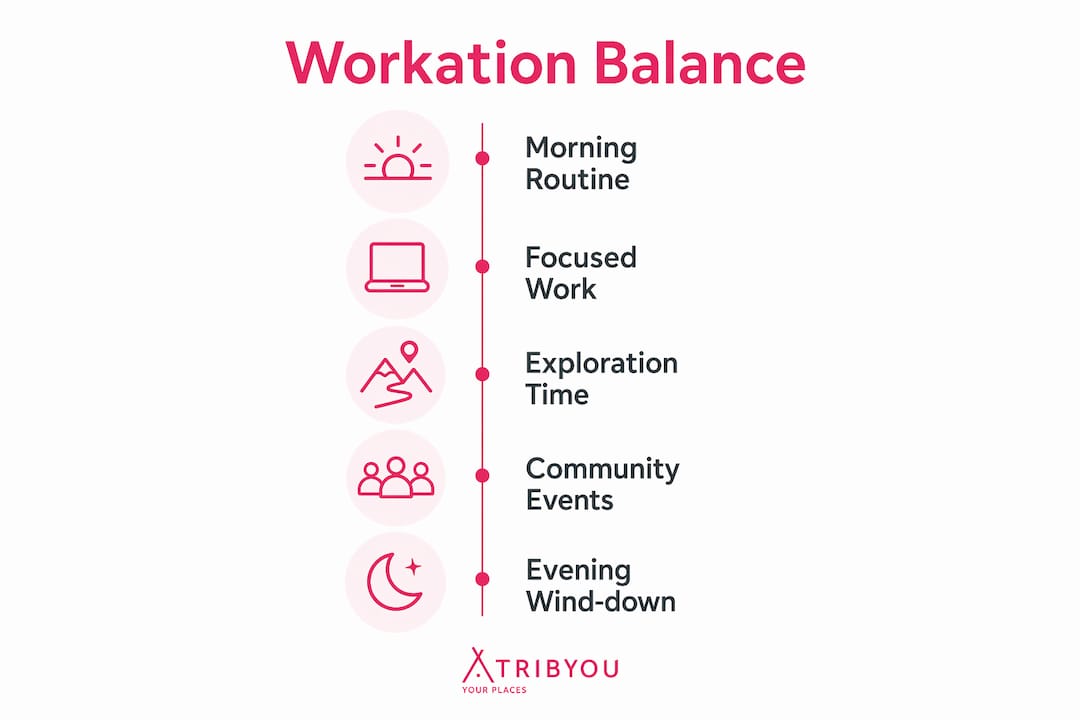
Micro-routines play a larger role than most people expect. A consistent morning coffee ritual, a short walk before opening your laptop, or a fixed start time in the same coworking chair each day signals the start of the workday and prevents the mental drift that comes from working in novel environments. These small anchors are what separate productive workations from chaotic ones.
Community engagement is a defining feature of structured workation programs, but the best programs keep it light. Optional social interactions and informal rituals, such as a shared dinner twice a week or a Saturday morning hike, consistently outperform heavily scheduled bonding activities. Forced fun erodes trust. Genuine, low-pressure community moments build it.
You should also treat workations as a complement to real vacations, not a replacement. Exclusive reliance on workations risks burnout because the mental boundary between work and rest never fully closes. Plan at least one fully disconnected trip per year alongside any workation program you participate in.
Pro Tip: Block your calendar for a 90-minute "exploration window" every afternoon. Treat it with the same discipline you apply to a client call. It is the single habit that prevents a workation from collapsing into a regular remote workday in a new zip code.
What are the most common workation challenges and how do you solve them?
Planning a workation without addressing these pitfalls is the fastest route to a frustrating trip. Here are the five most frequent challenges and the practical fixes that work:
-
Logistical overload from aesthetic choices. Prioritizing aesthetics over utility is the most common mistake first-time workation participants make. A stunning villa with unreliable Wi-Fi will cost you client relationships. Filter accommodations by dedicated workspace and wired ethernet first, then evaluate the view.
-
Time zone mismanagement. Identify your team's two or three most critical recurring meetings and work backward from those time slots when selecting a destination. A destination that forces you to join a daily standup at 11 PM is not a workation. It is a scheduling problem with a passport.
-
Isolation and loneliness. Remote work already carries a higher risk of social disconnection. A workation in an unfamiliar city amplifies this if you have no community touchpoints. Book accommodations in coworking-integrated properties or neighborhoods with active digital nomad communities. Cities like Lisbon, Medellín, and Tbilisi have established nomad infrastructure precisely for this reason.
-
Unclear employer expectations. Set explicit agreements with your manager before departure. Define your availability hours, response time commitments, and any blackout periods for deep work. This conversation protects both your productivity and your professional reputation.
-
Duration miscalculation. The optimal workation duration is 1 to 2 weeks for first-time participants. This window is long enough to settle into a routine without triggering the logistical complexity of longer stays, such as tax residency questions or visa requirements.
Pro Tip: Run a full "workation simulation" for two days before your trip. Work from a local coworking space, use only your travel laptop, and test your VPN and video conferencing setup. You will surface 80% of your technical problems before they become real ones.
What formats do workation programs take, and how are employers responding?
Workation programs exist on a spectrum from fully self-directed to institutionally managed. Understanding where a program sits on that spectrum helps you evaluate whether it fits your work style and company culture.
| Program format | Who manages it | Best suited for |
|---|---|---|
| Individual workation | The remote worker | Solo digital nomads, freelancers |
| Team workation | Employer or HR team | Distributed teams seeking cohesion |
| Open company program | Employer with opt-in policy | Mixed teams with varying travel interest |
| Platform-curated program | Travel providers like TribYou - Your Places | Workers seeking full logistical support |
Employer adoption is growing but still uneven. About 12.5% of employers have formal workation policies in place, and 20% of managers have personally experienced a workation. That gap between leadership experience and formal policy is closing as remote work matures as a permanent employment model.
The most successful programs are opt-in by design. Flexibility in workations builds trust and raises morale rather than creating pressure to perform in unfamiliar conditions. Mandatory participation undermines the autonomy that makes workations attractive in the first place. Companies that treat workation programs as a benefit rather than a directive see higher participation rates and stronger post-trip engagement scores.
For teams evaluating program success, the metrics that matter most are participation rates, self-reported productivity scores, and retention data in the 90 days following the workation. These indicators tell you whether the program delivered genuine value or simply generated good photos for the company LinkedIn page.
Key takeaways
Workation programs succeed when they combine reliable infrastructure, intentional scheduling, and opt-in community structures that respect individual autonomy and professional output.
| Point | Details |
|---|---|
| Infrastructure is non-negotiable | Confirm internet speed, ergonomic setup, and coworking access before booking any destination. |
| Split schedules protect productivity | Reserve mornings for focused work and afternoons for leisure to honor both commitments. |
| Opt-in design builds trust | Programs with voluntary participation consistently outperform mandatory formats in engagement and morale. |
| Duration matters for first-timers | One to two weeks is the recommended length for a first workation to balance routine and logistics. |
| Workations complement vacations | They do not replace fully disconnected time off, which remains necessary for long-term well-being. |
What I have learned from watching workations succeed and fail
By Luca
The most common mistake I see is treating a workation as a productivity hack. It is not. It is a purposeful change of work location that, when designed well, resets your creative energy and strengthens your relationship with your own work. When designed poorly, it is just a stressful trip with a laptop.
The programs that consistently deliver results share one quality: they do not try to do too much. The best workation I have observed involved a team of eight people, a farmhouse in Puglia, a shared dinner on the first evening, and then complete autonomy for the rest of the week. No scheduled workshops. No mandatory excursions. Just good Wi-Fi, a long table to work from, and the freedom to explore the Valle d'Itria in the afternoons. Productivity held. Relationships deepened. Three people on that trip are still with the company two years later.
What I tell anyone planning their first workation is this: communicate before you go, not after problems arise. Tell your team your hours. Tell your manager your availability. Tell yourself what success looks like at the end of the week. That preparation is what separates a workation from a working vacation gone sideways.
The structure of remote work travel matters more than the destination. A well-chosen location with clear expectations and a light community structure will outperform a spectacular destination with no planning every single time. Start small, protect your boundaries, and let the place do its work.
— Luca
Discover your next workation with TribYou - Your Places
TribYou - Your Places curates workation experiences that combine professional-grade infrastructure with authentic local engagement, so you never have to choose between getting your work done and genuinely experiencing where you are.
From remote-worker-friendly accommodations in hidden Italian destinations to team workation programs designed for distributed companies, TribYou - Your Places handles the logistics so you can focus on what matters. Every destination in the network is vetted for connectivity, workspace quality, and community access. Whether you are planning a solo workation or coordinating a team retreat, explore the TribYou - Your Places platform to find a place that becomes truly yours.
FAQ
What is a workation program exactly?
A workation program is a structured arrangement that allows remote workers to perform their jobs from a travel destination, combining professional responsibilities with leisure and community experiences. It differs from a vacation because work output is maintained throughout.
How much internet speed do I need for a workation?
A minimum of 25 Mbps is required for standard remote work tasks, while enterprise-level work such as video calls and large file transfers requires 100 Mbps or more. Always verify actual speeds at the property before booking.
How long should my first workation be?
Industry guidance recommends 1 to 2 weeks for a first workation. This duration is long enough to establish a productive routine without triggering complex logistics like visa requirements or tax residency considerations.
How do I choose the right workation destination?
Start with your team's core meeting hours and identify destinations that offer a 3 to 4 hour time zone overlap. Then filter by coworking access, accommodation workspace quality, and the presence of an established digital nomad community. You can explore workation destination factors in detail to refine your selection criteria.
Are workation programs suitable for teams, not just individuals?
Yes. Team-based workation programs are one of the fastest-growing formats, with employers using them to strengthen cohesion among distributed teams. The most effective team programs are opt-in, keep social activities optional, and prioritize functional workspace over scheduled bonding events.