

Shared travel experiences are the most direct way to boost morale with team travel experiences that stick beyond a single quarter. Teams that meet in person at least twice a year reduce turnover by 28% and improve collaboration by 34%. Those numbers come from studies on distributed teams at companies like Buffer and GitLab. The implication is clear: travel is not a perk. It is a retention and performance strategy. When HR leaders and business owners treat group travel as a culture investment rather than a reward, the returns compound over time.
How to plan team travel that actually boosts morale
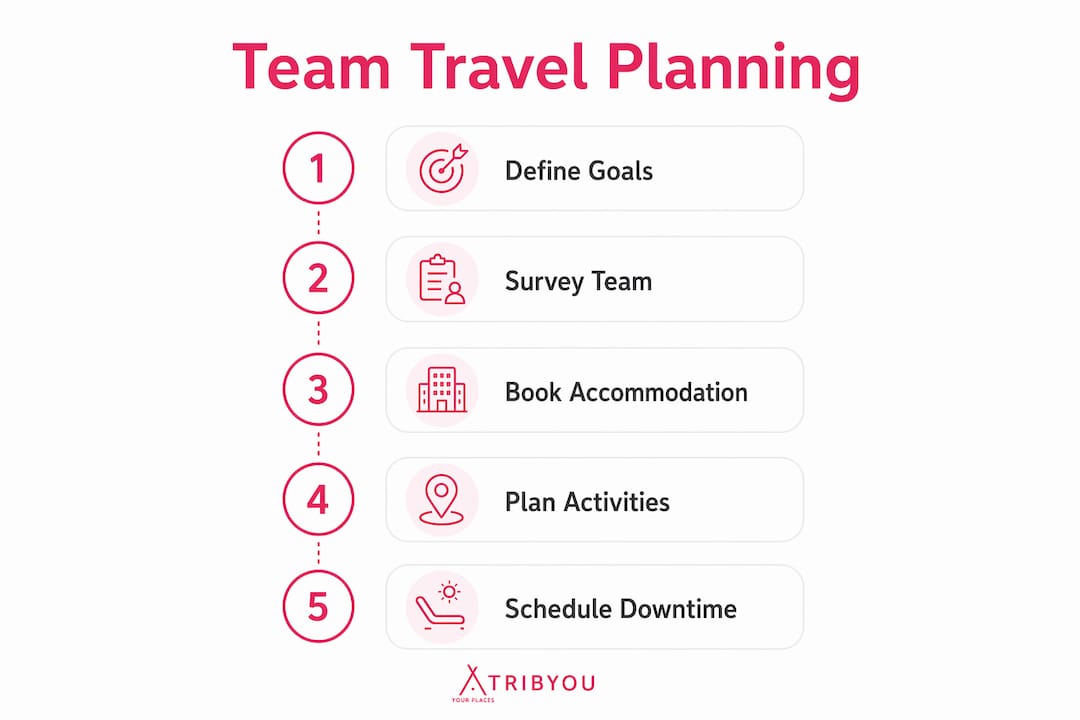
Effective corporate retreat planning starts with a single, non-negotiable step: defining your objective before booking anything. Setting 1–2 specific goals such as rebuilding trust after a restructure or solving a persistent cross-functional problem transforms a generic trip into a strategic culture event. Without that clarity, even a beautiful destination produces a forgettable experience.
Once your objective is set, survey your team. Ask about dietary needs, physical limitations, travel anxiety, and activity preferences. This step does more than improve logistics. It signals to every team member that their comfort matters, which itself is a morale act.

Logistics and accommodation deserve equal attention. Start planning 3–6 months in advance and secure travel insurance early to protect against cancellations and medical emergencies abroad. Use a structured group travel logistics checklist to track flights, transfers, visa requirements, and dietary accommodations in one place.
Accommodation choice shapes team dynamics more than almost any other decision. Shared villas and apart-hotels outperform hotel blocks for bonding because communal living spaces create natural, low-pressure interaction. Here is a quick comparison:
| Accommodation Type | Best Team Size | Key Advantage | Key Trade-off |
|---|---|---|---|
| Shared villa | 6–15 people | Casual bonding, home atmosphere | Requires more coordination |
| Apart-hotel | 15–30 people | Balance of privacy and shared space | Less intimate than a villa |
| Dedicated retreat center | Any size | Reduced planning effort | Higher cost per person |
Pro Tip: Book a villa or retreat center with a shared kitchen and outdoor dining space. Meals prepared and eaten together generate more genuine conversation than any structured icebreaker.
Which activities best build team spirit through travel?
The most effective travel experiences for team building combine structured learning with unstructured social time. Neither alone produces lasting morale gains. Structured activities build shared reference points. Free time lets those reference points deepen into actual relationships.
Experiential learning activities such as cooking classes, cultural tours, hiking, and kayaking consistently outperform conference-room exercises because they place people in unfamiliar situations that require real cooperation. A team that navigates a local market together to source ingredients for a group dinner has practiced communication, negotiation, and shared decision-making without a single slide deck.
Nature-based activities carry an additional benefit. Exposure to natural environments reduces stress, sharpens creative thinking, and encourages collaboration in ways that conventional conference settings cannot replicate. A morning hike before a strategy session produces measurably different energy than a hotel ballroom warm-up.
Strong activity mixes for group travel include:
- Cultural immersion: Local cooking classes, artisan workshops, guided heritage tours
- Outdoor adventure: Hiking, kayaking, cycling, or nature walks in scenic terrain
- Creative collaboration: Group photography challenges, improv workshops, or local craft sessions
- Community contribution: Volunteer projects with local organizations that connect the team to the destination's people
- Informal social time: Shared dinners, evening walks, or unstructured exploration hours
The last item on that list is the one most planners underestimate. Informal time is not wasted time. It is where trust actually forms.
Pro Tip: Assign optional, not mandatory, evening activities. Teams with introverts or parents traveling away from home will engage more authentically when they have genuine choice.
How to design an itinerary that maximizes team engagement
The most reliable scheduling framework for a corporate retreat follows a 30/40/30 time split: 30% work sessions, 40% team-building activities, and 30% free time. This structure prevents the two most common retreat failures: the trip that feels like a working conference in a nicer room, and the trip so packed with activities that people return home exhausted.
A standard retreat runs 5–7 days. Here is how a well-structured daily flow looks in practice:
- Morning (9:00–11:30): Strategy update or focused workshop. Keep it to one topic per session. Two hours of sharp thinking beats four hours of drift.
- Midday (12:00–13:30): Shared lunch, ideally at a local restaurant or prepared together. This is transition time, not dead time.
- Afternoon (14:00–17:00): Team-building activity, cultural excursion, or outdoor experience. This is the 40% block where connection happens.
- Evening (18:00 onward): Free time or optional social event. Dinners, local markets, or a group sunset walk all work well here.
Structured sessions covering strategy and problem-solving reinforce company values when they are tied directly to the retreat's stated objective. A workshop on cross-team communication lands differently when it follows a morning kayaking session where those same communication gaps showed up in real time.
The 'white space' principle recommends keeping no more than 70% of any day structured. That remaining 30% is where organic bonding happens. Over-scheduling creates resentment and fatigue, which directly undercuts the morale gains you are trying to build.
Pro Tip: Build one fully unscheduled half-day into every multi-day retreat. Give people a destination suggestion and a meeting time for dinner. What happens in between is often the most memorable part of the trip.
For destination selection guidance, the TribYou - Your Places article on choosing a retreat destination covers how to match location type to team size and objective.
How do you sustain morale gains after the trip ends?
The morale impact of a well-run retreat fades within weeks without intentional follow-up. The trip creates the conditions for change. Leadership behavior after the trip determines whether that change takes hold.
The most effective post-trip practices include:
- Structured debrief within one week: Hold a 60-minute team session to capture what worked, what surprised people, and what commitments the group wants to carry forward.
- Shared documentation: Compile trip highlights, photos, and key decisions into a shared document. This creates a reference point the team can return to.
- Communication habit reinforcement: If the retreat surfaced better ways of working together, name those habits explicitly and check in on them during regular team meetings for the following 60 days.
- Leadership modeling: Managers who visibly apply lessons from the retreat signal that the experience was real, not performative. This is the single most powerful sustaining factor.
- Annual or biannual cadence: Teams that travel together regularly build cumulative trust. A one-time retreat is a spark. A recurring program is a culture.
Removing teams from routine into new environments creates the cognitive reset that makes reflection possible. The follow-up work converts that reflection into lasting behavioral change. Both halves are required.
Pro Tip: Send a short, anonymous survey within 48 hours of returning. Ask three questions: What was most valuable? What would you change? What one habit do you want to keep? The responses will shape your next retreat and show the team their input matters.
For inspiration on structuring the full experience, the TribYou - Your Places guide to incentive retreat packages offers concrete examples of what high-impact programs look like in practice.
Key takeaways
Team travel builds morale when it combines clear objectives, the right accommodation, balanced scheduling, and deliberate post-trip follow-up.
| Point | Details |
|---|---|
| Define objectives first | Set 1–2 specific goals before planning to turn a trip into a strategic culture event. |
| Choose accommodation for bonding | Shared villas and apart-hotels outperform hotel blocks for genuine team connection. |
| Use the 30/40/30 framework | Split retreat time into 30% work, 40% activities, and 30% free time to prevent burnout. |
| Prioritize unstructured time | No more than 70% of any day should be scheduled; organic moments build the deepest trust. |
| Follow up with intention | Post-trip debriefs and leadership modeling determine whether morale gains last beyond the first week back. |
What i've learned about travel and team morale after years in the field
The most common mistake I see business leaders make is treating the retreat as the product. They invest heavily in the destination, the activities, and the catering, then return to the office and expect the culture to have changed on its own. It does not work that way.
What actually moves the needle is the combination of a genuinely meaningful environment and deliberate leadership behavior before, during, and after the trip. I have seen teams in stunning Italian villas leave more disconnected than when they arrived because no one defined what the trip was for. I have also seen teams in modest countryside farmhouses leave with a level of trust that reshaped how they worked together for the following year. The difference was always intention, not budget.
The other thing I would push back on is the idea that team-building activities need to be elaborate. Some of the most powerful moments I have witnessed happened during an unscheduled evening walk through a local village, or a spontaneous conversation over a shared meal. Those moments are not accidental. They are the product of an itinerary that left room for them to happen.
Authentic destinations matter too. When a team travels somewhere with real local character, where the food, the people, and the landscape are genuinely different from their daily environment, the cognitive shift is deeper. That shift is what makes reflection and reconnection possible. Generic resort settings rarely produce it.
If you are planning a retreat in 2026, my honest recommendation is this: spend less time on the activity schedule and more time on the environment, the objective, and the follow-up plan. Those three elements determine whether your investment produces lasting results or just a nice photo album.
— Luca
Plan your next team retreat with TribYou - your places
TribYou - Your Places designs curated team travel experiences that connect your people to authentic destinations, local communities, and meaningful activities. Every program is built around your team's specific goals, whether that means rebuilding trust, sparking creativity, or rewarding performance with an experience worth remembering.
From shared villas in the Italian countryside to cultural immersion programs in hidden destinations, TribYou - Your Places manages the full logistics so your HR team can focus on people, not spreadsheets. Discover how TribYou - Your Places can design a retreat that your team will talk about long after they return to the office.
FAQ
What does it mean to boost morale with team travel?
Boosting morale through team travel means using shared travel experiences to strengthen trust, improve communication, and renew motivation among employees. It is a structured approach to culture-building that produces measurable results in retention and collaboration.
How long should a corporate team retreat be?
A standard corporate retreat runs 5–7 days, with a recommended split of 30% work sessions, 40% team-building activities, and 30% free time. Shorter trips of 2–3 days can work for smaller teams with focused objectives.
What accommodation type is best for team bonding?
Shared villas work best for teams of 6–15 people, while apart-hotels suit groups of 15–30. Both outperform hotel blocks because communal living spaces create natural, low-pressure interaction that builds genuine connection.
How do you maintain morale gains after a retreat?
Hold a structured debrief within one week of returning, document key commitments, and have leaders visibly model the behaviors the retreat reinforced. Without intentional follow-up, morale benefits typically fade within a few weeks.
How far in advance should you plan a team travel experience?
Plan 3–6 months ahead to secure the best accommodation options, manage travel logistics, and arrange group travel insurance. Earlier planning also gives team members time to prepare and increases participation rates.