

Communication is the single most important factor determining whether a group trip succeeds or falls apart. Without clear channels, defined roles, and structured decision-making, even the most carefully planned itinerary collapses under the weight of misaligned expectations and unanswered messages. The role of communication in group travel extends far beyond logistics. It shapes trust, preserves relationships, and determines how well a group adapts when plans change. Travel experts recommend maintaining a budget buffer of 10–15% and scheduling one free afternoon for every two travel days. Both buffers only work when the group communicates clearly enough to use them.
What are the main communication challenges in group travel?
Group travel communication fails in predictable ways. Recognizing those patterns is the first step toward fixing them.
The most common failure point is the group chat itself. Messages about restaurant recommendations, flight delays, and payment reminders all land in the same thread. Group chats are unstructured and ineffective for decision-making. Critical logistics get buried under reaction emojis and off-topic banter. By the time someone needs the hotel address, it has scrolled out of view.
The second problem is decision paralysis. Groups rarely have a clear mechanism for closing a discussion. Someone proposes a dinner spot, three people respond, and five others stay silent. The conversation stalls. Nobody books. This pattern repeats across every planning decision until the trip is two weeks away and nothing is confirmed.
The third problem is accountability. When a question goes unanswered in a group chat, nobody feels personally responsible. Silence reads as passive agreement, but it is actually passive avoidance. The result is a planning stalemate that frustrates the organizer and exhausts everyone.
- Chaotic group chats mix social conversation with logistics, burying critical information.
- No decision deadline means discussions stay open indefinitely, stalling progress.
- Diffuse accountability means no single person owns a response, so nothing gets resolved.
- Information overload causes travelers to disengage from the planning process entirely.
The fix for decision paralysis is the 72-hour rule. Silence equals consent after 72 hours, which means the group moves forward with the best available option when no objection is raised within that window. This single rule eliminates most planning stalemates.
Pro Tip: Post the 72-hour rule at the top of your group chat before planning begins. When everyone knows the rule upfront, enforcing it feels fair rather than authoritarian.

How can structured communication improve group travel coordination?
Structure does not mean bureaucracy. It means giving every piece of information a designated place so nobody has to hunt for it.
The most effective foundation is a single shared document that serves as the group's source of truth. Separating logistics from banter on different platforms drastically reduces information loss. The shared document holds the itinerary, accommodation addresses, payment records, and emergency contacts. The group chat handles social conversation and quick questions. These two channels should never overlap.
Structured communication also requires defined roles. Without them, the same two or three people carry all the planning weight while others coast. Rotating the daily point person role spreads the mental load and keeps everyone engaged. The daily coordinator handles logistics for that day: confirming reservations, managing timing, and fielding questions. The role rotates each morning so no single person burns out.
- Assign a trip captain to own the master itinerary and final decisions on logistics.
- Rotate the daily coordinator so each person takes one day of operational responsibility.
- Use polls for group decisions on restaurants, activities, and optional excursions.
- Set response deadlines for every open question and communicate them explicitly.
- Pin the shared document link at the top of every communication channel the group uses.
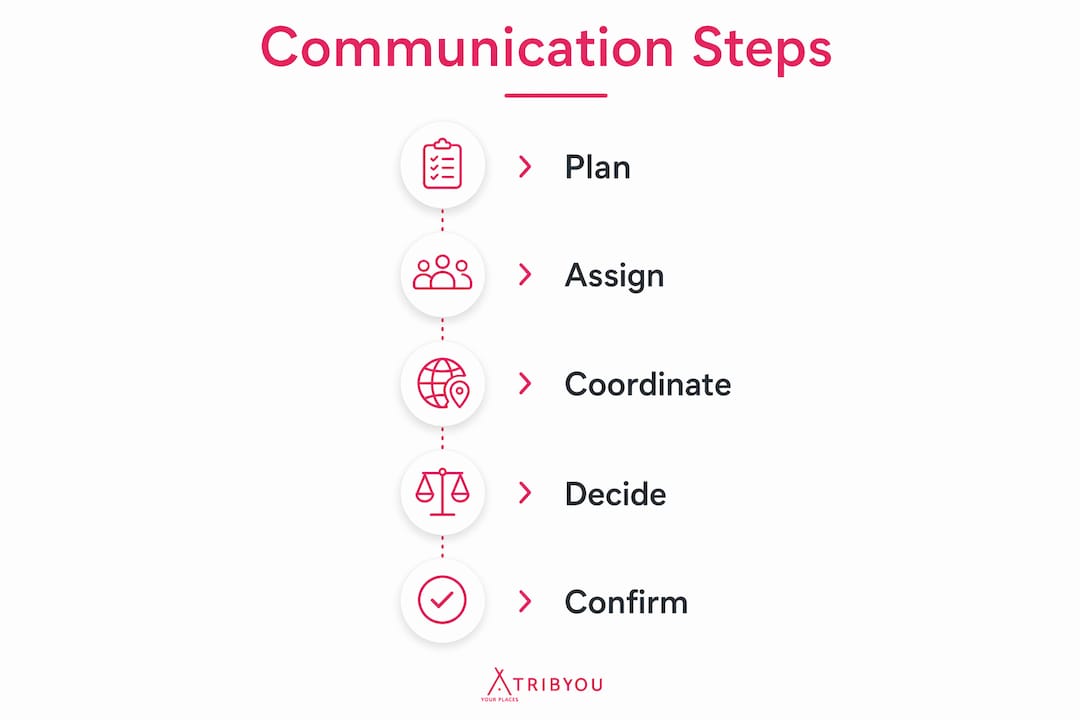
Decision-making also benefits from a sequential stack. Addressing decisions in order prevents the group from reopening settled choices. Lock in travel dates first, then destination, then accommodation, then activities. Once a layer is closed, it stays closed. This structure keeps planning focused and prevents the exhausting cycle of relitigating decisions.
Pro Tip: Create a simple Google Form for any decision with more than four options. A poll with a 48-hour deadline produces a clear winner faster than any group chat thread.
What digital tools and platforms support effective communication in group travel?
The right tools reduce friction. The wrong tools, or too many tools, create new confusion. The goal is to match each communication need to one specific platform and train the group to use it consistently.
| Communication need | Recommended tool type | Key benefit |
|---|---|---|
| Social chatter and quick questions | Messaging apps (WhatsApp, Telegram) | Fast, familiar, and low friction |
| Itinerary and logistics | Shared docs (Google Docs, Notion) | Permanent, searchable, and editable |
| Expense tracking | Expense apps (Splitwise, Tricount) | Transparent and reduces money tension |
| Group decisions and polls | Poll tools (Doodle, Google Forms) | Structured input with a clear deadline |
| Emergency contacts | Offline document plus digital backup | Accessible without internet connectivity |
The table above reflects a core principle: one tool per function. When groups use a single messaging app for everything, important information disappears. When they use a shared document for itinerary details, that information stays accessible for the entire trip.
Pinning the shared document link in every channel is not optional. Storing key information accessibly before departure prevents the frantic search for a hotel address when the group is standing in an airport. Digital reservations and booking confirmations deserve the same treatment. Understanding how digital reservations work helps every traveler in the group access their own information without depending on the organizer.
The most overlooked tool is the offline backup. Connectivity abroad is unreliable. Every critical document, from the itinerary to emergency contacts, should exist in a format that works without a data connection.
How does communication enhance the overall experience and group dynamics?
Effective communication in group trips does more than prevent logistical failures. It actively builds the quality of the shared experience. Communication is the backbone of the tourism industry, reducing misunderstandings and creating emotional connections between travelers and the places they visit.
The most underrated communication practice in group travel is the routine check-in. Ritualized low-pressure check-ins surface individual needs and prevent silent frustration from building into conflict. A brief end-of-day question, such as "What worked today and what would you change tomorrow?", gives quieter group members a structured moment to speak. It also gives the coordinator real-time feedback to adjust the next day's plan.
- Trust grows when travelers know their concerns will be heard and acted on.
- Flexibility increases when the group has a clear process for changing plans without drama.
- Inclusion improves when quieter voices get a dedicated moment to contribute.
- Relationships survive the trip when communication prevents resentment from accumulating silently.
The rotating coordinator role reinforces these dynamics. When each person takes a turn managing the day's logistics, empathy for the organizer's workload increases across the group. Travelers who have personally managed a day of reservations and timing are far less likely to complain when something goes slightly off schedule.
Proactive communication also preserves trust when disruptions happen. Proactive communication maintains trust even when plans change unexpectedly. A group that has established clear channels and honest communication habits adapts to a canceled flight or a closed restaurant far more gracefully than one that has been operating on assumptions.
When and how should emergency communication be handled in group travel?
Emergency communication requires preparation before departure, not improvisation during a crisis. The U.S. State Department recommends that travelers store emergency contacts and embassy information both digitally and in a physical format before leaving home. Connectivity abroad is unreliable, and a crisis is the worst moment to search for a phone number.
- Compile emergency contacts before departure: local emergency services, the nearest embassy or consulate, travel insurance hotline, and the group organizer's number.
- Assign a communication hub person who serves as the primary contact for the group in an emergency. This person holds all critical information and coordinates with external services.
- Share the emergency document with every traveler in a format that works offline, such as a downloaded PDF or a screenshot saved to each phone.
- Establish a check-in protocol for situations with limited connectivity, such as a daily text to confirm everyone is safe.
Planning for corporate group travel emergencies follows the same logic. The group needs a clear chain of communication before anything goes wrong. When a protocol exists, the group responds with coordination rather than panic. That difference matters enormously in a foreign country with a language barrier.
Key Takeaways
Structured communication is the defining factor between a group trip that builds lasting memories and one that damages relationships.
| Point | Details |
|---|---|
| Separate logistics from social chatter | Use a shared document for itinerary and a messaging app for conversation to prevent information loss. |
| Apply the 72-hour rule | Silence equals consent after 72 hours, which eliminates decision paralysis and keeps planning moving. |
| Rotate the daily coordinator | Spreading the organizational role prevents burnout and builds empathy across the group. |
| Prepare emergency contacts offline | Store embassy numbers and emergency contacts in a format that works without internet access. |
| Use routine check-ins | Brief daily check-ins surface individual needs and prevent silent frustration from becoming conflict. |
What I've learned about communication in group travel
After years of organizing and joining group trips, I've come to one firm conclusion: most group travel problems are communication design problems, not personality problems. The traveler who "always causes drama" is usually reacting to a system that gave them no structured way to raise a concern earlier.
The shift that changed everything for me was treating the group chat as a social space only. The moment I moved all logistics to a shared Google Doc and stopped expecting the chat to hold critical information, the quality of both spaces improved. The chat became fun again. The document became reliable.
I've also learned that check-ins work best when they are low-pressure and specific. Asking "Is everyone happy?" produces polite nods. Asking "What's one thing you'd change about tomorrow's plan?" produces honest answers. The second question gives quieter travelers permission to speak without putting them on the spot.
The hardest lesson was enforcing deadlines. The first time I applied the 72-hour rule with a group of friends, it felt uncomfortable. By the second trip, everyone expected it and the planning moved twice as fast. Clear deadlines are not unkind. They are respectful of everyone's time.
The group travel logistics checklist I now use before every trip covers communication setup as a first step, not an afterthought. That single change has saved more trips than any other adjustment I've made.
— Luca
How TribYou - Your Places supports group travel coordination
Group travel coordination works best when itinerary, communication, and planning live in one place rather than scattered across a dozen apps and threads.
TribYou - Your Places is built for exactly this. The platform connects travelers, teams, and organizers with curated accommodations, experiences, and local partners, all within a single ecosystem designed for both leisure and professional group travel. Whether you are planning a corporate retreat, a workation, or a multigenerational trip, TribYou - Your Places gives your group a structured foundation for communication and coordination. Explore what group travel with TribYou looks like for your team and find out how much smoother the planning process becomes when everything is in one place.
FAQ
What is the role of communication in group travel?
Communication coordinates logistics, builds trust, and prevents misunderstandings that derail group trips. Without clear channels and defined roles, even well-planned itineraries fail under the weight of unanswered messages and stalled decisions.
How do you enforce decisions in a group travel chat?
The 72-hour rule is the most effective method. If no objection is raised within 72 hours of a proposal, the group moves forward with that option. This eliminates planning paralysis without requiring unanimous agreement.
What tools work best for group travel communication?
Use messaging apps like WhatsApp or Telegram for social conversation, a shared document like Google Docs or Notion for the itinerary, and expense apps like Splitwise or Tricount for payments. One tool per function prevents information overload.
How should a group handle emergencies abroad?
Store emergency contacts, travel insurance numbers, and local embassy information both digitally and in an offline format before departure. Assign one person as the communication hub and establish a daily check-in protocol for areas with limited connectivity.
How do check-ins improve group travel dynamics?
Routine check-ins surface individual needs before they become conflicts. Asking a specific question, such as what one traveler would change about tomorrow's plan, gives quieter group members a structured moment to contribute and helps the coordinator adjust in real time.