

Balancing a work travel lifestyle means intentionally structuring your schedule, income, and travel choices so that professional output and personal exploration reinforce each other rather than compete. This is not a permanent vacation. It is a demanding organizational model that requires reliable income, stable infrastructure, and clear daily boundaries. Professionals who succeed at this treat it as a discipline, not a perk. The strategies below cover prerequisites, scheduling frameworks, destination selection, and common pitfalls, giving you a complete system for sustainable work-travel integration.
What does it take to balance work travel lifestyle effectively?
The foundation of any work-travel model is income security. Securing consistent remote income before traveling full-time is non-negotiable. Professionals who move first and figure out income later typically burn through savings within months. Lock in your remote contract, freelance retainer, or location-independent business before booking a one-way ticket.
Reliable connectivity is the second pillar. Carrying a dedicated 5G travel router is the best practice among experienced remote workers. Public Wi-Fi and accommodation networks fail at the worst moments. A personal router gives you private, stable access regardless of where you are staying.
Beyond connectivity, you need the right physical setup and legal clarity. The essentials include:
- Ergonomic gear: A portable laptop stand, compact keyboard, and travel mouse protect your posture and reduce fatigue during long work sessions.
- Visa and legal compliance: Research digital nomad visas, work permits, and tax residency rules for each destination before arrival. Ignoring this creates serious legal exposure.
- Health and travel insurance: Standard travel insurance rarely covers remote work scenarios. Choose a policy that covers medical evacuation, equipment loss, and trip interruption.
- Emergency savings: Maintain at least three months of living expenses in a liquid account. Unexpected costs, from flight cancellations to equipment failure, are routine.
- Backup internet: A local SIM card with a data plan serves as a secondary connection when your router fails.
Pro Tip: Test your full remote work setup, including video calls, file uploads, and VPN access, from a new location before committing to a long stay. Discovering a problem on day one of a client deadline is avoidable.
Hospitality experts note that efficient food and lodging management is also a core operational skill for remote workers. Knowing how to source reliable accommodation with a dedicated workspace, and how to maintain nutrition on the road, directly affects your daily output.

How can professionals structure daily routines for work-travel balance?
Structure is what separates professionals who thrive while traveling from those who burn out. The most effective framework is the 8-4-12 fluid workday: four hours of deep, focused work in the morning, four hours of local exploration or physical activity in the afternoon, and two hours of asynchronous tasks and communication in the early evening. This model respects both your professional obligations and the reason you chose to travel.
Anchor hours are equally critical. Booking two protected hours daily on your professional calendar, labeled as unavailable, prevents work from consuming your personal time. These hours might be a morning walk, a long lunch, or an evening meal. The label matters because it signals to colleagues that you are not available, not that you are slacking.
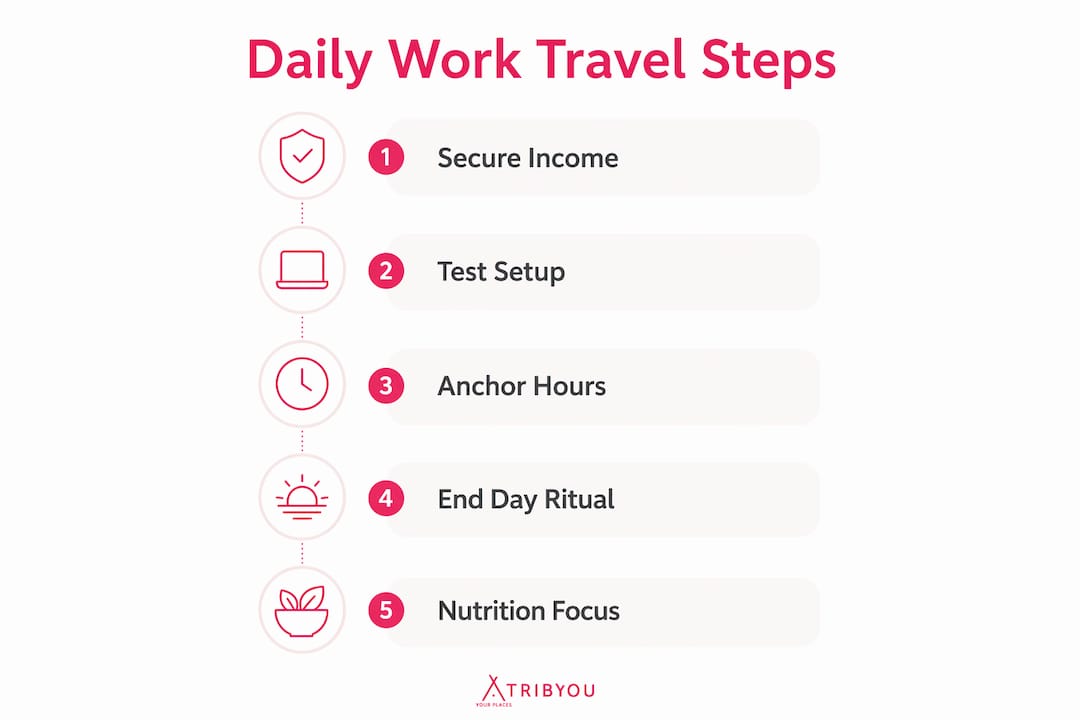
A structured end-of-day ritual completes the boundary system. Closing browser tabs, writing next-day priorities, and physically leaving your workspace sends a clear psychological signal that the workday is over. Without this ritual, work hours expand into evenings and weekends, which is the primary driver of remote work burnout.
Here is a practical weekly scheduling approach:
- Block your core hours first. Set your four deep-work hours at the same time each day. Consistency builds a mental work mode that activates automatically.
- Schedule meetings in clusters. Group all calls into one or two daily windows. Scattered meetings destroy focus blocks.
- Designate travel days as low-productivity days. Working during transit reduces productivity significantly. Plan only asynchronous tasks on days you move between destinations.
- Manage time zone overlaps proactively. Use a world clock tool to identify overlap windows with your team. Communicate your available hours at the start of each new location.
- Review and reset weekly. Every Sunday, assess what worked and what did not. Adjust the following week's schedule based on what you learned.
Pro Tip: Use a physical notebook to write your next-day priorities at the end of each workday. The act of writing by hand reinforces the psychological close of the workday far more effectively than typing.
Which destinations and travel strategies best support sustained balance?
Destination choice is a professional decision, not just a personal preference. The slow travel model, staying 30–90 days per location, is the most sustainable approach for professionals. It prevents the common burnout cycle that hits frequent movers around the three to four month mark. Staying longer lets you establish grocery routines, a reliable workspace, and the mental clarity that short-term travel constantly disrupts.
Weekly relocations cause decision fatigue and project delays. Every move requires you to re-solve the same problems: where to work, where to eat, how to get around. Slow travel eliminates that overhead and lets you focus on actual work and genuine local experience.
When evaluating destinations, apply these criteria:
- Reliable infrastructure: Consistent electricity, fast internet, and accessible coworking spaces are baseline requirements, not bonuses.
- Walkable amenities: Access to grocery stores, cafes, and fitness facilities within walking distance reduces daily logistics and supports healthy routines.
- Time zone compatibility: Choose destinations within three to four hours of your primary client or team base to keep meeting schedules manageable.
- Visa clarity: Confirm that your nationality can legally work remotely from that country. Many destinations now offer specific digital nomad visa programs.
- Cost of living: A destination that strains your budget creates financial stress that undermines the entire balance you are trying to build.
Structured travel planning that aligns flight times and accommodation check-ins with your work schedule reduces transit fatigue. Book flights on Friday evenings or weekends when possible. Arrive at a new destination a day before work resumes to allow for setup and orientation.
Workation retreats offer a curated alternative to self-managed slow travel. Platforms like TribYou - Your Places provide structured workation programs that combine reliable workspaces, authentic local experiences, and community, removing the logistical burden from the professional entirely.
Pro Tip: Research your destination's key infrastructure factors before committing to a stay. Internet speed tests, coworking space reviews, and local expat forums give you ground-level data that tourism sites never provide.
Maintaining nutrition while traveling is a real productivity factor. Professionals who eat well on the road report better focus and fewer energy crashes during work hours. Prioritize destinations with accessible fresh food markets and cooking facilities.
What common challenges arise and how do you troubleshoot them?
Unexpected logistical issues are the leading cause of work-travel balance failure. Professionals who plan for contingencies recover quickly. Those who do not lose days of productivity and accumulate stress that compounds over time.
The most frequent challenges and their solutions:
- Connectivity failure: Always carry a local SIM card and a 5G travel router. Test your connection speed before your first work session at any new location.
- Social isolation: Join local coworking spaces, attend professional meetups, and use community platforms to connect with other remote workers. Isolation is a slow productivity killer.
- Irregular sleep and nutrition: Treat sleep and meal times as fixed appointments. Disrupted sleep degrades cognitive performance faster than almost any other variable.
- Unexpected travel delays: Build buffer time between travel days and high-stakes deadlines. Never schedule a major client deliverable the day after a long-haul flight.
- Financial overspending: Track expenses weekly, not monthly. Frequent travel accumulates costs in ways that monthly reviews miss until the damage is done.
"Maintaining professional credibility while traveling requires the same consistency and availability as working from a home office. Real success depends on organizational structure and discipline, not on the novelty of the destination."
Burnout recognition is a skill that most remote workers develop too late. Signs include declining output quality, irritability during calls, and a growing reluctance to explore the destination you chose. When these appear, treat them as operational signals. Reduce travel frequency, extend your current stay, and restore your anchor hours before the situation worsens.
Key Takeaways
Sustainable work-travel balance requires income security, structured daily routines, and slow travel principles applied consistently before any destination becomes enjoyable.
| Point | Details |
|---|---|
| Secure income first | Confirm stable remote income before traveling full-time to avoid burning savings. |
| Use the 8-4-12 workday | Dedicate four hours to deep work, four to exploration, and two to async tasks daily. |
| Practice slow travel | Stay 30–90 days per location to build routines and prevent burnout from frequent moves. |
| Set anchor hours | Block two daily non-work hours on your calendar to protect personal time from work-creep. |
| Plan for failure | Carry backup internet, buffer travel days, and maintain emergency savings for disruptions. |
The part nobody tells you about working while traveling
Most content about the remote work travel lifestyle focuses on the upside: the views, the freedom, the flexibility. After years of observing how professionals actually perform in this model, the honest picture is more nuanced.
The professionals who sustain this lifestyle long-term are, almost without exception, the most disciplined people in the room. They are not the ones posting from hammocks. They are the ones who have a 7:00 AM work block, a dedicated router, and a Sunday planning ritual. The travel is real. The freedom is real. But it sits on top of a structure that most people underestimate.
The biggest mistake I see is treating slow travel as a compromise rather than a feature. Staying in one place for two months feels less exciting than moving every two weeks. But the professionals who move constantly are the ones who burn out, miss deadlines, and eventually go home. The ones who stay longer build something that actually works.
My honest recommendation: start with a single 60-day workation in a destination with strong infrastructure and a coworking community. Treat it as a test of your systems, not a vacation. If your routines hold, your output stays consistent, and you still want to explore the place after week four, you have found your model. Then scale from there.
The work-travel lifestyle is not for everyone, and that is fine. But for professionals who want it to work, the path is clear. Build the structure first. The freedom follows.
— Luca
TribYou - Your Places: curated support for work-travel professionals
Professionals who want the benefits of slow travel without the logistical overhead have a direct path forward with TribYou - Your Places.
TribYou - Your Places designs workation and retreat programs built specifically for remote workers and professional teams. Every destination in the TribYou - Your Places network is vetted for reliable infrastructure, authentic local experiences, and workspace quality. You get the structure that makes balance possible, without spending weeks researching connectivity speeds and visa rules. Whether you are planning a solo workation or a team retreat, TribYou - Your Places handles the logistics so you can focus on the work and the experience. Reach out to the TribYou - Your Places team to find the right program for your professional needs.
FAQ
What is a work travel lifestyle?
A work travel lifestyle is a professional model where remote workers integrate their career duties with extended travel, typically using structured routines and slow travel principles to maintain productivity across multiple destinations.
How long should I stay in one place to avoid burnout?
The slow travel model recommends staying 30–90 days per location. Shorter stays cause decision fatigue and disrupt the routines that keep work output consistent.
What tools do I need to work remotely while traveling?
A dedicated 5G travel router, a local SIM card, ergonomic portable gear, and a VPN are the core tools. Backup internet options are non-negotiable for professional reliability.
How do I prevent work from taking over my travel time?
Book two protected non-work hours daily on your professional calendar and follow a strict end-of-day ritual, such as closing tabs and writing next-day priorities, to create a clear boundary between work and personal time.
Is the work travel lifestyle sustainable long-term?
Yes, with the right structure. Professionals who secure stable income first, practice slow travel, and maintain consistent daily routines sustain this model for years. Those who skip the structure typically burn out within three to four months.