

Most business leaders assume that cash is the most direct path to higher performance. Give people money, and they'll work harder. The logic seems sound. But research consistently challenges this assumption, and understanding why incentive trips boost performance reveals something more nuanced about human motivation. Incentive travel, the industry's formal term for reward-based travel programs tied to performance targets, outperforms cash in key metrics that actually matter to organizations: retention, loyalty, and sustained effort. This guide breaks down the science, the business case, and the design principles that make incentive travel a strategic tool rather than a discretionary perk.
Table of Contents
- Key Takeaways
- Why incentive trips boost performance: the motivational science
- Measurable business outcomes from incentive travel
- How incentive travel compares to other reward types
- Designing programs that actually drive results
- My take on why cash will never replace this
- Build your next incentive program with TribYou - Your Places
- FAQ
Key Takeaways
| Point | Details |
|---|---|
| Travel beats cash in motivation | Individual travel is rated extremely motivating by 61% of respondents, outperforming cash and gift cards. |
| Retention impact is significant | 89% of incentive travel attendees report higher loyalty and stronger intention to stay with their employer. |
| Measurement drives ROI confidence | Top-performing companies track sales, retention, and customer loyalty metrics to validate incentive program outcomes. |
| Design matters more than destination | Program mechanics, recognition moments, and visible progress loops drive performance more than any single location choice. |
| Executive sponsorship amplifies results | Programs with strong leadership support correlate with better business outcomes and stronger employee participation. |
Why incentive trips boost performance: the motivational science
To understand why travel rewards work so well, you need to understand a concept from behavioral economics called hedonic adaptation. It describes how people quickly return to a baseline level of happiness after receiving a reward. Cash is particularly vulnerable to this effect. An employee receives a bonus, pays a bill or adds it to savings, and within days the emotional impact is gone. The money disappears into mental accounting alongside all other income.
Travel does not work that way. An upcoming trip to a coastal resort or a curated experience in a historic Italian city remains vivid in the mind for weeks before it ever happens. This anticipation effect is real, and it carries directly into the qualification period. Emotional anticipation from travel amplifies employee effort during the periods that matter most for business performance.
Behavioral researchers also describe what they call "trophy value." Non-cash rewards, especially travel, create lasting emotional memory and social reinforcement that equivalent cash simply cannot replicate. A salesperson who earned a group trip to Sicily tells that story at family dinners years later. Tangible experiential rewards increase effort by making the reward more salient and emotionally valued than any financial equivalent. That story becomes part of how the employee sees themselves within the organization, which is a powerful identity shift.
"Incentive travel is the dominant non-cash motivator across all generations, outperforming gift cards, merchandise, and recognition-only programs in both stated preference and behavioral impact."
The generational dimension matters for HR leaders. Whether your high performers are Gen X managers or younger sales professionals, individual travel rates highest in motivation across all demographic groups, with 61% calling it extremely motivating compared to significantly lower scores for cash alternatives.
Pro Tip: Communicate the incentive trip destination and experience details early in the qualification period. The more vividly employees can picture the reward, the stronger the motivational pull throughout the performance window.
Measurable business outcomes from incentive travel
The motivational case for travel rewards is compelling. But business leaders and HR professionals need numbers, not just psychology. The data from recent studies on incentive programs effectiveness is clear.
89% of attendees report higher loyalty and a stronger intention to remain with their employer after participating in an incentive trip. This is not a small effect. Consider the cost of replacing a high-performing sales employee, typically estimated at 150% to 200% of annual salary when you factor in recruitment, onboarding, and lost productivity. A single well-designed incentive trip that retains three top performers more than justifies its budget.
The re-qualification dynamic is equally powerful. 93% of incentive travel participants report motivation to qualify again the following year. This means a well-run program does not just reward past performance. It actively seeds the motivation for future performance before the next cycle even begins.
| Metric | Cash Bonuses | Incentive Travel |
|---|---|---|
| Lasting emotional impact | Low | High |
| Retention effect | Moderate | Strong (89% loyalty increase) |
| Re-qualification motivation | Low | Very High (93%) |
| Social reinforcement | None | Strong |
| Measurable ROI confidence | Moderate | High (when tracked systematically) |
Among top-performing European companies, 58% strongly agree that incentive travel contributes directly to business performance, and 62% actively track ROI metrics to validate program outcomes. These are not companies treating trips as nice-to-haves. They are treating them as business interventions with expected returns.
Pro Tip: Before launching your next incentive program, establish a baseline by documenting current sales numbers, customer satisfaction scores, and retention rates for your eligible employee group. Post-program comparison is how you build an internal ROI case.
For a structured approach to managed program benefits, tracking methodology matters as much as the experience itself.
How incentive travel compares to other reward types
Cash, gift cards, merchandise, recognition awards, and incentive travel are not interchangeable. Each operates differently in the motivational economy of your workforce. Understanding those differences helps you allocate reward budgets where they actually produce results.
Cash bonuses feel fair and flexible, but their motivational power degrades rapidly due to hedonic adaptation. Employees also mentally categorize cash with income, which means it carries none of the social visibility or identity reinforcement that travel provides. A $2,000 bonus and a $2,000 trip to a curated destination are not equivalent in motivational terms, even if the dollar figure matches.
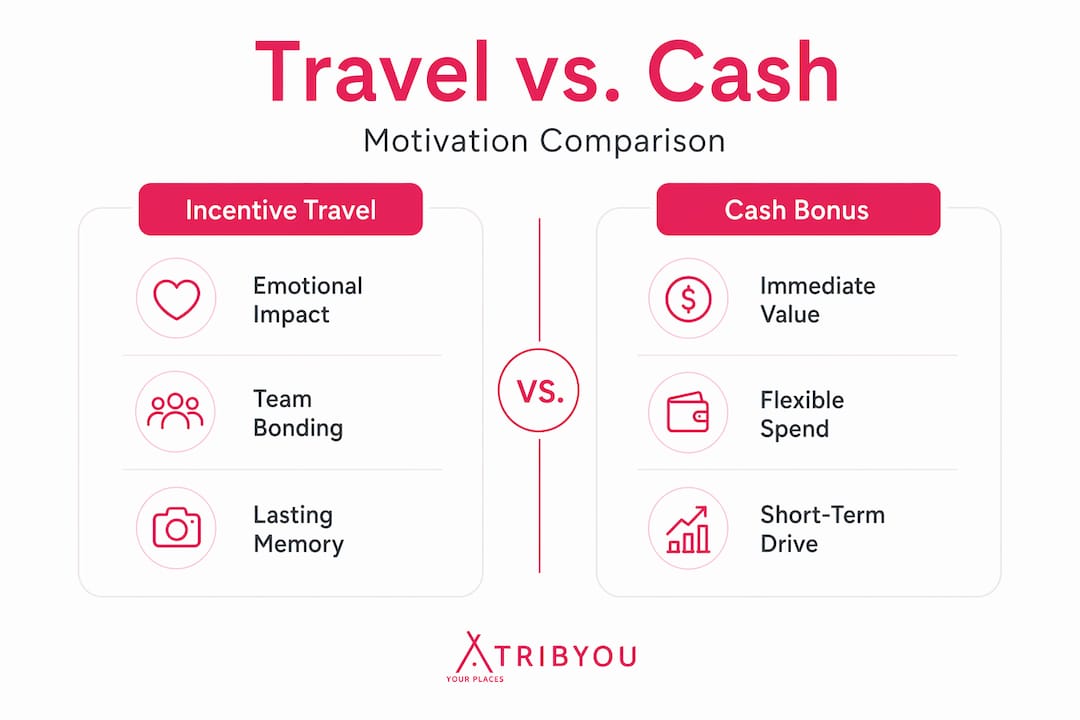
Gift cards and merchandise occupy a middle ground. They have some trophy value and create a physical reminder of recognition, but they lack the social dimension and shared storytelling that group or individual travel generates. They work well as secondary reinforcement but rarely sustain effort over a multi-month qualification period the way a travel reward does.
Here is how common reward types compare on the criteria that matter most:
- Individual incentive travel: Highest motivation scores, strong retention effect, creates lasting social narrative, re-qualification drive is very high.
- Group incentive travel: Adds team cohesion to the individual benefits, slightly lower individual motivation score (50% vs. 61%), but builds cross-functional relationships.
- Cash bonuses: High perceived fairness, fast adaptation, low lasting impact, no social reinforcement.
- Gift cards and merchandise: Moderate motivation, moderate trophy value, limited social reinforcement, easier to budget.
- Recognition only programs: Important as a complement but rarely sufficient as a standalone motivator for sustained performance.
The critical warning for program designers: incentive travel must be deliberately differentiated from other reward types to maintain its prestige. If leadership begins treating travel as interchangeable with a cash equivalent or starts cutting the quality of experiences to save budget, the motivational impact erodes quickly. The prestige of the reward is part of the reward.
Designing programs that actually drive results
Knowing why travel motivates employees is one thing. Building a program that translates that motivation into consistent performance improvement requires deliberate design. The destination you choose matters far less than most planners think. Program design mechanics — the qualification structure, progress visibility, and recognition moments — are what drive results.
Here are the six design principles that separate high-impact incentive programs from expensive perks:
-
Set clear, specific qualification targets. Ambiguity kills motivation. Employees need to know exactly what performance level qualifies them, and they need to believe the target is achievable with effort. Stretch targets that feel impossible produce disengagement rather than effort.
-
Make progress visible throughout the qualification period. Regular leaderboards, progress updates, and milestone acknowledgments keep the emotional connection to the reward alive. Visible progress and recognition moments create a sustained motivation loop that cash simply cannot replicate.
-
Design recognition into the trip itself, not just the qualification. The award ceremony, the personalized acknowledgment from leadership, and the peer recognition during the experience are as motivating as the destination. Participants need to feel seen, not just rewarded.
-
Tailor experiences to participant preferences. Top-performing companies prioritize perceived value and uniqueness in trip design over cost minimization. A curated local experience in a destination that feels genuinely exclusive carries more motivational weight than a standard hotel package.
-
Secure strong executive sponsorship. Companies where senior leaders actively sponsor incentive programs report consistently better outcomes than those where the program sits exclusively in HR or marketing. Leadership visibility signals that the organization genuinely values high performance.
-
Measure systematically and update continuously. Top performers track ROI using pre and post performance data, participant feedback surveys, and business KPI comparisons. Programs that get iterated based on data sustain their impact across multiple cycles. Programs that stay static gradually lose their motivational power.
For organizations looking at real incentive retreat packages to understand what excellent design looks like in practice, the structural differences between generic trips and purpose-built programs are immediately apparent.
My take on why cash will never replace this
I have spoken with executives who genuinely believe their top performers would rather have a bonus than a trip. And I understand the instinct. Cash feels direct. Transparent. Unambiguous. But in my experience, this assumption almost always reflects how leaders think about rewards, not how their employees actually respond to them.
The most memorable conversations I have had with high-performing sales teams are about trips they took five or seven years ago. They remember who was there, what they experienced, and how their company honored them in front of their peers. Nobody tells a story about a bonus they received in 2019.
What I have found to be consistently true is this: the destination matters far less than most planners obsess over. I have seen uninspiring locations produce extraordinary outcomes because the program design was tight, the recognition was genuine, and leadership showed up with real commitment. And I have seen beautiful destinations fail to move the needle because the program felt like a poorly communicated afterthought.
If you lead an HR function or a sales organization, my strongest advice is to stop asking whether travel beats cash in theory and start auditing your current program's design mechanics. Are your qualification criteria clear? Does progress get communicated with enough frequency to sustain motivation? Does leadership co-own the program or simply approve the budget? Those execution details, not the resort you pick, determine whether your program actually changes behavior.
The organizations I have seen get the most from incentive travel treat it as a cultural signal, not just a reward. It tells employees: we invest in experiences that recognize you as a whole person, not just a line on a performance chart. That message compounds over time in ways that a deposit in a bank account never will.
— Luca
Build your next incentive program with TribYou - Your Places
Your team's best performance deserves more than a generic resort package. TribYou - Your Places specializes in designing corporate incentive travel experiences that combine authentic local culture, premium accommodations, and program structures built around your specific business goals.
Whether you are designing your first formal incentive program or optimizing an existing one, TribYou - Your Places offers customizable packages aligned with participant preferences and measurable performance outcomes. From curated retreats in Italy's most authentic destinations to internationally tailored group experiences, every program is built to make the reward feel genuinely exclusive and worth earning. Explore how TribYou's incentive experiences can help your organization turn performance targets into lasting motivation, retention, and loyalty.
FAQ
Why do incentive trips motivate employees more than cash?
Travel creates lasting emotional memory and social recognition that cash cannot replicate. Research shows individual travel is rated extremely motivating by 61% of respondents, compared to significantly lower scores for cash and gift cards.
How do incentive trips affect employee retention?
The retention impact is measurable and significant. 89% of incentive travel participants report stronger loyalty and higher intention to remain with their employer after attending a company-sponsored trip.
What makes an incentive travel program effective?
Program design mechanics matter more than destination choice. Clear qualification targets, visible progress communication, genuine recognition moments, and strong executive sponsorship are the primary drivers of performance improvement through incentives.
How should companies measure incentive travel ROI?
Establish baseline metrics before the program begins, including sales performance, retention rates, and customer satisfaction scores. Top performers track sales performance, customer loyalty, and retention data systematically to build a credible ROI case.
Are incentive trips effective for all employee generations?
Yes. Incentive travel ranks as the top non-cash motivator across all demographic groups. Individual travel consistently outperforms merchandise, gift cards, and recognition-only programs in both stated preference and behavioral motivation across generational segments.