

Most executive teams leave their offsites feeling energized. Then nothing changes. Only 28% of executives rate their last offsite as producing decisions that fundamentally changed company operations. That number should stop you cold. Why executive offsites drive strategy is not a question of whether to hold them. It is a question of whether you design them to produce decisions or just conversations. The difference between those two outcomes determines whether your next offsite becomes a turning point or an expensive team dinner.
Table of Contents
- Key Takeaways
- Why executive offsites drive strategy for leadership teams
- Why most offsites fail to move strategy forward
- How offsites create accountability and accelerate execution
- Selecting the right structure, participants, and environment
- Measuring and sustaining offsite impact
- My take on what actually separates great offsites from expensive ones
- How Tribyou helps your team get offsite strategy right
- FAQ
Key Takeaways
| Point | Details |
|---|---|
| Decisions over topics | Design every offsite around 3 to 5 named-owner decisions, not discussion themes. |
| Accountability is the gap | Teams that leave with shared understanding but no ownership rarely execute on what was discussed. |
| Group size matters | Keep active decision-makers to 5 to 8 people to preserve accountability and decision quality. |
| Pre-work drives outcomes | Pre-reads submitted 24 hours in advance significantly improve decision velocity and meeting quality. |
| Measure and review | Weekly review of decision logs keeps execution rates above 60% after the offsite ends. |
Why executive offsites drive strategy for leadership teams
An executive offsite is not a reward. It is a governance tool. When designed correctly, it pulls your leadership team out of daily operations long enough to make the decisions that only they can make.
The importance of executive offsites lies in what they enable structurally. Inside the office, every conversation competes with inbox pressure, quarterly targets, and the next meeting. Outside it, your team has the cognitive space to examine long-term direction, challenge assumptions, and align on priorities that will shape the next 12 to 36 months.
The benefits of strategy retreats extend well beyond a refreshed team dynamic. They include:
- Long-term vision setting that gets crowded out by operational demands in normal working weeks
- Governance responsibilities addressed with the full leadership team present and focused
- Improved decision-making through structured debate rather than hallway consensus
- Cultural alignment when leaders model candor and accountability in front of each other
- Accelerated leadership development, since executives develop competencies 40% faster in structured peer learning environments than through formal training alone
High team alignment drives performance more than individual talent. It unlocks the honesty and candor that leadership teams need most when pressure is high. An offsite creates the conditions for that alignment to form.
Why most offsites fail to move strategy forward
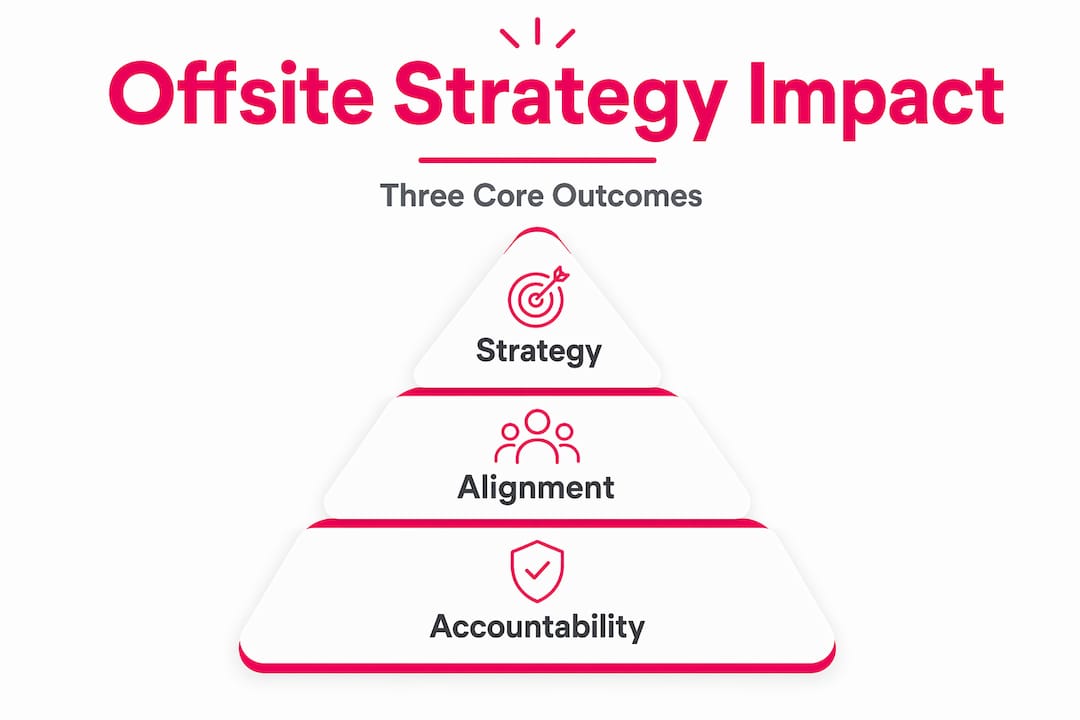
Here is the uncomfortable truth about most executive retreats. They produce alignment, not accountability. Your team agrees on priorities, nods at the whiteboard, and flies home. Six weeks later, nothing has moved.
This is what researchers call the "alignment trap." Teams share understanding but leave without ownership or accountability for outcomes. It feels productive. It rarely is.
The most common failure modes follow a predictable pattern:
- Groups that are too large. Groups larger than 8 to 10 people dilute accountability and reduce decision quality. When everyone is responsible, no one is.
- No pre-work. Executives arrive without shared context, spend the first half-day catching up, and never reach the depth needed for real decisions.
- Topic-based agendas. Covering topics feels like progress. It is not. An agenda built around topics produces discussion. An agenda built around decisions produces outcomes.
- No decision discipline. Conversations end without a named owner, a clear decision, and a measurable 90-day outcome attached to it.
- Structured dissent is absent. When the most senior voice speaks first, others conform. Without a deliberate process for surfacing disagreement, you get false consensus.
The fix for each of these is specific, not general. Pre-reads submitted 24 hours in advance correlate strongly with higher decision velocity and better outcomes. If someone has not read the pre-work, reschedule their participation. That sounds extreme. It sends an unmistakable signal about standards.
Pro Tip: Design your offsite agenda around exactly 3 to 5 decisions, not topics. Write each agenda item as a decision question: "Should we enter the Southeast Asia market in Q3?" forces a yes or no with an owner. "Southeast Asia expansion" produces a conversation.
How offsites create accountability and accelerate execution
The difference between a great offsite and a forgettable one is what happens in the 90 days after it ends.
Leadership teams with documented, named-owner commitments are 3 times more likely to execute decisions than those with only shared understanding. That is not a marginal improvement. It is the difference between strategic momentum and strategic drift.
The mechanism is straightforward. Every decision made at the offsite gets logged with three fields: the decision itself, the named owner, and the measurable outcome expected within 90 days. That log gets reviewed in weekly leadership meetings. No exceptions.

| Execution practice | Impact on decision follow-through |
|---|---|
| Named-owner decision log | 3x higher execution rate vs. shared understanding only |
| Weekly decision log review | Execution rate above 60% vs. below 40% without review |
| 90-day outcome targets | Creates urgency and measurable accountability |
| Post-offsite retrospective | Improves design and outcomes of future offsites |
Teams that review decision logs weekly maintain execution rates above 60%, compared to below 40% for teams that do not. That gap is the cost of skipping the follow-through infrastructure.
Consider the cost-benefit reality. A typical 2-day offsite for 8 executives costs $45,000 to $80,000 all in, including venue, travel, and leadership time. Spread across 3 to 5 decisions that each unlock meaningful strategic progress, the ROI is significant. The risk is not the cost. The risk is spending that budget and leaving without decisions that stick.
Framing offsites as governance interventions rather than discretionary retreats increases board and stakeholder buy-in substantially. That framing also changes how your own leadership team prepares for and shows up to the event.
Selecting the right structure, participants, and environment
The design of your offsite determines its output before anyone walks in the door.
Getting the participant list right
Keep your decision-making group to 5 to 8 active participants. This is not about excluding people. It is about preserving the accountability that makes decisions real. Observers and subject-matter experts can present context, then step out for the decision conversation.
Building the pre-session foundation
A 60-minute strategy call two weeks before the offsite aligns the team on the decisions to be made and the context required. Asynchronous context-setting, including data summaries, competitive analyses, and pre-read documents, should be distributed at least 24 hours in advance. This shifts the offsite from information-sharing to decision-making.
Pro Tip: Send a one-page decision brief for each agenda item before the offsite. It should state the decision to be made, the two or three options under consideration, and the criteria for choosing. Executives who arrive with that context make faster, better decisions.
Choosing the right environment
Location is not a luxury consideration. It is a design variable. The benefits of strategy retreats are amplified when the environment itself signals that this is different from a normal meeting. A neutral location removes office politics from the room. An inspiring setting, whether a coastal resort, a mountain property, or a culturally rich city like Florence or Phuket, lowers defensiveness and increases candor.
The agenda should balance three things:
- Decision time for the structured debates that produce named-owner commitments
- Reflection time for leaders to think without an immediate output required
- Relationship time for the informal conversations that build the trust needed for honest debate
Skipping the relationship component is a common mistake. The candor that drives good decisions depends on psychological safety. That safety is built in unstructured time, not just in facilitated sessions.
Measuring and sustaining offsite impact
A well-run offsite creates momentum. Sustaining that momentum requires a measurement system that starts before the event ends.
- Set KPIs tied directly to each decision. If you decided to restructure the go-to-market team, the KPI is not "restructuring complete." It is the revenue or efficiency outcome the restructuring was meant to produce.
- Survey executive engagement before and after the offsite. A short pre-offsite survey captures baseline confidence in the team's strategic clarity. A post-offsite survey measures whether that changed. The gap tells you whether the offsite worked.
- Review the decision log in every leadership meeting for 90 days. This is non-negotiable. The log is the accountability mechanism. If it disappears from the agenda, so does execution.
- Run a retrospective before planning the next offsite. Which decisions were executed? Which stalled? What pre-work was actually useful? The answers redesign your next offsite more effectively than any external framework.
How offsites shape strategy over time is a compounding effect. Each well-run offsite builds the team's capacity for the next one. The decisions get sharper. The pre-work gets better. The execution rate climbs.
My take on what actually separates great offsites from expensive ones
I've sat in on more executive offsites than I can count, and the pattern is consistent. The teams that walk away with real strategic traction are not the ones with the best facilitator or the most beautiful venue. They are the ones that treated the offsite as a governance event, not a team experience.
What I've learned is that the biggest obstacle is not logistics. It is the willingness of senior leaders to make explicit commitments in front of their peers. There is real vulnerability in saying, "I own this decision, and in 90 days you can hold me accountable." Most offsites are designed to avoid that moment. The best ones are designed to create it.
I've seen named-owner commitments transform teams that had been "aligned" for years without moving. The difference was not new information. It was accountability made public and specific.
The resistance I encounter most often is from leaders who worry that committing to decisions at an offsite will constrain them later. My response is always the same: if a decision is not worth committing to, it is not worth discussing. The offsite is not the place for exploring ideas. It is the place for making choices.
Treat your next offsite as a governance intervention. Prepare for it like one. Measure it like one. The long-term value is not the two days away from the office. It is the 90 days of execution that follow.
— Luca
How Tribyou helps your team get offsite strategy right
If you are ready to move from well-intentioned offsites to ones that produce real decisions, the environment you choose matters more than most leaders realize.
Tribyou curates executive offsite experiences designed specifically for leadership teams that need more than a nice venue. From tropical team retreats in Phuket to executive incentive retreats in Italy, Tribyou combines inspiring locations with the structure and support your team needs to focus on what matters. Trusted facilities, facilitation-ready spaces, and a commitment to both productivity and wellbeing mean your leadership team arrives prepared and leaves with decisions that stick. Explore what Tribyou can do for your next executive retreat and give your strategy the environment it deserves.
FAQ
Why do executive offsites drive strategy better than regular meetings?
Executive offsites remove leaders from daily operational pressure, creating the cognitive space needed for long-term decision-making. Regular meetings rarely produce the depth of debate or the named-owner accountability that offsites are designed to generate.
How many people should attend an executive offsite?
Keep active decision-makers to 5 to 8 participants. Groups larger than 8 to 10 people dilute accountability and reduce the quality of decisions made.
What is the most common reason executive offsites fail?
Most offsites fall into the alignment trap, where teams reach shared understanding but leave without named owners or measurable commitments. Without a decision log and weekly review, execution rates drop below 40%.
How do you measure the success of a strategy retreat?
Track execution of named-owner decisions against 90-day outcomes, survey leadership confidence before and after the offsite, and review the decision log in every leadership meeting for the following quarter.
How far in advance should pre-reads be sent for an executive offsite?
Pre-reads should be distributed at least 24 hours before the offsite. Pre-reads submitted on this timeline correlate strongly with higher decision velocity and better overall outcomes.