

Understanding how conference travel is organized reveals a process far more layered than booking flights and hotel rooms. Conference trips compress learning, networking, and logistics into intense, high-pressure windows. A missed flight connection doesn't just inconvenience one person. It can derail a team's entire first day of sessions, pre-scheduled meetings, and speaker commitments. Whether you're coordinating three colleagues or thirty, the planning behind a successful conference trip requires strategic thinking across timelines, budgets, roles, and contingencies.
Table of Contents
- Key Takeaways
- How conference travel is organized: the pre-planning foundation
- Booking flights, hotels, and building your itinerary
- Budgeting strategies and cost control for group travel
- Maximizing team engagement and conference ROI
- Handling last-minute challenges and disruptions
- My perspective on conference travel in 2026
- Take your conference travel further with TribYou - Your Places
- FAQ
Key Takeaways
| Point | Details |
|---|---|
| Start planning 3 to 6 months out | Early timelines unlock visa processing, early-bird rates, and better flight options. |
| Budget beyond the obvious costs | Factor in registration, incidentals, contingency funds, and team meals alongside travel and lodging. |
| Build in buffer time | Arriving a day early protects against delays and opens informal networking opportunities. |
| Contingency planning is non-negotiable | In 2026, travel disruptions affect the majority of organizations sending teams to conferences. |
| Engagement matters as much as logistics | Balance formal sessions with networking time and team wellbeing to maximize ROI. |
How conference travel is organized: the pre-planning foundation
Every effective conference trip starts well before anyone opens a booking site. The first decision is clarity of purpose. Why is your team attending? Are you there to learn from keynote sessions, close business relationships, showcase work, or recruit? Your answer shapes every subsequent decision, from who attends to how many nights you book.
Set your budget before you set anything else. The full cost of organizing conference travel includes more line items than most teams account for upfront:
- Conference registration fees (which can range from $400 to $2,500 per person for major industry events)
- Round-trip flights and airport transfers
- Hotel accommodation for each night, plus an arrival buffer day
- Per diem for meals and incidentals
- A contingency reserve of 10 to 15 percent of total spend
- Optional team events or dinners
Plan conference travel 3 to 6 months in advance to access early-bird registration discounts, secure visa approvals for international attendees, and meet abstract submission deadlines. For team submissions, panel travel grants can reach up to $4,000, which meaningfully offsets costs for research-oriented trips.
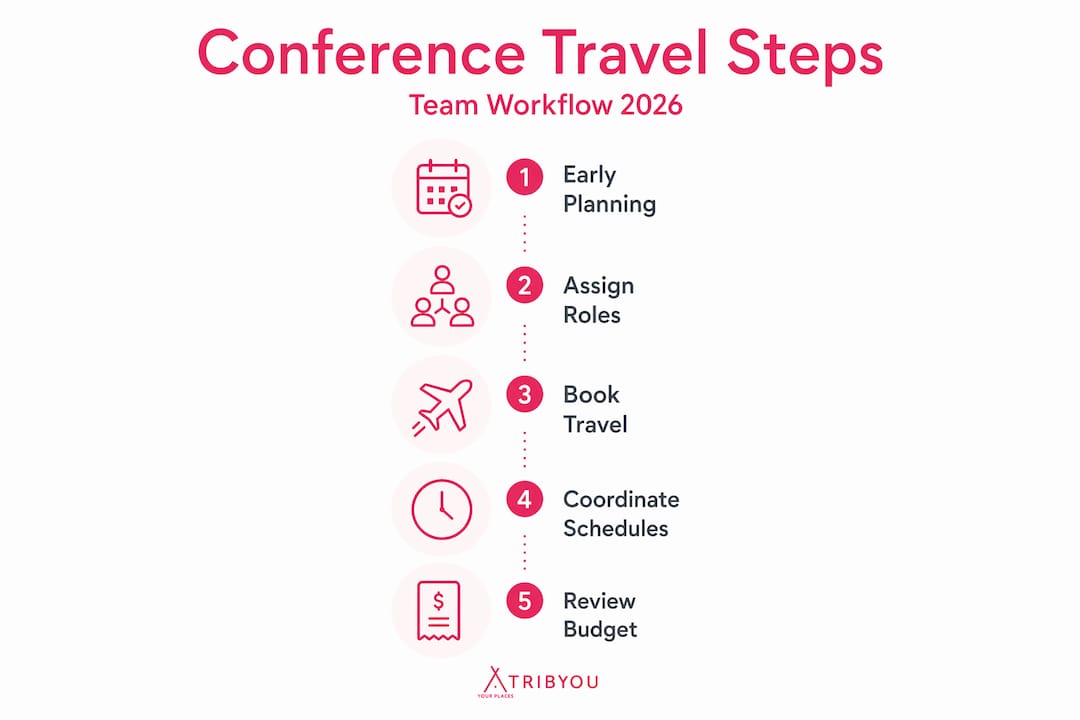
Coordinate team calendars early. Assign one person as the travel coordinator and distribute clear responsibilities: who handles registrations, who manages accommodation, who owns the group itinerary. When roles are unclear, tasks fall through the gaps.
Pro Tip: Contact the conference organizers directly and ask whether they have a dedicated group registration desk or hotel block partnerships. Many conferences have unpublished group rates that only become available when you ask.
Booking flights, hotels, and building your itinerary
Logistics management is where conference travel planning either holds together or starts to fracture. Book flights with buffer days built in. Arriving the day before the conference opens is not a luxury. It protects against delays, allows your team to check in calmly, orient themselves at the venue, and pursue pre-conference networking. That first evening is often when the most authentic conversations happen.
Here is a proven sequence for handling travel bookings:
- Confirm the conference dates and venue location before booking anything.
- Research direct flight options first. Connecting flights introduce compounding delay risk for large teams.
- Book a hotel block near the venue, ideally within walking distance. Negotiate a group rate directly with the property.
- Create a master itinerary document shared with every traveler that includes flight numbers, check-in details, session schedules, and emergency contacts.
- Designate a single communication channel (a group chat, a project tool, or an email thread) for real-time updates during travel.
- Brief your team on the venue layout, registration process, and key sessions at least one week before departure.
When selecting accommodation, proximity to the venue matters more than star rating. Long daily commutes between hotel and conference center eat into networking time and create fatigue. Hotel blocks negotiated through official channels can also unlock specialized transit and logistics support unavailable to independent travelers.
| Booking option | Best for | Key advantage |
|---|---|---|
| Conference-partnered hotel block | Teams of 4 or more | Negotiated group rate, close to venue |
| Independent hotel near venue | Small groups of 1 to 3 | Flexibility and potential savings |
| Short-term rental (apartment) | Long conferences (5+ days) | Kitchen access, more working space |
| Hotel with conference shuttle | Budget-conscious teams | Lower rate offset by free transport |

Pro Tip: When reviewing hotel rates, check whether the property offers weekly rates if your stay spans more than four nights. A weekly hotel rate structure can cut your accommodation budget significantly compared to booking nightly.
Budgeting strategies and cost control for group travel
Budgeting for conference travel requires a full-cost view, not just the visible line items. Teams that only account for flights and registration often arrive underprepared for the real spend.
Break your budget into five clear categories:
- Fixed costs: Registration fees, flights booked in advance, confirmed hotel rates
- Variable costs: Ground transportation, meals not included in registration, team dinners
- Incidentals: Printing, shipping materials, last-minute supplies at the venue
- Contingency fund: 10 to 15 percent of total budget set aside for disruptions
- Post-conference costs: Any follow-up travel, materials mailed home, or team debrief expenses
Group discounts are available more often than teams realize. Airlines offer group booking rates for ten or more travelers on the same route. Hotels respond well to direct outreach for multi-room bookings. Conference organizers frequently have unpublished group registration tiers that unlock when you contact them by phone rather than booking online.
For teams with corporate travel programs, the benefits of managed programs include consolidated expense reporting, pre-negotiated vendor rates, and duty-of-care tracking that most in-house planners cannot replicate manually. Expense tracking tools like Concur, Navan, or a shared spreadsheet reviewed weekly keep costs visible and prevent end-of-trip reconciliation surprises.
One often-overlooked cost driver is schedule inefficiency. When team members attend a conference without a structured shared agenda, they end up duplicating sessions instead of dividing them. A simple coverage map (who attends which session and reports back) stretches your investment and prevents everyone from spending three days in the same room.
Maximizing team engagement and conference ROI
Getting your team to a conference is the logistical half of the work. Getting genuine value from the trip is the strategic half. The most common mistake teams make is over-scheduling formal sessions and leaving no room for the conversations that actually move the needle.
Networking in informal settings consistently yields higher ROI than attending every panel. The breakfast queue, the hallway outside the keynote room, the organized dinner on night two: these are where relationships form and ideas take shape. Encourage your team to identify five to ten specific people they want to connect with before the conference begins, using the attendee list or the conference app.
The EDGE framework (Education, Discovery, Gathering, and Evolution) offers a useful lens. It reframes conference attendance from passive session-sitting to active value-creation. Your team should leave with new knowledge, new contacts, and a clear sense of how the experience will change their work.
Practical strategies that raise engagement and protect wellbeing:
- Block two or three unscheduled hours each day for team debriefs, spontaneous meetings, and recovery time.
- Avoid scheduling team dinners every night. One or two shared meals are motivating. Every night becomes draining.
- Encourage team members to attend different tracks and share notes, rather than clustering in the same sessions.
- Build in one team-building moment, whether it's a group walk, a local experience, or a shared meal at an authentic local restaurant. This is where corporate wellness trips and conference travel begin to overlap in meaningful ways.
Pro Tip: Before the conference, create a shared document where each team member lists two concrete goals. Review it on the final day. This simple practice transforms vague attendance into measurable outcomes.
Handling last-minute challenges and disruptions
In 2026, 65.38% of organizations reported travel disruptions affecting their conference participants, up from 41.67% the year before. That number is not an anomaly. It reflects a new baseline for conference travel logistics.
Geopolitical instability, extreme weather, and shifting health protocols have reshaped risk for business travelers. 33.07% of events were canceled or relocated due to instability in the past year. Building contingency plans into your itinerary is now standard practice, not an edge case.
Your contingency toolkit should include:
- Backup flight options identified before departure, not searched for in a panic at the gate
- A clear protocol for who communicates changes and through which channel
- Remote access options for key sessions, in case a team member cannot travel or gets stranded
- Travel insurance covering cancellation, delay, and medical emergencies
- Local contacts or professional organizers who can troubleshoot on the ground
"Professional organizers managed over 7.7 million participants in 2025, generating €17.36 billion in economic impact. Their ability to absorb complexity and keep programs on track is precisely why more corporate teams are choosing managed conference travel over self-organized trips." — IAPCO Survey, 2026
Working with professional travel coordinators or platforms that specialize in corporate group travel significantly reduces the burden of real-time problem-solving. When disruptions hit, having a single point of contact who knows your booking details, travel preferences, and team structure is worth considerably more than the coordination fee.
My perspective on conference travel in 2026
I've seen too many teams approach conference travel as a procurement task. Book the flight, confirm the hotel, share the itinerary. Done. What they miss is that the real value of a conference trip is not what happens in the session rooms. It's what happens in the margins.
In my experience, the teams that come home with real outcomes are the ones that treated the trip as a strategic investment. They defined goals before they left. They built space for informal connection. They arrived a day early and used that evening well.
The disruption data from 2026 reinforces something I've believed for a long time: self-organized conference travel is increasingly fragile. The teams that experience the smoothest trips, and the highest ROI, are the ones working with experienced organizers who understand both logistics and team experience design.
There's also a wellbeing dimension that deserves more attention. Packed schedules and red-eye flights don't produce engaged, creative professionals. They produce tired ones. When you factor recovery time and authentic local experiences into your conference travel planning, you come home with a team that felt motivated by the trip, not depleted by it.
The best conference travel I've observed blends structure with breathing room. Clear objectives, professional logistics, and space for your people to actually connect with the place and each other.
— Luca
Take your conference travel further with TribYou - Your Places
When your team needs more than a booking confirmation, TribYou - Your Places brings a different level of support to conference travel planning.
TribYou - Your Places works with businesses and teams to coordinate accommodations, experiences, and team engagement strategies around major conferences and corporate events. Whether you need a hotel block near a venue, a wellness-focused itinerary for a multi-day trip, or a curated team dinner that goes beyond the standard restaurant booking, the platform connects you with trusted local partners who make it real. Explore how managed corporate travel through TribYou - Your Places transforms the conference trip from a logistical challenge into a genuine team experience. Your next conference deserves more than a spreadsheet.
FAQ
How far in advance should conference travel be planned?
Plan conference travel 3 to 6 months ahead to cover visa applications, early-bird registration rates, and group flight bookings. Speakers and key participants should be identified even earlier, ideally 6 to 9 months in advance.
What is the best way to manage travel disruptions for conference groups?
Build contingency plans before departure: identify backup flights, confirm remote access options, and designate one team member as the disruption coordinator. In 2026, most organizations attending conferences experienced at least one travel disruption, making proactive planning non-negotiable.
How do you maximize ROI from conference travel?
Define specific goals for each team member before departure and balance formal session attendance with unstructured networking time. Informal off-session meetings consistently deliver higher value than attending every panel on the program.
What are the biggest hidden costs in conference travel planning?
Beyond registration and flights, teams underestimate ground transportation, team meals, incidentals, and last-minute changes. Budget a 10 to 15 percent contingency reserve and track all expenses in a shared tool to avoid end-of-trip surprises.
When does it make sense to use a professional travel organizer for conferences?
When your group exceeds four people, involves international travel, or requires coordinated accommodation, a professional travel organizer reduces risk and improves the team experience. The coordination fee typically pays for itself in negotiated rates and avoided disruptions.